(2020.10.31 カトリック・あい)
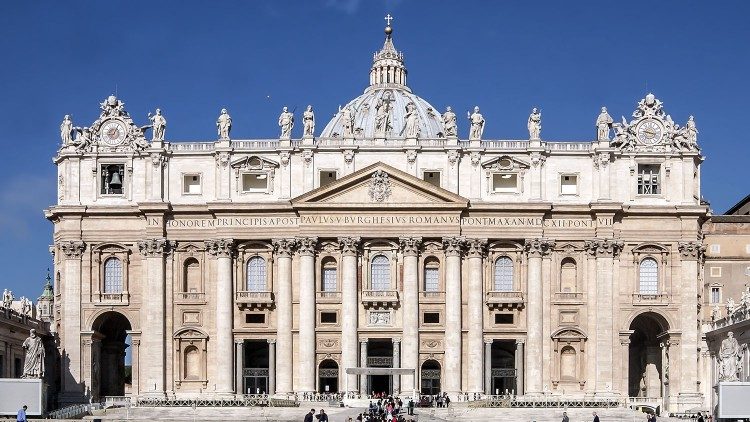
毎週水曜日に行われている教皇フランシスコの一般謁見が、9月から再開していた公開方式を11月4日から中止、再びバチカン宮殿からのビデオ中継に戻されることになった。
イタリアを含む欧州主要国では新型コロナウイルス感染が再び深刻化し、各国でいったん緩和していた規制が再び強化せざるを得ない事態となっている。バチカンの今回の判断もそれにならったもの。バチカン広報局が29日発表した声明によると、10月21日のパウロ6世ホールで行われた公開の一般謁見で参加者から一人の感染者を出したことも理由となっている。
教皇一般謁見は、新型コロナウイルス感染拡大を受けて、今年3月中旬より、教皇宮殿内からのビデオ中継の形をとってきたが、9月からは、信者が参加する公開謁見を教皇宮殿の「聖ダマソの中庭」で再開、さらに10月からは、多くが参加できるパウロ6世ホールで行われていた。
(2020.10.25 Vatican News)
教皇フランシスコは25日の正午の祈りの後、枢機卿に新たに13人を任命する、と世界の聖職者、信徒たちに向けて発表した。正式な任命式は11月28日に行われる。
13人のうち、80歳未満で今後の教皇選挙権を持つことになる枢機卿は9人、80歳以上は4人。また、13人のうち、80歳未満の9人中、2人はバチカン高官で、マルテーゼ・マリオ・グレッグ・シノドス事務局長とマルチェロ・セメラーノ列聖省長官。7人は、イタリアのアッシジの聖フランシスコ修道院のマウロ・ガンベッティ院長と、世界中で司牧に当たっている米国、イタリア、チリ、フィリピン、ルワンダの大司教4人とブルネイの使徒座代理区長で、ガンベッティ師以外の枢機卿予定者は次の通り。
なお、バチカン広報局が11月24日確認したところによると、このうち、フィリピンとブルネイの枢機卿予定者は、新型コロナウイルス感染拡大のため、任命式に欠席する、という。
(翻訳・「カトリック・あい」南條俊二)
Archbishop of Kilgali, Rwanda, Antoine Kambanda; Archbishop of Washington, United States, Wilton Gregory; Archbishop of Capiz, in the Philippines, Jose Fuerte Advincula; Archbishop of Santiago, Chile, Celestino Aós Braco; Apostolic Vicar of Brunei, Cornelius Sim; Archbishop of Siena, Italia, Augusto Paolo Lojudice.
また、80歳以上で新たな枢機卿に選ばれた4人は、 Felipe Arizmendi Esquivel, Archbishop Emeritus of San Cristóbal de Las Casas (Mexico); former Apostolic Nuncio Silvano Tomasi, former permanent observer at the United Nations in Geneva who then worked in the Dicastery for Promoting Integral Human Development; Capuchin Father Raniero Cantalamessa, preacher of the Papal Household; the pastor of the Shrine of Divine Love, Father Enrico Feroci.
(バチカン放送日本語課)
新しく枢機卿に任命される人々は次のとおり(発表順・括弧内は出身国と年齢)。
[80歳未満の有権枢機卿]
*マリオ・グレック司教、シノドス事務局・事務局長(マルタ、63) *マルチェッロ・セメラーロ司教、列聖省長官(イタリア、72) *アントワーヌ・カンバンダ大司教、ルワンダ・キガリ大司教(ルワンダ、61) *ウィルトン・グレゴリー大司教、米国・ワシントン大司教(米国、72) *ホセ・アドヴィンクラ大司教、フィリピン・カピス大司教(フィリピン、68) *セレスティーノ・アオス・ブラコ大司教、チリ・サンチアゴ大司教、カプチン・フランシスコ修道会(スペイン、75) *コルネリウス・シム司教、ブルネイおよびクアラルンプール代牧(ブルネイ、75) *アウグスト・パオロ・ロユーデチェ大司教、伊・シエナ‐コッレ・ヴァル・デルサ‐モンタルチーノ大司教(イタリア、56) *マウロ・ガンベッティ神父、コンヴェンツァル・聖フランシスコ修道会、アッシジ・聖フランシスコ修道院院長(イタリア、54)
[80歳以上の枢機卿]
*フェリペ・アリスメンディ・エスキヴェル司教、メキシコ、サンクリストバル・デ・ラス・カサス名誉司教(メキシコ、80) *シルヴァーノ・マリア・トマーシ大司教、教皇大使(イタリア、80) *ラニエーロ・カンタラメッサ神父、教皇付説教師、カプチン・フランシスコ修道会(イタリア、86) *エンリコ・フェローチ、ローマ教区サンタ・マリア・デヴィーノ・アモーレ主任司祭(イタリア、80)
The Provisional Agreement between the Holy See and the People’s Republic of China regarding the appointment of Bishops was signed in Beijing on September 22, 2018. That Agreement expires today since it went into effect one month later, with the term of two years ad experimentum.
As this date drew near, the two parties evaluated various aspects of the Agreement’s application, and through an official exchange of Note Verbali, have agreed to prolong the term for another two years, until October 22, 2022. Therefore, the renewal of the Provisional Agreement seems to be a propitious occasion to explore its objective and motivations.
The primary objective of the Provisional Agreement regarding the appointment of Bishops in China is that of sustaining and promoting the proclamation of the Gospel in that land, restoring the full and visible unity of the Church. In fact, the primary motivations that have guided the Holy See in this process, in dialogue with the Government leaders of that country, are fundamentally of an ecclesiological and pastoral nature.
The question regarding the appointment of Bishops is of vital importance for the life of the Church, both at the local as well as at the universal levels. In this regard, Vatican Council II, in the Dogmatic Constitution on the Church, stated that “Jesus Christ, the eternal Shepherd, established His holy Church, having sent forth the apostles as He Himself had been sent by the Father (see John 20:21); and He willed that their successors, namely the bishops, should be shepherds in His Church even to the consummation of the world. And in order that the episcopate itself might be one and undivided, He placed Blessed Peter over the other apostles, and instituted in him a permanent and visible source and foundation of unity of faith and communion” (Lumen Gentium, 18).
This fundamental teaching regarding the particular role of the Supreme Pontiff within the Episcopal College and in the appointment of Bishops itself, inspired the negotiations and was a point of reference in the drafting of the text of the Agreement. Thus will be ensured, little by little as things go forward, both the unity of faith and the communion among the Bishops, as well as being able to completely be at the service of the Catholic community in China. As of today, for the first time after many decades, all of the Bishops in China are in communion with the Bishop of Rome and, thanks to the implementation of the Agreement, there will be no more illegitimate ordinations.
It should, however, be noted that all the open issues or situations that are still of concern for the Church have not been treated in the Agreement, but solely the issue of episcopal appointments, which is decisive and essential to guarantee the ordinary life of the Church in China, as in all other parts of the world. His Eminence Cardinal Pietro Parolin, Vatican Secretary of State, recently spoke about “The Catholic Church in China, past and present” at a Convention held in Milan this month for the 150th anniversary of the arrival of the PIME missionaries in Henan. On that occasion, he pointed out that various misunderstandings had arisen regarding the Provisional Agreement.
Many of them originated because extraneous objectives or unrelated events regarding the life of the Catholic Church in China were attributed to the Agreement and it was even connected to political issues that have nothing to do with the actual Agreement. Recalling that the Agreement exclusively concerns the appointment of Bishops, Cardinal Parolin stated he is aware of the existence of various problems regarding the life of the Catholic Church in China, but also that it is impossible to confront all the issues together. The stipulation of the Agreement, therefore, constitutes the destination point of a long journey undertaken by the Holy See and the People’s Republic of China, but it is also and above all the point of departure for broader and more far-sighted agreements.
The Provisional Agreement, the text of which, given its experimental nature, has been consensually kept confidential, is the fruit of an open and constructive dialogue. This dialogic posture, nourished by respect and friendship, is strongly willed and promoted by the Holy Father. Pope Francis is well aware of the wounds the Church’s communion has sustained in the past, and after years of prolonged negotiations that his Predecessors had begun and carried on and indubitably in continuity with their thought, he has re-established full communion with the Chinese Bishops who were ordained without the necessary Pontifical mandate and authorized the signing of the Agreement regarding the appointment of Bishops, which had already been approved by Pope Benedict XVI in draft form.
Cardinal Parolin emphasized that the current dialogue between the Holy See and China has age-old roots and is the continuation of a journey begun a long time ago. The last Pontiffs, in fact, sought that which Pope Benedict XVI described as the overcoming of the heavy “situation of misunderstandings and incomprehension” that serves neither the “interests of…the Chinese authorities nor the Catholic Church in China”. Citing his predecessor, Pope John Paul II, he wrote in 2007: “It is no secret that the Holy See, in the name of the whole Catholic Church and, I believe, for the benefit of the whole human family, hopes for the opening of some form of dialogue with the authorities of the People’s Republic of China. Once the misunderstandings of the past have been overcome, such a dialogue would make it possible for us to work together for the good of the Chinese People and for peace in the world” (Letter of the Holy Father Pope Benedict XVI to the Bishops, priests, consecrated persons and lay faithful of the Catholic Church of the People’s Republic of China, no. 4).
Some sectors of international politics have sought to analyze the Holy See’s work primarily along geopolitical lines. Regarding the scope of the Provisional Agreement, instead, the Holy See views it as a profoundly ecclesiological issue, in conformity with two principles stated thus: “Ubi Petrus, ibi Ecclesia” (Saint Ambrose, “Where Peter is, there is the Church”) and “Ubi episcopus, ibi Ecclesia” (Saint Ignatius of Antioch, “Where the Bishop is, there is the Church”). Moreover, there also exists an awareness that the dialogue between the Holy See and the People’s Republic of China favors the search for the common good for the benefit of the entire international community.
Specifically with this intention, Archbishop Paul R. Gallagher, Secretary for Relations with States, met with Mr. Wang Yi, State Councilor and Foreign Minister of the People’s Republic of China, on February 14, 2020 in Munich in Bavaria, in the context of the 56th Munich Safety Conference, even though their first personal meeting, although not official, had taken place on the occasion of the General Assembly of the United Nations Organization in New York in 2019. It should be noted that both meetings took place in the context of multilateral diplomatic meetings in favor of global peace and security, thus seeking to pick up on even the slightest signal to foster and sustain the culture of encounter and dialogue.
As was made public by the Holy See, the two diplomats acknowledged the contact between the two parties that had developed positively over time during the meeting that took place in Germany. On that occasion, the desire to pursue the bilateral dialogue at the institutional level fostering the life of the Catholic Church and the good of the Chinese people was reiterated. In addition, the hope was expressed that increased international cooperation would promote civil co-existence and peace in the world and they exchanged considerations regarding intercultural dialogue and human rights. In particular, the importance of the Provisional Agreement regarding the appointment of Bishops, which has now been renewed, was highlighted with the hope that its fruits might grow on the basis of the experience gained over the first two years of it being in force.
Regarding the results achieved so far, on the basis of the regulatory framework established by the Agreement, two Bishops have been appointed (His Excellency Antonio Yao Shun, Diocese of Jining, Inner Mongolia Autonomous Region, and His Excellency Stefano Xu Hongwei, Diocese of Hanzhong, Shaanxi Province), while various other processes for new episcopal appointments are in the process, some at the initial stage, others in more advanced stages.
Even though, statistically speaking, these results may not seem to be that great, nevertheless they represent a good start, in the hope that other positive goals might be progressively reached. It cannot be overlooked that in recent months the entire world has been practically paralyzed by the health crisis that has influenced both life and activity in almost all sectors of both public and private life. The same reality has obviously influenced regular contact between the Holy See and the Chinese government as well as the implementation of the Provisional Agreement.
The application of the Agreement, with an effective and progressively more active participation of the Chinese Episcopate is, therefore, of great importance for the life of the Catholic Church in China and, as a consequence, for the universal Church. It is also in that context that the pastoral objective of the Holy See can be situated: to help Chinese Catholics, who have long been internally divided, to manifest signs of reconciliation, collaboration and unity for a renewed and more effective proclamation of the Gospel in China. In a Letter dated September 26, 2018, the Pope had entrusted in a particular way to the Catholic community in China – to the bishops, priests, men and women religious, and lay faithful – the commitment to live love for one another in an authentic spirit, expressing it through concrete actions so as to help overcome misunderstandings, giving witness to their own faith and genuine love. It must be acknowledged that there are still many situations causing serious suffering.
The Holy See is very much aware of them, is taking them into account and does not fail to draw them to the attention of the Chinese government so that religious freedom might be truly exercised. There is still a long and difficult road ahead.
Trusting completely in the Lord of history who unfailingly guides His Church and in the maternal intercession of the Most Holy Virgin Mary, Our Lady of Sheshan, the Holy See entrusts this delicate and important step to the gracious support and, above all, to the prayers of all Catholics, and hopes that with this contact and dialogue with the People’s Republic of China, which has matured to the point of the signing of the Provisional Agreement on the appointment of Bishops and its renewal today, that they might contribute to the resolution of the matters of common interest that are still open, in particular, those touching the life of the Catholic community in China, as well as the promotion of an international vision of peace, in a moment in which we are experiencing numerous tensions on an international level.
(This is an unofficial working translation of the Italian original.)
(2020.10.13 バチカン放送)
オーストラリア出身で2014年から2019年まで教皇庁財務事務局長官を務めたペル枢機卿(79)が、ローマに戻り、12日、バチカンに教皇フランシスコを訪問した。教皇は、ペル枢機卿と再会の挨拶を交わされ、同枢機卿のこれまでの証しに感謝を述べられた。
**********
ペル枢機卿は、メルボルン大司教時代における未成年者への性的虐待の訴えを受け、裁判のため、財務事務局長官任期中の2017年7月、教皇の許可を得てオーストラリアに帰国。2018年12月、メルボルン地裁から有罪判決を受けた。2019年8月の控訴審で、ビクトリア州最高裁は、地裁判決を支持し、枢機卿の控訴を棄却。だが、無罪を主張してきた枢機卿は、連邦最高裁判所に上告し、2020年4月、同裁判所が、「犯罪は行われなかったという理にかなった可能性があり、よって、無実の人物を罪に定める可能性がある」とし、下級審の有罪判決を破棄し、無罪とした。
最高裁判決まで、ペル枢機卿は、約400日間、禁固刑に服していた。枢機卿は釈放後、自身が常に訴え続けた無実が認められたことで、「これまで受けた不正義が正された」と語り、告発者に対する恨みはない、とも述べた。そして、長い癒しの基礎となるものは真理であり、正義の唯一の基礎も真理である、なぜなら正義とは、すべての人のための真理を意味している、と話した。
教皇フランシスコは、ペル枢機卿の無罪判決の知らせから数時間後、バチカンのサンタ・マルタ館でのミサで、「四旬節のこの日々、私たちは、イエスが迫害され、律法学者たちがイエスをいかに敵視したかを見ました。イエスは罪のない方でありながら、憎しみによって裁かれました。今日、わたしは、憎しみによる不当な判決に苦しむすべての人々のために祈りたいと思います」と、ペル枢機卿の名前に触れずに、このように説教した。
バチカン広報局は、ペル枢機卿の無罪判決を受けて声明を出し、教皇庁は常にオーストラリアの司法当局に信頼を置き、同連邦最高裁判所の、ジョージ・ペル枢機卿に対する未成年者虐待の訴えに無罪を告げ、実刑判決を破棄した、全会一致の判決を好意的に受け止めている、と述べていた。また、枢機卿は、司法府の判断に自らをゆだね、真理が明らかになることを待ちながら、一貫して無罪を訴えていた、とし、この機会に、未成年者に対するあらゆる虐待の防止と追及に取り組む教皇庁の意向を改めて強調していた。
(編集「カトリック・あい」)
(2020.9.30 Crux Senior Corespondent Elise Ann Allen)
 U.S. Secretary of State Mike Pompeo delivers his speech during the “Advancing and Defending International Religious Freedom Through Diplomacy” symposium, in Rome, Wednesday, Sept. 30, 2020. (Credit: Guglielmo Mangiapane/Pool Photo via AP.)
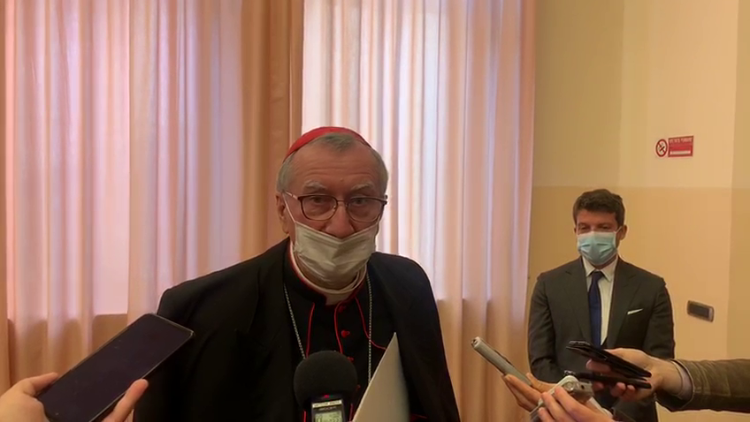
Cardinal Parolin speaking at a Symposium in Rome hosted by the U.S. Embassy to the Holy See (photo courtesy U.S. Embassy to the Holy See)
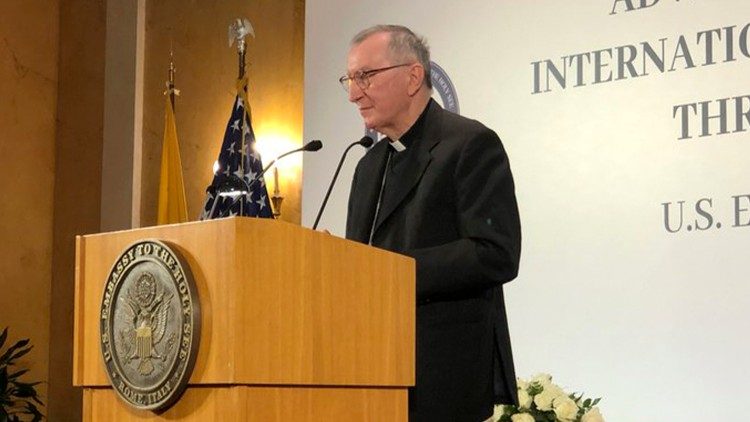 ROME –バチカンと中国の司教任命に関する暫定合意が期限を迎えた9月30日、米国の在バチカン大使館主催の「外交と信教の自由」に関するシンポジウムが開かれた。
会議には、先日、First Things誌への寄稿で「中国の人権や信教の自由を蹂躙している行為に異議を唱えないことでバチカンと教皇フランシスコが道徳的権威を失うリスクがある」と指摘した米国のマイク・ポンペオ国務長官、暫定合意更新の方針を明確にしているバチカンのピエトロ・パロリン国務長官、ポール・ギャラガー外務局長などが出席した。
*米国務長官「中国で信教の自由が危機にさらされている-バチカンは勇気ある道徳的な証しを」
ポンぺオ国務長官は講演で、教皇を含む宗教指導者たちに、信教の自由を守る「勇気ある道徳的な証し」をするよう強く求めるとともに、現在の中国について、「中国ほど、信教の自由が脅威にさらされているところはない」と非難した。
*バチカン外務局長「議論を放棄することは誰にとっても不利益」と”対話路線”強調
これに対し、ギャラガー外務局長は、中国と対決姿勢を取らないバチカンの路線を擁護し、「信教の自由を巡る議論を放棄することは、犠牲者たちにとっても、『私たちに同意しない人々』にとっても、不利益をもたらすことになるだろう」と主張。
バチカンが中国や他の誰かに目をつぶっていないことを婉曲的に表明し、「バチカンは信教の自由の侵害に、懸命に、絶えず注意を払っている・・・ 私たちは、自分たちに手にある外交ツールを使い続ける」と述べた。
また外務局長は、無差別に標的にしていると思われる「新右翼」を装った「西側諸国における巧妙な形の迫害」について懸念を表明した。
*米国務長官「ヨハネ・パウロ二世は欧州での共産主義に終焉をもたらした」
ポンペオ長官は講演の冒頭で、宗教指導者たち、とくにカトリック教会の指導者たちに、信教の自由を、中国共産党などの「専制政治体制」やISISなどの過激派集団から守る「道徳的な証し」をするように求めた。
そして、ポーランド出身の故ヨハネ・パウロ二世教皇が「専制政治に挑戦し、そうすることによって、教会が世界をより人間的な方向に動かすことができることを示した」と述べ、欧州における共産主義の終焉をもたらすのに果たした同教皇の役割を賞賛。
さらに、私たち全員が現在の時代においても、彼のように力強く振る舞う必要がある、とし、聖書でイエスが弟子たちに促されている「地球の塩であり世界の光」という言葉は、「力強い道徳的な証しをすることを意味している」と強調した。
*駐バチカン米大使「信教の自由を守るのは国家安全保障上の義務」
また、米国のカリスタ・ギングリッチ駐バチカン大使は、開会のあいさつで、「信教の自由を守ることは、国家安全保障上の義務」としたうえで、「信教の自由を守るために、今ほど重要な時期はありません」と述べ、ミャンマーのロヒンギア・イスラム教徒、ニカラグアとナイジェリアのキリスト教徒、サウジアラビアのイスラム教徒と非イスラム教徒、そして、中国におけるウイグル人イスラム教徒や他の宗教団体の人々に対してなされている宗教的迫害を挙げた。
このシンポジウムには、パネリストとして、米国のサミュエル・ブラウンバック信教の自由担当大使、ネイサン・セイルズ国務次官(民間安全保障、民主主義、人権担当)、バチカンの諸宗教間対話評議会のカレド・アカシェ・イスラム教担当らが出席した。
ポンペオ長官は、発言の中で、「人間の尊厳と宗教の自由を守ることは米国の外交政策の中心課題」とし、中国については特に、ウイグル人イスラム教徒に対する迫害、具体的には、強制収容所や女性に対する強制的な中絶と不妊手術などを挙げて非難。
*米国務長官「中国国内で全ての宗教、宗派が犠牲にー香港市民も、ウイグル人イスラム教徒も、カトリック教徒も」
「犠牲になっているのは彼らだけではない…中国共産党は国内のすべての宗教、宗派を打ちのめしている… カトリック教徒も、この抑圧の波を免れなかった」と述べ、聖堂の破壊、司祭と司教の逮捕、そして香港での民主活動家の逮捕、監禁などを具体的に上げた。
そして、このような迫害の実態に「光を当てる」には、さらに多くのことをしなければならない、とし、そうするうえで、「カトリック教会は指導的役割を果たすことができる特別の立場にある。各国政府関係者は中国との間を往来しているが、教会は別の立場にある」と指摘した。
*米国務長官「列聖20周年迎える中国の殉教者123人は信教の自由を守った勇気ある人々」
また、ポンぺオ長官は、ヨハネ・パウロ二世が中国人殉教者123人を列聖して今週で20周年を迎えることを取り上げ、「彼らは、自らの良心に従って、信仰を守る為に危険を冒す世界中の多くの勇気ある男女たちの、模範となった」と述べた。
*バチカン外務局長「信教の自由守る対話でカトリック教会は”羅針盤”に」
バチカン国務省のギャラガー外務局長は、ここ数十年で「国際の平和と安全の問題において宗教が果たす重要な役割についての認識が高まっている」と述べ、信教の自由を尊重することは、「人類の共通善」を促進するという点で「必須条件」だ、と強調した。
その一方で、バチカンは、公的および私的領域における宗教の自由を制限する、いわゆる「新右翼」」などの傾向について懸念を強めている、とした。
それは「主として西欧の国々で見られる、宗教の信じる生き方と矛盾する法律について、従来以上に一般化した傾向… 物理的な迫害の形によるものだけでなく、政治的な矯正と呼ばれるイデオロギー的傾向が従来よりも顕著になっている… それは、寛容と差別の名のもとに、自分たちの立場を受け入れない人々を非難するのを容易にしている」とし、これらの法律を発動する人々は、「自分自身、忍耐力に欠け、差別的だ」と断言した。
また外務局長は、バチカンは、信教の自由についての議論や討論において「活動的であり続ける」と述べ、カトリック教会はこの問題に関する対話において「道徳的な羅針盤」になることができる、と強調した。
*バチカン国務長官「信教の自由に関する根本的誤解を解く障害は”不寛容”」
バチカンのパロリン国務長官は、シンポジウムの閉会あいさつで、「信教の自由と良心の自由は人間性の『固有の部分』として重要であり、そこでは、人それぞれが神から『良いことをする』ように召されている」と述べた。
そして、良心に対する新たな数々の侵犯の理由の一部は-そうするのが、過酷な行為を強制しようとするテロリストの政治体制であろうと、『政治的イデオロギーでぶつかる人々を黙らせ』ようとする『政治的には正しい、不寛容な人々』であろうと-、『恐怖とイデオロギー』によって突き動かされた『信教の自由に関する根本的な誤解』がもとになっている」と指摘。
さらに、「過激な主観主義」と「誇張された個人主義」が、そうした誤解の根本原因になっている、と批判。「こうした現状、そして、異なる信条を表明する人たちの間で対話の機会が減っている中で、私たちがもっと不寛容について真剣に考えるべきだ」と語り、同意しない能力は健全な社会のしるし、と強調した。
(翻訳「カトリック・あい」南條俊二)
・・Cruxは、カトリック専門のニュース、分析、評論を網羅する米国のインターネット・メディアです。 2014年9月に米国の主要日刊紙の一つである「ボストン・グローブ」 (欧米を中心にした聖職者による幼児性的虐待事件摘発のきっかけとなった世界的なスクープで有名。映画化され、日本でも昨年、全国上映された)の報道活動の一環として創刊されました。現在は、米国に本拠を置くカトリック団体とパートナーシップを組み、多くのカトリック関係団体、機関、個人の支援を受けて、バチカンを含め,どこからも干渉を受けない、独立系カトリック・メディアとして世界的に高い評価を受けています。「カトリック・あい」は、カトリック専門の非営利メディアとして、Cruxが発信するニュース、分析、評論の日本語への翻訳、転載について了解を得て、掲載しています。
Crux is dedicated to smart, wired and independent reporting on the Vatican and worldwide Catholic Church. That kind of reporting doesn’t come cheap, and we need your support. You can help Crux by giving a small amount monthly, or with a onetime gift. Please remember, Crux is a for-profit organization, so contributions are not tax-deductible.