・「安楽死は人の命に対する犯罪」ーバチカン教理省が生命倫理に関する書簡+英語版全文

教理省書簡「サマリタヌス・ボヌス」発表(2020.9.22 バチカン放送)

 バチカン教理省が22日、生命倫理に関する書簡「Samaritanus bonus(良いサマリア人)」を発表した。

 教皇フランシスコの承認を受けて発表した書簡は、「重篤段階および終末期にある患者の治療」をテーマとし、「あらゆる形の自殺ほう助に反対」するとともに、「家族と医療従事者に対する支援」の必要を説き、「『治らない患者』は、決して、『治療できない患者』ではない… 終末期の患者にも『受け入れられ、ケアされ、愛される権利』がある」と強調している。

 書簡の目的は、福音書の「善きサマリア人」のメッセージを実践するための、具体的な指針を提供すること。「治ることが不可能、あるいはその可能性がないように思われる場合」でも、「医療・看護的、心理的、霊的な寄り添いは避けることのできない義務」と述べている。

*「治らないこと」は「治療ができないこと」と同義ではない

 そして、「回復の可能性がある限り、常に治療がある」というヨハネ・パウロ二世の言葉は、「治らないことは、治療ができないことと、同義ではない」ことを意味している、とし、「寄り添い、耳を傾け、愛されていることを感じさせながら、最後までケアし、患者と共にいることで、孤独や、苦しみや死への怖れを避けることができる」と述べ、福音とイエスの犠牲の光のもとに、苦悩や苦しみの意味を見つめようとしている。


*侵すことのできない命の価値

 さらに、「侵すことのできない命の価値は、自然倫理法の柱となる真理であり、法秩序の本質的基礎」とし、「たとえそれが要求されたとしても、人の命に対する攻撃を直接、選ぶことはできない… 堕胎、安楽死、あるいは意図的に自から命を絶つことは、人類文明を損ない… 創造主の名を深く傷つける」と強調。

*命の聖なる価値を曇らせるもの

 また書簡は、命の価値を受容する力を削ぐ、いくつかの原因を挙げている。たとえば、その一つに、ある種の精神や身体の状態がなければ「値する人生」とはいえない、という考え方がある。「同情」「憐み」の誤った解釈も、命の受容を妨げる要因である。真の憐みとは「死をもたらすこと」にあるのではなく、患者を愛情と共に受け入れ、苦しみを和らげる手段によって支えることにある。人を孤独に導く個人主義の拡大も、命の価値を受容する力を削ぐ原因だ。


*教会の教えは、「安楽死は、人の命に対する犯罪」

 教会の最終的な教えは、「安楽死は『人の命に対する犯罪』であり、どのような状況においても『本質的に悪い行為』」ということだ。安楽死に対する、あらゆる形式的あるいは即時の物理的な協力は、「人の命に対する重大な罪」であり、いかなる権威もこれを「合法的に」強要、あるいは許可することはできない。安楽死に関する法律を承認する者は、人の命に対する重大な犯罪の「加担者となる」。そして、そうした法律は良心を歪めさせることから、「人々をつまずかせる罪」を負うことになる。絶望や苦悩が、安楽死を願う個人の責任を軽くする、あるいは無いものとすることがあっても、安楽死的行為は、「認容できないものとして残る」としている。

*過剰な延命治療には反対

 書簡は、「尊厳ある死を守る」ことは、「過剰な延命治療を排除する」ことを意味する、と述べ、「避けられない間近に迫った死を前に、一時的で、苦しみを与えるだけの延命処置を断念することは、正当なこと」としている。ただし、その際、「患者に当然与えられるべき通常のケアが中断されることがあってはならない」「栄養と水分の保証は、一つの義務。緩和ケアの中に、安楽死の可能性は決して含まれてはならない」と条件を付けた。「緩和ケア」には、患者とその家族に対する精神的な支援を含めている。

*家族への政府による支援

 ケアにおいて、患者が自分を重荷に感じることなく、「家族の寄り添いと尊重に包まれていることが不可欠。この使命を果たすために、家族は、支援とふさわしい手段を必要としている」とし、各国政府に対しては「家族が持つ第一の基本的な社会的機能とそのかけがえのない役割を認識し、この分野において、家族を支えるための、必要な予算とシステムを整備することが必要」と要望している。

*胎児期と幼少期のケア

 形成異常や疾患を持つ子どもは、受胎の時から、「命を尊重する方法」をもって寄り添われるべきである。「短期間内に死が確実視される胎児の疾患」で、その病状を改善させる治療法がない場合、「いかなる方法によっても、子どもが医療支援計画から見捨てられることなく、自然の死に至るまで、見守られるようにすべき」と述べている。また、「時として強迫観念的なまでの出生前診断」について批判すると共に、「障害を拒絶する文化」が存在する、とし、「堕胎が正当な行為であることは決してない」と強調している。


*深い鎮静

 苦痛を軽減するために、医師が、患者の意識を低下させる可能性のある薬を用いることがあるが、「命の終わりを、可能な限り、安らかに迎えることができるようにする目的」での「鎮静措置の正当性」を認めている。「死が真近かにある」場合、終末段階の深い緩和的鎮静措置についても同様だが、「直接的かつ意図的に死をもたらす」ために、鎮静措置が行われることは容認できない、としている。

*植物状態

 意識がない状態にあっても、患者は「その価値を認められ、ふさわしい治療をもって看護」されねばならず、は栄養・水分補給を受ける権利がある。だが、それを続けても効果が期待できず、その処置によって過度の負担を生むなど、「処置がバランスを欠く」こともあり得る。「植物状態患者の看護で負担が長く続く場合、家族に対するふさわしい支援が必要」と述べている。


*良心的拒否

 書簡は、安楽死について、現地の教会が立場を明確にし、カトリック系の医療機関が自らの証しをすることを願っている。安楽死を認める法律は、「良心的拒否をもって、それに抗する重大かつ厳格な義務」が生じることを示している。死に直面した人々に寄り添えるように、医師や医療従事者が養成されることが重要、とし、安楽死を望む人に対する精神的支援には「回心を常に促す寄り添いが必要」だが、安楽死の措置がとられる際にその場に同席するなど「安楽死に賛成している」と解釈されるような「外面的ないかなる態度も認められない」と言明している。


    書簡「Samaritanus bonus」の公式英語版全文以下の通り

Letter “Samaritanus bonus” of the Congregation for the Doctrine of the Faith on the care of persons in the critical and terminal phases of life, 22.09.2020

Introduction

  The Good Samaritan who goes out of his way to aid an injured man (cf. Lk 10:30-37) signifies Jesus Christ who encounters man in need of salvation and cares for his wounds and suffering with “the oil of consolation and the wine of hope”.[1] He is the physician of souls and bodies, “the faithful witness” (Rev 3:14) of the divine salvific presence in the world. How to make this message concrete today? How to translate it into a readiness to accompany a suffering person in the terminal stages of life in this world, and to offer this assistance in a way that respects and promotes the intrinsic human dignity of persons who are ill, their vocation to holiness, and thus the highest worth of their existence?

The remarkable progressive development of biomedical technologies has exponentially enlarged the clinical proficiency of diagnostic medicine in patient care and treatment. The Church regards scientific research and technology with hope, seeing in them promising opportunities to serve the integral good of life and the dignity of every human being.[2] Nonetheless, advances in medical technology, though precious, cannot in themselves define the proper meaning and value of human life. In fact, every technical advance in healthcare calls for growth in moral discernment[3] to avoid an unbalanced and dehumanizing use of the technologies especially in the critical or terminal stages of human life.

Moreover, the organizational management and sophistication, as well as the complexity of contemporary healthcare delivery, can reduce to a purely technical and impersonal relationship the bond of trust between physician and patient. This danger arises particularly where governments have enacted legislation to legalize forms of assisted suicide and voluntary euthanasia among the most vulnerable of the sick and infirm. The ethical and legal boundaries that protect the self-determination of the sick person are transgressed by such legislation, and, to a worrying degree, the value of human life during times of illness, the meaning of suffering, and the significance of the interval preceding death are eclipsed. Pain and death do not constitute the ultimate measures of the human dignity that is proper to every person by the very fact that they are “human beings”.

In the face of challenges that affect the very way we think about medicine, the significance of the care of the sick, and our social responsibility toward the most vulnerable, the present letter seeks to enlighten pastors and the faithful regarding their questions and uncertainties about medical care, and their spiritual and pastoral obligations to the sick in the critical and terminal stages of life. All are called to give witness at the side of the sick person and to become a “healing community” in order to actualize concretely the desire of Jesus that, beginning with the most weak and vulnerable, all may be one flesh.[4] It is widely recognized that a moral and practical clarification regarding care of these persons is needed. In this sensitive area comprising the most delicate and decisive stages of a person’s life, a “unity of teaching and practice is certainly necessary.”[5]

Various Episcopal Conferences around the world have published pastoral letters and statements to address the challenges posed to healthcare professionals and patients especially in Catholic institutions by the legalization of assisted suicide and voluntary euthanasia in some countries. Regarding the celebration of the Sacraments for those who intend to bring an end to their own life, the provision of spiritual assistance in particular situations raises questions that today require a more clear and precise intervention on the part of the Church in order to:

‒ reaffirm the message of the Gospel and its expression in the basic doctrinal statements of the Magisterium, and thus to recall the mission of all who come into contact with the sick at critical and terminal stages (relatives or legal guardians, hospital chaplains, extraordinary ministers of the Eucharist and pastoral workers, hospital volunteers and healthcare personnel), as well as the sick themselves; and,

‒ provide precise and concrete pastoral guidelines to deal with these complex situations at the local level and to handle them in a way that fosters the patient’s personal encounter with the merciful love of God.

I. Care For One’s Neighbor

Despite our best efforts, it is hard to recognize the profound value of human life when we see it in its weakness and fragility. Far from being outside the existential horizon of the person, suffering always raises limitless questions about the meaning of life.[6] These pressing questions cannot be answered solely by human reflection, because in suffering there is concealed the immensity of a specific mystery that can only be disclosed by the Revelation of God.[7] In particular, the mission of faithful care of human life until its natural conclusion[8] is entrusted to every healthcare worker and is realized through programs of care that can restore, even in illness and suffering, a deep awareness of their existence to every patient. For this reason we begin with a careful consideration of the significance of the specific mission entrusted by God to every person, healthcare professional and pastoral worker, as well as to patients and their families.

The need for medical care is born in the vulnerability of the human condition in its finitude and limitations. Each person’s vulnerability is encoded in our nature as a unity of body and soul: we are materially and temporally finite, and yet we have a longing for the infinite and a destiny that is eternal. As creatures who are by nature finite, yet nonetheless destined for eternity, we depend on material goods and on the mutual support of other persons, and also on our original, deep connection with God. Our vulnerability forms the basis for an ethics of care, especially in the medical field, which is expressed in concern, dedication, shared participation and responsibility towards the women and men entrusted to us for material and spiritual assistance in their hour of need .

The relationship of care discloses the twofold dimension of the principle of justice to promote human life (suum cuique tribuere) and to avoid harming another (alterum non laedere). Jesus transformed this principle into the golden rule “Do unto others whatever you would have them do to you” (Mt 7:12). This rule is echoed in the maxim primum non nocere of traditional medical ethics.

Care for life is therefore the first responsibility that guides the physician in the encounter with the sick. Since its anthropological and moral horizon is broader, this responsibility exists not only when the restoration to health is a realistic outcome, but even when a cure is unlikely or impossible. Medical and nursing care necessarily attends to the body’s physiological functions, as well as to the psychological and spiritual well-being of the patient who should never be forsaken. Along with the many sciences upon which it draws, medicine also possesses the key dimension of a “therapeutic art,” entailing robust relationships with the patient, with healthcare workers, with relatives, and with members of communities to which the patient is linked. Therapeutic artclinical procedures and ongoing care are inseparably interwoven in the practice of medicine, especially at the critical and terminal stages of life.

The Good Samaritan, in fact, “not only draws nearer to the man he finds half dead; he takes responsibility for him”.[9] He invests in him, not only with the funds he has on hand but also with funds he does not have and hopes to earn in Jericho: he promises to pay any additional costs upon his return. Likewise Christ invites us to trust in his invisible grace that prompts us to the generosity of supernatural charity, as we identify with everyone who is ill: “Amen, I say to you, whatever you did for one of these least brothers of mine, you did for me” (Mt 25:40). This affirmation expresses a moral truth of universal scope: “we need then to ‘show care’ for all life and for the life of everyone”[10] and thus to reveal the original and unconditional love of God, the source of the meaning of all life.

To that end, especially in hospitals and clinics committed to Christian values, it is vital to create space for relationships built on the recognition of the fragility and vulnerability of the sick person. Weakness makes us conscious of our dependence on God and invites us to respond with the respect due to our neighbor. Every individual who cares for the sick (physician, nurse, relative, volunteer, pastor) has the moral responsibility to apprehend the fundamental and inalienable good that is the human person. They should adhere to the highest standards of self-respect and respect for others by embracing, safeguarding and promoting human life until natural death. At work here is a contemplative gaze[11] that beholds in one’s own existence and that of others a unique and unrepeatable wonder, received and welcomed as a gift. This is the gaze of the one who does not pretend to take possession of the reality of life but welcomes it as it is, with its difficulties and sufferings, and, guided by faith, finds in illness the readiness to abandon oneself to the Lord of life who is manifest therein.

To be sure, medicine must accept the limit of death as part of the human condition. The time comes when it is clear that specific medical interventions cannot alter the course of an illness that is recognized to be terminal. It is a dramatic reality, that must be communicated to the sick person both with great humanity and with openness in faith to a supernatural horizon, aware of the anguish that death involves especially in a culture that tries to conceal it. One cannot think of physical life as something to preserve at all costs –which is impossible – but as something to live in the free acceptance of the meaning of bodily existence: “only in reference to the human person in his ‘unified totality’, that is as ‘a soul which expresses itself in a body and a body informed by an immortal spirit’, can the specifically human meaning of the body be grasped”.[12]

The impossibility of a cure where death is imminent does not entail the cessation of medical and nursing activity. Responsible communication with the terminally ill person should make it clear that care will be provided until the very end: “to cure if possible, always to care”.[13] The obligation always to take care of the sick provides criteria to assess the actions to be undertaken in an “incurable” illness: the judgement that an illness is incurable cannot mean that care has come at an end. The contemplative gaze calls for a wider notion of care. The objective of assistance must take account of the integrity of the person, and thus deploy adequate measures to provide the necessary physical, psychological, social, familial and religious support to the sick. The living faith of the persons involved in care contributes to the authentic theologal life of the sick person, even if this is not immediately evident. The pastoral care of all – family, doctors, nurses, and chaplains – can help the patient to persevere in sanctifying grace and to die in charity and the Love of God. Where faith is absent in the face of the inevitability of illness, especially when chronic or degenerative, fear of suffering, death, and the discomfort they entail is the main factor driving the attempt to control and manage the moment of death, and indeed to hasten it through euthanasia or assisted suicide.

II. The Living Experience of the Suffering Christ and the Proclamation of Hope

If the figure of the Good Samaritan throws new light on the provision of healthcare, the nearness of the God made man is manifest in the living experience of Christ’s suffering, of his agony on the Cross and his Resurrection: his experience of multiple forms of pain and anguish resonates with the sick and their families during the long days of infirmity that precede the end of life.

Not only do the words of the prophet Isaiah proclaim Christ as one familiar with suffering and pain (cf. Is 53), but, as we re-read the pages about his suffering, we also recognize the experience of incredulity and scorn, abandonment, and physical pain and anguish. Christ’s experience resonates with the sick who are often seen as a burden to society; their questions are not understood; they often undergo forms of affective desertion and the loss of connection with others.

Every sick person has the need not only to be heard, but to understand that their interlocutor “knows” what it means to feel alone, neglected, and tormented by the prospect of physical pain. Added to this is the suffering caused when society equates their value as persons to their quality of life and makes them feel like a burden to others. In this situation, to turn one’s gaze to Christ is to turn to him who experienced in his flesh the pain of the lashes and nails, the derision of those who scourged him, and the abandonment and the betrayal of those closest to him.

In the face of the challenge of illness and the emotional and spiritual difficulties associated with pain, one must necessarily know how to speak a word of comfort drawn from the compassion of Jesus on the Cross. It is full of hope – a sincere hope, like Christ’s on the Cross, capable of facing the moment of trial and the challenge of death. Ave crux, spes unica, we sing in the Good Friday liturgy. In the Cross of Christ are concentrated and recapitulated all the sickness and suffering of the world: all the physical suffering, of which the Cross, that instrument of an infamous and shameful death, is the symbol; all the psychological suffering, expressed in the death of Jesus in the darkest of solitude, abandonment and betrayal; all the moral suffering, manifested in the condemnation to death of one who is innocent; all the spiritual suffering, displayed in a desolation that seems like the very silence of God.

Christ is aware of the painful shock of his Mother and his disciples who “remain” under the Cross and who, though “remaining”, appear impotent and resigned, and yet provide the affective intimacy that allows the God made man to live through hours that seem meaningless.

Then there is the Cross: an instrument of torture and execution reserved only for the lowest, that symbolically looks just like those afflictions that nail us to a bed, that portend only death, and that render meaningless time and its flow. Still, those who “remain” near the sick not only betoken but also embody affections, connections, along with a profound readiness to love. In all this, the suffering person can discern the human gaze that lends meaning to the time of illness. For, in the experience of being loved, all of life finds its justification. During his passion Christ was always sustained by his confident trust in the Father’s love, so evident in the hours of the Cross, and also in his Mother’s love. The Love of God always makes itself known in the history of men and women, thanks to the love of the one who never deserts us, who “remains,” despite everything, at our side.

At the end of life, people often harbor worries about those they leave behind: about their children, spouses, parents, and friends. This human element can never be neglected and requires a sympathetic response.

With the same concern, Christ before his death thinks of his Mother who will remain alone within a sorrow that she will have to bear from now on. In the spare account of the Gospel of John, Christ turns to his Mother to reassure her and to entrust her to the care of the beloved disciple: “Woman, behold your son” (cf. Jn 19: 26-27). The end of life is a time of relationships, a time when loneliness and abandonment must be defeated (cf. Mt 27:46 and Mk 15:34) in the confident offering of one’s life to God (cf. Lk 23:46).

In this perspective, to gaze at the crucifix is to behold a choral scene, where Christ is at the center because he recapitulates in his own flesh and truly transfigures the darkest hours of the human experience, those in which he silently faces the possibility of despair. The light of faith enables us to discern the trinitarian presence in the brief, supple description provided by the Gospels, because Christ trusts in the Father thanks to the Holy Spirit who sustains his Mother and his disciples. In this way “they remain” and in their “remaining” at the foot of the Cross, they participate, with their human dedication to the Suffering One, in the mystery of Redemption.

In this manner, although marked by a painful passing, death can become the occasion of a greater hope that, thanks to faith, makes us participants in the redeeming work of Christ. Pain is existentially bearable only where there is hope. The hope that Christ communicates to the sick and the suffering is that of his presence, of his true nearness. Hope is not only the expectation of a greater good, but is a gaze on the present full of significance. In the Christian faith, the event of the Resurrection not only reveals eternal life, but it makes manifest that in history the last word never belongs to death, pain, betrayal, and suffering. Christ rises in history, and in the mystery of the Resurrection the abiding love of the Father is confirmed.

To contemplate the living experience of Christ’s suffering is to proclaim to men and women of today a hope that imparts meaning to the time of sickness and death. From this hope springs the love that overcomes the temptation to despair.

While essential and invaluable, palliative care in itself is not enough unless there is someone who “remains” at the bedside of the sick to bear witness to their unique and unrepeatable value. For the believer, to look upon the Crucified means to trust in the compassionate love of God. In a time when autonomy and individualism are acclaimed, it must be remembered that, while it is true that everyone lives their own suffering, their own pain and their own death, these experiences always transpire in the presence of others and under their gaze. Nearby the Cross there are also the functionaries of the Roman state, there are the curious, there are the distracted, there are the indifferent and the resentful: they are at the Cross, but they do not “remain” with the Crucified.

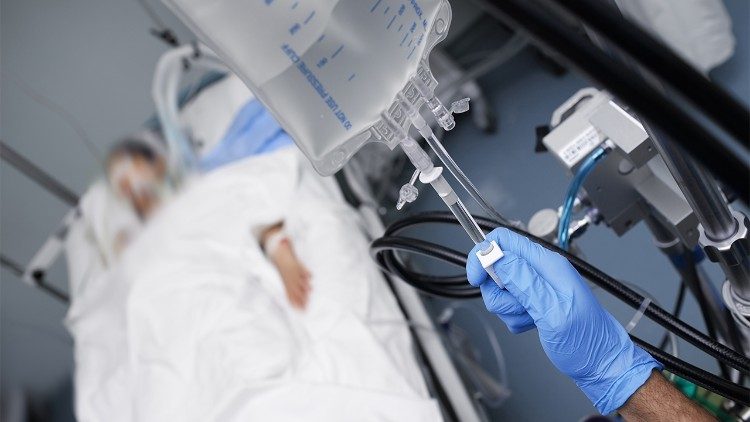
In intensive care units or centers for chronic illness care, one can be present merely as a functionary, or as someone who “remains” with the sick.

The experience of the Cross enables us to be present to the suffering person as a genuine interlocutor with whom to speak a word or express a thought, or entrust the anguish and fear one feels. To those who care for the sick, the scene of the Cross provides a way of understanding that even when it seems that there is nothing more to do there remains much to do, because “remaining” by the side of the sick is a sign of love and of the hope that it contains. The proclamation of life after death is not an illusion nor merely a consolation, but a certainty lodged at the center of love that death cannot devour.

III. The Samaritan’s “heart that sees”: human life is a sacred and inviolable gift

Whatever their physical or psychological condition, human persons always retain their original dignity as created in the image of God. They can live and grow in the divine splendor because they are called to exist in “the image and glory of God” (1 Cor11:7; 2 Cor 3:18). Their dignity lies in this vocation. God became man to save us, and he promises us salvation and calls us to communion with Him: here lies the ultimate foundation of human dignity.[14]

It is proper for the Church to accompany with mercy the weakest in their journey of suffering, to preserve them the theologal life, and to guide them to salvation.[15] The Church of the Good Samaritan[16] regards “the service to the sick as an integral part of its mission”.[17] When understood in the perspective of communion and solidarity among human persons, the Church’s salvific mediation helps to surmount reductionist and individualistic tendencies.[18]

“A heart that sees” is central to the program of the Good Samaritan. He “teaches that it is necessary to convert the gaze of the heart, because many times the beholder does not see. Why? Because compassion is lacking […] Without compassion, people who look do not get involved with what they observe, and they keep going; instead people who have a compassionate heart are touched and engaged, they stop and show care”.[19] This heart sees where love is needed and acts accordingly.[20]These eyes identify in weakness God’s call to appreciate that human life is the primary common good of society.[21]

Human life is a highest good, and society is called to acknowledge this. Life is a sacred and inviolable gift[22] and every human person, created by God, has a transcendent vocation to a unique relationship with the One who gives life. “The invisible God out of the abundance of his love”[23] offers to each and every human person a plan of salvation that allows the affirmation that: “Life is always a good. This is an instinctive perception and a fact of experience, and man is called to grasp the profound reason why this is so”.[24] For this reason, the Church is always happy to collaborate with all people of good will, with believers of other confessions or religions as well as non-believers, who respect the dignity of human life, even in the last stages of suffering and death, and reject any action contrary to human life.[25] God the Creator offers life and its dignity to man as a precious gift to safeguard and nurture, and ultimately to be accountable to Him.

The Church affirms that the positive meaning of human life is something already knowable by right reason, and in the light of faith is confirmed and understood in its inalienable dignity.[26] This criterion is neither subjective nor arbitrary but is founded on a natural inviolable dignity. Life is the first good because it is the basis for the enjoyment of every other good including the transcendent vocation to share the trinitarian love of the living God to which every human being is called:[27] “The special love of the Creator for each human being ‘confers upon him or her an infinite dignity’.[28]

The uninfringeable value of life is a fundamental principle of the natural moral law and an essential foundation of the legal order. Just as we cannot make another person our slave, even if they ask to be, so we cannot directly choose to take the life of another, even if they request it. Therefore, to end the life of a sick person who requests euthanasia is by no means to acknowledge and respect their autonomy, but on the contrary to disavow the value of both their freedom, now under the sway of suffering and illness, andof their life by excluding any further possibility of human relationship, of sensing the meaning of their existence, or of growth in the theologal life. Moreover, it is to take the place of God in deciding the moment of death. For this reason, “abortion, euthanasia and wilful self-destruction (…) poison human society, but they do more harm to those who practice them than those who suffer from the injury. Moreover, they are a supreme dishonor to the Creator”.[29]

IV. The Cultural Obstacles that Obscure the Sacred Value of Every Human Life

Among the obstacles that diminish our sense of the profound intrinsic value of every human life, the first lies in the notion of “dignified death” as measured by the standard of the “quality of life,” which a utilitarian anthropological perspective sees in terms “primarily related to economic means, to ‘well-being,’ to the beauty and enjoyment of physical life, forgetting the other, more profound, interpersonal, spiritual and religious dimensions of existence”.[30] In this perspective, life is viewed as worthwhile only if it has, in the judgment of the individual or of third parties, an acceptable degree of quality as measured by the possession or lack of particular psychological or physical functions, or sometimes simply by the presence of psychological discomfort. According to this view, a life whose quality seems poor does not deserve to continue. Human life is thus no longer recognized as a value in itself.

A second obstacle that obscures our recognition of the sacredness of human life is a false understanding of “compassion”[31]. In the face of seemingly “unbearable” suffering, the termination of a patient’s life is justified in the name of “compassion”. This so-called “compassionate” euthanasia holds that it is better to die than to suffer, and that it would be compassionate to help a patient to die by means of euthanasia or assisted suicide. In reality, human compassion consists not in causing death, but in embracing the sick, in supporting them in their difficulties, in offering them affection, attention, and the means to alleviate the suffering.

A third factor that hinders the recognition of the value of one’s own life and the lives of others is a growing individualism within interpersonal relationships, where the other is viewed as a limitation or a threat to one’s freedom. At the root of this attitude is “a neo-pelagianism in which the individual, radically autonomous, presumes to save himself, without recognizing that, at the deepest level of being, he depends on God and others […]. On the other hand, a certain neo-gnosticism, puts forward a model of salvation that is merely interior, closed off in its own subjectivism”,[32] that wishes to free the person from the limitations of the body, especially when it is fragile and ill.

Individualism, in particular, is at the root of what is regarded as the most hidden malady of our time: solitude or privacy.[33] It is thematized in some regulatory contexts even as a “right to solitude”, beginning with the autonomy of the person and the “principle of permission-consent” which can, in certain conditions of discomfort or sickness, be extended to the choice of whether or not to continue living. This “right” underlies euthanasia and assisted suicide. The basic idea is that those who find themselves in a state of dependence and unable to realize a perfect autonomy and reciprocity, come to be cared for as a favor to them. The concept of the good is thus reduced to a social accord: each one receives the treatment and assistance that autonomy or social and economic utility make possible or expedient. As a result, interpersonal relationships are impoverished, becoming fragile in the absence of supernatural charity, and of that human solidarity and social support necessary to face the most difficult moments and decisions of life.

This way of thinking about human relationships and the significance of the good cannot but undermine the very meaning of life, facilitating its manipulation, even through laws that legalize euthanistic practices, resulting in the death of the sick. Such actions deform relationships and induce a grave insensibility toward the care of the sick person. In such circumstances, baseless moral dilemmas arise regarding what are in reality simply mandatory elements of basic care, such as feeding and hydration of terminally ill persons who are not conscious.

In this connection, Pope Francis has spoken of a “throw-away culture”[34] where the victims are the weakest human beings, who are likely to be “discarded” when the system aims for efficiency at all costs. This cultural phenomenon, which is deeply contrary to solidarity, John Paul II described as a “culture of death” that gives rise to real “structures of sin”[35] that can lead to the performance of actions wrong in themselves for the sole purpose of “feeling better” in carrying them out. A confusion between good and evil materializes in an area where every personal life should instead be understood to possess a unique and unrepeatable value with a promise of and openness to the transcendent. In this culture of waste and death, euthanasia and assisted suicide emerge as erroneous solutions to the challenge of the care of terminal patients.

V. The Teaching of the Magisterium

1.     The prohibition of euthanasia and assisted suicide

With her mission to transmit to the faithful the grace of the Redeemer and the holy law of God already discernible in the precepts of the natural moral law, the Church is obliged to intervene in order to exclude once again all ambiguity in the teaching of the Magisterium concerning euthanasia and assisted suicide, even where these practices have been legalized.

In particular, the dissemination of medical end-of-life protocols such as the Do Not Resuscitate Order or the Physician Orders for Life Sustaining Treatment – with all of their variations depending on national laws and contexts – were initially thought of as instruments to avoid aggressive medical treatment in the terminal phases of life. Today these protocols cause serious problems regarding the duty to protect the life of patients in the most critical stages of sickness.

On the one hand, medical staff feel increasingly bound by the self-determination expressed in patient declarations that deprive physicians of their freedom and duty to safeguard life even where they could do so. On the other hand, in some healthcare settings, concerns have recently arisen about the widely reported abuse of such protocols viewed in a euthanistic perspective with the result that neither patients nor families are consulted in final decisions about care. This happens above all in the countries where, with the legalization of euthanasia, wide margins of ambiguity are left open in end-of-life law regarding the meaning of obligations to provide care.

For these reasons, the Church is convinced of the necessity to reaffirm as definitive teaching that euthanasia is a crime against human life because, in this act, one chooses directly to cause the death of another innocent human being. The correct definition of euthanasia depends, not on a consideration of the goods or values at stake, but on the moral object properly specified by the choice of “an action or an omission which of itself or by intention causes death, in order that all pain may in this way be eliminated”.[36]

“Euthanasia’s terms of reference, therefore, are to be found in the intention of the will and in the methods used”.[37] The moral evaluation of euthanasia, and its consequences does not depend on a balance of principles that the situation and the pain of the patient could, according to some, justify the termination of the sick person. Values of life, autonomy, and decision-making ability are not on the same level as the quality of life as such.

Euthanasia, therefore, is an intrinsically evil act, in every situation or circumstance. In the past the Church has already affirmed in a definitive way “that euthanasia is a grave violation of the Law of God, since it is the deliberate and morally unacceptable killing of a human person. This doctrine is based upon the natural law and upon the written Word of God, is transmitted by the Church’s Tradition and taught by the ordinary and universal Magisterium. Depending on the circumstances, this practice involves the malice proper to suicide or murder”.[38]

  Any formal or immediate material cooperation in such an act is a grave sin against human life: “No authority can legitimately recommend or permit such an action. For it is a question of the violation of the divine law, an offense against the dignity of the human person, a crime against life, and an attack on humanity”.[39] Therefore, euthanasia is an act of homicide that no end can justify and that does not tolerate any form of complicity or active or passive collaboration. Those who approve laws of euthanasia and assisted suicide, therefore, become accomplices of a grave sin that others will execute. They are also guilty of scandal because by such laws they contribute to the distortion of conscience, even among the faithful.[40]

Each life has the same value and dignity for everyone: the respect of the life of another is the same as the respect owed to one’s own life. One who choses with full liberty to take one’s own life breaks one’s relationship with God and with others, and renounces oneself as a moral subject. Assisted suicide aggravates the gravity of this act because it implicates another in one’s own despair. Another person is led to turn his will from the mystery of God in the theological virtue of hope and thus to repudiate the authentic value of life and to break the covenant that establishes the human family. Assisting in a suicide is an unjustified collaboration in an unlawful act that contradicts the theologal relationship with God and the moral relationship that unites us with others who share the gift of life and the meaning of existence.

When a request for euthanasia rises from anguish and despair,[41] “although in these cases the guilt of the individual may be reduced, or completely absent, nevertheless the error of judgment into which the conscience falls, perhaps in good faith, does not change the nature of this act of killing, which will always be in itself something to be rejected”.[42] The same applies to assisted suicide. Such actions are never a real service to the patient, but a help to die.

Euthanasia and assisted suicide are always the wrong choice: “the medical personnel and the other health care workers – faithful to the task ‘always to be at the service of life and to assist it up until the very end’ – cannot give themselves to any euthanistic practice, neither at the request of the interested party, and much less that of the family. In fact, since there is no right to dispose of one’s life arbitrarily, no health care worker can be compelled to execute a non-existent right”.[43]

This is why euthanasia and assisted suicide are a defeat for those who theorize about them, who decide upon them, or who practice them.[44]

For this reason, it is gravely unjust to enact laws that legalize euthanasia or justify and support suicide, invoking the false right to choose a death improperly characterized as respectable only because it is chosen.[45] Such laws strike at the foundation of the legal order: the right to life sustains all other rights, including the exercise of freedom. The existence of such laws deeply wound human relations and justice, and threaten the mutual trust among human beings. The legitimation of assisted suicide and euthanasia is a sign of the degradation of legal systems. Pope Francis recalls that “the current socio-cultural context is gradually eroding the awareness of what makes human life precious.

In fact, it is increasingly valued on the basis of its efficiency and utility, to the point of considering as ‘discarded lives’ or ‘unworthy lives’ those who do not meet this criterion. In this situation of the loss of authentic values, the mandatory obligations of solidarity and of human and Christian fraternity also fail. In reality, a society deserves the status of ‘civil’ if it develops antibodies against the culture of waste; if it recognizes the intangible value of human life; if solidarity is factually practiced and safeguarded as a foundation for living together”.[46] In some countries of the world, tens of thousands of people have already died by euthanasia, and many of them because they displayed psychological suffering or depression. Physicians themselves report that abuses frequently occur when the lives of persons who would never have desired euthanasia are terminated. The request for death is in many cases itself a symptom of disease, aggravated by isolation and discomfort. The Church discerns in these difficulties an occasion for a spiritual purification that allows hope to become truly theological when it is focused on God and only on God.

Rather than indulging in a spurious condescension, the Christian must offer to the sick the help they need to shake off their despair. The commandment “do not kill” (Ex 20:13; Dt 5:17) is in fact a yes to life which God guarantees, and it “becomes a call to attentive love which protects and promotes the life of one’s neighbor”.[47] The Christian therefore knows that earthly life is not the supreme value. Ultimate happiness is in heaven. Thus the Christian will not expect physical life to continue when death is evidently near. The Christian must help the dying to break free from despair and to place their hope in God.

From a clinical perspective, the factors that largely determine requests for euthanasia and assisted suicide are unmanaged pain, and the loss of human and theological hope, provoked by the often inadequate psychological and spiritual human assistance provided by those who care for the sick.[48]

Experience confirms that “the pleas of gravely ill people who sometimes ask for death are not to be understood as implying a true desire for euthanasia; in fact, it is almost always a case of an anguished plea for help and love. What a sick person needs, besides medical care, is love, the human and supernatural warmth with which sick persons can and ought to be surrounded by all those close to him or her, parents and children, doctors and nurses”.[49] A sick person, surrounded by a loving human and Christian presence, can overcome all forms of depression and need not succumb to the anguish of loneliness and abandonment to suffering and death.

One experiences pain not just as a biological fact to be managed in order to make it bearable, but as the mystery of human vulnerability in the face of the end of physical life—a difficult event to endure, given that the unity of the body and the soul is essential to the human person.

Therefore, the “end of life”, inevitably presaged by pain and suffering, can be faced with dignity only by the re-signification of the event of death itself—by opening it to the horizon of eternal life and affirming the transcendent destiny of each person. In fact, “suffering is something which is still wider than sickness, more complex, and at the same time still more deeply rooted in humanity itself”.[50] With the help of grace this suffering can, like the suffering of Christ on the Cross, be animated from within with divine charity.

Those who assist persons with chronic illnesses or in the terminal stages of life must be able to “know how to stay”, to keep vigil, with those who suffer the anguish of death, “to console” them, to be with them in their loneliness, to be an abiding withthat can instil hope.[51] By means of the faith and charity expressed in the intimacy of the soul, the caregiver can experience the pain of another, can be open to a personal relationship with the weak that expands the horizons of life beyond death, and thus can become a presence full of hope.

“Weep with those who weep” (Rm 12:15): for blessed is the one whose compassion includes shedding tears with others (cf. Mt 5:4). Love is made possible and suffering given meaning in relationships where persons share in solidarity the human condition and the journey to God, and are joined in a covenant[52] that enables them to glimpse the light beyond death. Medical care occurs within the therapeutic covenant between the physician and the patient who are united in the recognition of the transcendent value of life and the mystical meaning of suffering. In the light of this covenant, good medical care can be valued, while the utilitarian and individualistic vision that prevails today can be dispelled.

2.     The moral obligation to exclude aggressive medical treatment

The Magisterium of the Church recalls that, when one approaches the end of earthly existence, the dignity of the human person entails the right to die with the greatest possible serenity and with one’s proper human and Christian dignity intact.[53]To precipitate death or delay it through “aggressive medical treatments” deprives death of its due dignity.[54] Medicine today can artificially delay death, often without real benefit to the patient. When death is imminent, and without interruption of the normal care the patient requires in such cases, it is lawful according to science and conscience to renounce treatments that provide only a precarious or painful extension of life.[55]

It is not lawful to suspend treatments that are required to maintain essential physiological functions, as long as the body can benefit from them (such as hydration, nutrition, thermoregulation, proportionate respiratory support, and the other types of assistance needed to maintain bodily homeostasis and manage systemic and organic pain). The suspension of futile treatments must not involve the withdrawal of therapeutic care. This clarification is now indispensable in light of the numerous court cases in recent years that have led to the withdrawal of care from – and to the early death of–critically but not terminally ill patients, for whom it was decided to suspend life-sustaining care which would not improve the quality of life.

In the specific case of aggressive medical treatment, it should be repeated that the renunciation of extraordinary and/or disproportionate means “is not the equivalent of suicide or euthanasia; it rather expresses acceptance of the human condition in the face of death”[56] or a deliberate decision to waive disproportionate medical treatments which have little hope of positive results. The renunciation of treatments that would only provide a precarious and painful prolongation of life can also mean respect for the will of the dying person as expressed in advanced directives for treatment, excluding however every act of a euthanistic or suicidal nature.[57]

The principle of proportionality refers to the overall well-being of the sick person. To choose among values (for example, life versus quality of life) involves an erroneous moral judgment when it excludes from consideration the safeguarding of personal integrity, the good life, and the true moral object of the act undertaken.[58] Every medical action must always have as its object—intended by the moral agent—the promotion of life and never the pursuit of death.[59] The physician is never a mere executor of the will of patients or their legal representatives, but retains the right and obligation to withdraw at will from any course of action contrary to the moral good discerned by conscience.[60]

3.     Basic Care: the requirement of nutrition and hydration

A fundamental and inescapable principle of the assistance of the critically or terminally ill person is the continuity of care for the essential physiological functions. In particular, required basic care for each person includes the administration of the nourishment and fluids needed to maintain bodily homeostasis, insofar as and until this demonstrably attains the purpose of providing hydration and nutrition for the patient.[61]

When the provision of nutrition and hydration no longer benefits the patient, because the patient’s organism either cannot absorb them or cannot metabolize them, their administration should be suspended. In this way, one does not unlawfully hasten death through the deprivation of the hydration and nutrition vital for bodily function, but nonetheless respects the natural course of the critical or terminal illness. The withdrawal of this sustenance is an unjust action that can cause great suffering to the one who has to endure it. Nutrition and hydration do not constitute medical therapy in a proper sense, which is intended to counteract the pathology that afflicts the patient. They are instead forms of obligatory care of the patient, representing both a primary clinical and an unavoidable human response to the sick person. Obligatory nutrition and hydration can at times be administered artificially,[62] provided that it does not cause harm or intolerable suffering to the patient.[63]

4.     Palliative care

  Continuity of care is part of the enduring responsibility to appreciate the needs of the sick person: care needs, pain relief, and affective and spiritual needs. As demonstrated by vast clinical experience, palliative medicine constitutes a precious and crucial instrument in the care of patients during the most painful, agonizing, chronic and terminal stages of illness. Palliative care is an authentic expression of the human and Christian activity of providing care, the tangible symbol of the compassionate “remaining” at the side of the suffering person. Its goal is “to alleviate suffering in the final stages of illness and at the same time to ensure the patient appropriate human accompaniment”[64] improving quality of life and overall well-being as much as possible and in a dignified manner.

Experience teaches us that the employment of palliative care reduces considerably the number of persons who request euthanasia. To this end, a resolute commitment is desirable to extend palliative treatments to those who need them, within the limits of what is fiscally possible, and to assist them in the terminal stages of life, but as an integrated approach to the care of existing chronic or degenerative pathologies involving a complex prognosis that is unfavorable and painful for the patient and family.[65]

Palliative care should include spiritual assistance for patients and their families. Such assistance inspires faith and hope in God in the terminally ill as well as their families whom it helps to accept the death of their loved one. It is an essential contribution that is offered by pastoral workers and the whole Christian community. According to the model of the Good Samaritan, acceptance overcomes denial, and hope prevails over anguish,[66] particularly when, as the end draws near, suffering is protracted by a worsening pathology.

In this phase, the identification of an effective pain relief therapy allows the patient to face the sickness and death without the fear of undergoing intolerable pain. Such care must be accompanied by a fraternal support to reduce the loneliness that patients feel when they are insufficiently supported or understood in their difficulties.

Palliative care cannot provide a fundamental answer to suffering or eradicate it from people’s lives.[67] To claim otherwise is to generate a false hope, and cause even greater despair in the midst of suffering. Medical science can understand physical pain better and can deploy the best technical resources to treat it. But terminal illness causes a profound suffering in the sick person, who seeks a level of care beyond the purely technical. Spe salvi facti sumus: in hopetheological hope, directed toward God, we have been saved, says Saint Paul (Rm 8:24).

“The wine of hope” is the specific contribution of the Christian faith in the care of the sick and refers to the way in which God overcomes evil in the world. In times of suffering, the human person should be able to experience a solidarity and a love that takes on the suffering, offering a sense of life that extends beyond death. All of this has a great social importance: “A society unable to accept the suffering of its members and incapable of helping to share their suffering, and to bear it inwardly through ‘com-passion’ is a cruel and inhuman society”.[68]

It should be recognized, however, that the definition of palliative care has in recent years taken on a sometimes equivocal connotation. In some countries, national laws regulating palliative care (Palliative Care Act) as well as the laws on the “end of life” (End-of-Life Law) provide, along with palliative treatments, something called Medical Assistance to the Dying (MAiD) that can include the possibility of requesting euthanasia and assisted suicide. Such legal provisions are a cause of grave cultural confusion: by including under palliative care the provision of integrated medical assistance for a voluntary death, they imply that it would be morally lawful to request euthanasia or assisted suicide.

In addition, palliative interventions to reduce the suffering of gravely or terminally ill patients in these regulatory contexts can involve the administration of medications that intend to hasten death, as well as the suspension or interruption of hydration and nutrition even when death is not imminent. In fact, such practices are equivalent to a direct action or omission to bring about death and are therefore unlawful. The growing diffusion of such legislation and of scientific guidelines of national and international professional societies, constitutes a socially irresponsible threat to many people, including a growing number of vulnerable persons who needed only to be better cared for and comforted but are instead being led to choose euthanasia and suicide.

5.     The role of the family and hospice

The role of the family is central to the care of the terminally ill patient.[69] In the family a person can count on strong relationships, valued in themselves apart from their helpfulness or the joy they bring. It is essential that the sick under care do not feel themselves to be a burden, but can sense the intimacy and support of their loved ones. The family needs help and adequate resources to fulfil this mission. Recognizing the family’s primary, fundamental and irreplaceable social function, governments should undertake to provide the necessary resources and structures to support it. In addition, Christian-inspired health care facilities should not neglect but instead integrate the family’s human and spiritual accompaniment in a unified program of care for the sick person.

Next to the family, hospice centers which welcome the terminally sick and ensure their care until the last moment of life provide an important and valuable service. After all, “the Christian response to the mystery of death and suffering is to provide not an explanation but a Presence”[70] that shoulders the pain, accompanies it, and opens it to a trusting hope. These centers are an example of genuine humanity in society, sanctuaries where suffering is full of meaning. For this reason, they must be staffed by qualified personnel, possess the proper resources, and always be open to families.

“In this regard, I think about how well hospice does for palliative care, where terminally ill people are accompanied with qualified medical, psychological and spiritual support, so that they can live with dignity, comforted by the closeness of loved ones, in the final phase of their earthly life. I hope that these centers continue to be places where the ‘therapy of dignity’ is practiced with commitment, thus nurturing love and respect for life.”[71] In these settings, as well as in Catholic facilities, healthcare workers and pastoral staff, in addition to being clinically competent, should also be practicing an authentic theologal life of faith and hope that is directed towards God, for this constitutes the highest form of the humanization of dying.[72]

6.     Accompaniment and care in prenatal and pediatric medicine

Regarding the care of neo-natal infants and children suffering from terminal chronic-degenerative diseases, or are in the terminal stages of life itself, it is necessary to reaffirm what follows, aware of the need for first-rate programs that ensure the well-being of the children and their families.

Beginning at conception, children suffering from malformation or other pathologies are little patients whom medicine today can always assist and accompany in a manner respectful of life. Their life is sacred, unique, unrepeatable, and inviolable, exactly like that of every adult person.

Children suffering from so-called pre-natal pathologies “incompatible with life” – that will surely end in death within a short period of time – and in the absence of fetal or neo-natal therapies capable of improving their health, should not be left without assistance, but must be accompanied like any other patient until they reach natural death. Prenatal comfort carefavors a path of integrated assistance involving the support of medical staff and pastoral care workers alongside the constant presence of the family. The child is a special patient and requires the care of a professional with expert medical knowledge and affective skills. The empathetic accompaniment of a child, who is among the most frail, in the terminal stages of life, aims to give life to the years of a child and not years to the child’s life.

  Prenatal Hospice Centers, in particular, provide an essential support to families who welcome the birth of a child in a fragile condition. In these centers, competent medical assistance, spiritual accompaniment, and the support of other families, who have undergone the same experience of pain and loss, constitute an essential resource. It is the pastoral duty of the Christian-inspired healthcare workers to make efforts to expand the accessibility of these centers throughout the world.

These forms of assistance are particularly necessary for those children who, given the current state of scientific knowledge, are destined to die soon after birth or within a short period of time. Providing care for these children helps the parents to handle their grief and to regard this experience not just as a loss, but as a moment in the journey of love which they have travelled together with their child.

Unfortunately the dominant culture today does not encourage this approach. The sometimes obsessive recourse to prenatal diagnosis, along with the emergence of a culture unfriendly to disability, often prompts the choice of abortion, going so far as to portray it as a kind of “prevention.” Abortion consists in the deliberate killing of an innocent human life and as such it is never lawful. The use of prenatal diagnosis for selective purposes is contrary to the dignity of the person and gravely unlawful because it expresses a eugenic mentality. In other cases, after birth, the same culture encourages the suspension or non-initiation of care for the child as soon as it is born because a disability is present or may develop in the future. This utilitarian approach—inhumane and gravely immoral—cannot be countenanced.

The fundamental principle of pediatric care is that children in the final stages of life have the right to the respect and care due to persons. To be avoided are both aggressive medical treatment and unreasonable tenacity, as well as intentional hastening of their death. From a Christian perspective, the pastoral care of a terminally ill child demands participation in the divine life in Baptism and in Confirmation.

It may happen that pharmacological or other therapies, designed to combat the pathology from which a child suffers, are suspended during the terminal stage of an incurable disease. The attending physician may determine that the child’s deteriorated clinical condition renders these therapies either futile or extreme, and possibly the cause of added suffering. Nonetheless, in such situations the integral care of the child, in its various physiological, psychological, affective, and spiritual dimensions, must never cease.

Care means more than therapy and healing. When a therapy is suspended because it no longer benefits an incurable patient, treatments that support the essential physiological functions of the child must continue insofar as the organism can benefit from them (hydration, nutrition, thermoregulation, proportionate respiratory support, and other types of assistance needed to maintain bodily homeostasis and manage systemic and organic pain). The desire to abstain from any overly tenacious administration of treatments deemed ineffective should not entail the withdrawal of care.The path of accompaniment until the moment of death must remain open. Routine interventions, like respiratory assistance, can be provided painlessly and proportionately. Thus appropriate care must be customized to the personal needs of the patient, to avoid that a just concern for life does not contrast with an unjust imposition of pain that could be avoided.

Evaluation and management of the physical pain of a new-born or a child show the proper respect and assistance they deserve during the difficult stages of their illness. The tender personalized care that is attested today in clinical pediatric medicine, sustained by the presence of the parents, makes possible an integrated management of care that is more effective than invasive treatments.

Maintaining the emotional bond between the parent and the child is an integral part of the process of care. The connection between caregiving and parent-child assistance that is fundamental to the treatment of incurable or terminal pathologies should be favored as much as possible. In addition to emotional support, the spiritual moment must not be overlooked. The prayer of the people close to the sick child has a supernatural value that surpasses and deepens the affective relationship.

The ethical/juridical concept of “the best interest of the child” – when used in the cost-benefit calculations of care– can in no way form the foundation for decisions to shorten life in order to prevent suffering if these decisions envision actions or omissions that are euthanistic by nature or intention. As already mentioned, the suspension of disproportionate therapies cannot justify the suspension of the basic care, including pain relief, necessary to accompany these little patients to a dignified natural death, nor to the interruption of that spiritual care offered for one who will soon meet God.

7.     Analgesic therapy and loss of consciousness

Some specialized care requires, on the part of the healthcare workers, a particular attention and competence to attain the best medical practice from an ethical point of view, with attention to people in their concrete situations of pain.

To mitigate a patient’s pain, analgesic therapy employs pharmaceutical drugs that can induce loss of consciousness (sedation). While a deep religious sense can make it possible for a patient to live with pain through the lens of redemption as a special offering to God,[73] the Church nonetheless affirms the moral liceity of sedation as part of patient care in order to ensure that the end of life arrives with the greatest possible peace and in the best internal conditions. This holds also for treatments that hasten the moment of death (deep palliative sedation in the terminal stage),[74] always, to the extent possible, with the patient’s informed consent.

From a pastoral point of view, prior spiritual preparation of the patients should be provided in order that they may consciously approach death as an encounter with God.[75] The use of analgesics is, therefore, part of the care of the patient, but any administration that directly and intentionally causes death is a euthanistic practice and is unacceptable.[76] The sedation must exclude, as its direct purpose, the intention to kill, even though it may accelerate the inevitable onset of death.[77]

In pediatric settings, when a child (for example, a new-born) is unable to understand, it must be stated that it would be a mistake to suppose that the child can tolerate the pain, when in fact there are ways to alleviate it. Caregivers are obliged to alleviate the child’s suffering as much as possible, so that he or she can reach a natural death peacefully, while being able to experience the loving presence of the medical staff and above all the family.

8.     The vegetative state and the state of minimal consciousness

Other relevant situations are that of the patient with the persistent lack of consciousness, the so-called “vegetative state” or that of the patient in the state of “minimal consciousness”. It is always completely false to assume that the vegetative state, and the state of minimal consciousness, in subjects who can breathe autonomously, are signs that the patient has ceased to be a human person with all of the dignity belonging to persons as such[78]. On the contrary, in these states of greatest weakness, the person must be acknowledged in their intrinsic value and assisted with suitable care. The fact that the sick person can remain for years in this anguishing situation without any prospect of recovery undoubtedly entails suffering for the caregivers.

One must never forget in such painful situations that the patient in these states has the right to nutrition and hydration, even administered by artificial methods that accord with the principle of ordinary means. In some cases, such measures can become disproportionate, because their administration is ineffective, or involves procedures that create an excessive burden with negative results that exceed any benefits to the patient.

In the light of these principles, the obligation of caregivers includes not just the patient, but extends to the family or to the person responsible for the patient’s care, and should be comprised of adequate pastoral accompaniment. Adequate support must be provided to the families who bear the burden of long-term care for persons in these states. The support should seek to allay their discouragement and help them to avoid seeing the cessation of treatment as their only option. Caregivers must be sufficiently prepared for such situations, as family members need to be properly supported.

9.     Conscientious objections on the part of healthcare workers and of Catholic healthcare institutions

In the face of the legalization of euthanasia or assisted suicide – even when viewed simply as another form of medical assistance – formal or immediate material cooperation must be excluded. Such situations offer specific occasions for Christian witness where “we must obey God rather than men” (Acts 5:29). There is no right to suicide nor to euthanasia: laws exist, not to cause death, but to protect life and to facilitate co-existence among human beings. It is therefore never morally lawful to collaborate with such immoral actions or to imply collusion in word, action or omission. The one authentic right is that the sick person be accompanied and cared for with genuine humanity. Only in this way can the patient’s dignity be preserved until the moment of natural death. “No health care worker, therefore, can become the defender of a non-existing right, even if euthanasia were requested by the subject in question when he was fully conscious”.[79]

In this regard, the general principles regarding cooperation with evil, that is, with unlawful actions, are thus reaffirmed: “Christians, like all people of good will, are called, with a grave obligation of conscience, not to lend their formal collaboration to those practices which, although allowed by civil legislation, are in contrast with the Law of God. In fact, from the moral point of view, it is never licit to formally cooperate in evil. This cooperation occurs when the action taken, either by its very nature or by the configuration it is assuming in a concrete context, qualifies as direct participation in an act against innocent human life, or as sharing the immoral intention of the principal agent.

This cooperation can never be justified neither by invoking respect for the freedom of others, nor by relying on the fact that civil law provides for it and requires it: for the acts that each person personally performs, there is, in fact, a moral responsibility that no one can ever escape and on which each one will be judged by God himself (cf. Rm 2:6; 14:12)”.[80]

Governments must acknowledge the right to conscientious objection in the medical and healthcare field, where the principles of the natural moral law are involved and especially where in the service to life the voice of conscience is daily invoked.[81]Where this is not recognized, one may be confronted with the obligation to disobey human law, in order to avoid adding one wrong to another, thereby conditioning one’s conscience. Healthcare workers should not hesitate to ask for this right as a specific contribution to the common good.

Likewise, healthcare institutions must resist the strong economic pressures that may sometimes induce them to accept the practice of euthanasia. If the difficulty in finding necessary operating funds creates an enormous burden for these public institutions, then the whole society must accept an additional liability in order to ensure that the incurably ill are not left to their own or their families’ resources. All of this requires that episcopal conferences and local churches, as well as Catholic communities and institutions, adopt a clear and unified position to safeguard the right of conscientious objection in regulatory contexts where euthanasia and suicide are sanctioned.

Catholic healthcare institutions constitute a concrete sign of the way in which the ecclesial community takes care of the sick following the example of the Good Samaritan. The command of Jesus to “cure the sick,” (Lk 10:9) is fulfilled not only by laying hands on them, but also by rescuing them from the streets, assisting them in their own homes, and creating special structures of hospitality and welcome. Faithful to the command of the Lord, the Church through the centuries has created various structures where medical care finds its specific form in the context of integral service to the sick person.

Catholic healthcare institutions are called to witness faithfully to the inalienable commitment to ethics and to the fundamental human and Christian values that constitute their identity. This witness requires that they abstain from plainly immoral conduct and that they affirm their formal adherence to the teachings of the ecclesial Magisterium. Any action that does not correspond to the purpose and values which inspire Catholic healthcare institutions is not morally acceptable and endangers the identification of the institution itself as“Catholic.”

Institutional collaboration with other hospital systems is not morally permissible when it involves referrals for persons who request euthanasia. Such choices cannot be morally accepted or supported in their concrete realization, even if they are legally admissible. Indeed, it can rightly be said of laws that permit euthanasia that “not only do they create no obligation for the conscience, but instead there is a grave and clear obligation to oppose them by conscientious objection. From the very beginnings of the Church, the apostolic preaching reminded Christians of their duty to obey legitimately constituted public authorities (cf. Rm 13:1-7; 1 Pt 2:13-14), but at the same time firmly warned that ‘we must obey God rather than men’ (Acts 5:29)”.[82]

The right to conscientious objection does not mean that Christians reject these laws in virtue of private religious conviction, but by reason of an inalienable right essential to the common good of the whole society. They are in fact laws contrary to natural law because they undermine the very foundations of human dignity and human coexistence rooted in justice.

10.     Pastoral accompaniment and the support of the sacraments

Death is a decisive moment in the human person’s encounter with God the Savior. The Church is called to accompany spiritually the faithful in the situation, offering them the “healing resources” of prayer and the sacraments. Helping the Christian to experience this moment with spiritual assistance is a supreme act of charity. Because “no believer should die in loneliness and neglect”,[83] it encompasses the patient with the solid support of human, and humanizing, relationships to accompany them and open them to hope.

The parable of the Good Samaritan shows what the relationship with the suffering neighbor should be, what qualities should be avoided – indifference, apathy, bias, fear of soiling one’s hands, totally occupied with one’s own affairs – and what qualities should be embraced – attention, listening, understanding, compassion, and discretion.

The invitation to imitate the Samaritan’s example— “Go and do likewise” (Lk 10:37)—is an admonition not to underestimate the full human potential of presence, of availability, of welcoming, of discernment, and of involvement, which nearness to one in need demands and which is essential to the integral care of the sick.

The quality of love and care for persons in critical and terminal stages of life contributes to assuaging the terrible, desperate desire to end one’s life. Only human warmth and evangelical fraternity can reveal a positive horizon of support to the sick person in hope and confident trust.

Such accompaniment is part of the path defined by palliative care that includes the patients and their families.

The family has always played an important role in care, because their presence sustains the patient, and their love represents an essential therapeutic factor in the care of the sick person. Indeed, recalls Pope Francis, the family “has always been the nearest ‘hospital’ still today, in so many parts of the world, a hospital is for the privileged few, and is often far away. It is the mother, the father, brother, sisters and godparents who guarantee care and help one to heal”.[84]

Taking care of others, or providing care for the suffering of others, is a commitment that embraces not just a few but the entire Christian community. Saint Paul affirms that when one member suffers, it is the whole body that suffers (cf. 1 Cor12:26) and all bend to the sick to bring them relief. Everyone, for his or her part, is called to be a “servant of consolation” in the face of any human situation of desolation or discomfort.

Pastoral accompaniment involves the exercise of the human and Christian virtues of empathy (en-pathos), of compassion(cum-passio), of bearing another’s suffering by sharing it, and of the consolation (cum-solacium), of entering into the solitude of others to make them feel loved, accepted, accompanied, and sustained.

The ministry of listening and of consolation that the priest is called to offer, which symbolizes the compassionate solicitude of Christ and the Church, can and must have a decisive role. In this essential mission it is extremely important to bear witness to and unite truth and charity with which the gaze of the Good Shepherd never ceases to accompany all of His children. Given the centrality of the priest in the pastoral, human and spiritual accompaniment of the sick at life’s end, it is necessary that his priestly formation provide an updated and precise preparation in this area. It is also important that priests be formed in this Christian accompaniment. Since there may be particular circumstances that make it difficult for a priest to be present at the bedside, physicians and healthcare workers need this formation as well.

Being men and women skilled in humanity means that our way of caring for our suffering neighbor should favor their encounter with the Lord of life, who is the only one who can pour, in an efficacious manner, the oil of consolation and the wine of hope onto human wounds.

Every person has the natural right to be cared for, which at this time is the highest expression of the religion that one professes.

The sacramental moment is always the culmination of the entire pastoral commitment to care that precedes and is the source of all that follows.

The Church calls Penance and the Anointing of the Sick sacraments “of healing”[85], for they culminate in the Eucharist which is the “viaticum” for eternal life.[86] Through the closeness of the Church, the sick person experiences the nearness of Christ who accompanies them on their journey to his Father’s house (cf. Jn 14:6) and helps the sick to not fall into despair,[87] by supporting them in hope especially when the journey becomes exhausting.[88]

11.     Pastoral discernment towards those who request Euthanasia or Assisted Suicide

The pastoral accompaniment of those who expressly ask for euthanasia or assisted suicide today presents a singular moment when a reaffirmation of the teaching of the Church is necessary. With respect to the Sacrament of Penance and Reconciliation, the confessor must be assured of the presence of the true contrition necessary for the validity of absolutionwhich consists in “sorrow of mind and a detestation for sin committed, with the purpose of not sinning for the future”.[89]

In this situation, we find ourselves before a person who, whatever their subjective dispositions may be, has decided upon a gravely immoral act and willingly persists in this decision. Such a state involves a manifest absence of the proper disposition for the reception of the Sacraments of Penance, with absolution,[90] and Anointing,[91] with Viaticum.[92] Such a penitent can receive these sacraments only when the minister discerns his or her readiness to take concrete steps that indicate he or she has modified their decision in this regard.

Thus a person who may be registered in an association to receive euthanasia or assisted suicide must manifest the intention of cancelling such a registration before receiving the sacraments. It must be recalled that the necessity to postpone absolution does not imply a judgment on the imputability of guilt, since personal responsibility could be diminished or non-existent.[93] The priest could administer the sacraments to an unconscious person sub condicione if, on the basis of some signal given by the patient beforehand, he can presume his or her repentance.

The position of the Church here does not imply a non-acceptance of the sick person. It must be accompanied by a willingness to listen and to help, together with a deeper explanation of the nature of the sacrament, in order to provide the opportunity to desire and choose the sacrament up to the last moment. The Church is careful to look deeply for adequate signs of conversion, so that the faithful can reasonably ask for the reception of the sacraments. To delay absolution is a medicinal act of the Church, intended not to condemn, but to lead the sinner to conversion.

It is necessary to remain close to a person who may not be in the objective condition to receive the sacraments, for this nearness is an invitation to conversion, especially when euthanasia, requested or accepted, will not take place immediately or imminently. Here it remains possible to accompany the person whose hope may be revived and whose erroneous decision may be modified, thus opening the way to admission to the sacraments.

Nevertheless, those who spiritually assist these persons should avoid any gesture, such as remaining until the euthanasia is performed, that could be interpreted as approval of this action. Such a presence could imply complicity in this act. This principle applies in a particular way, but is not limited to, chaplains in the healthcare systems where euthanasia is practiced, for they must not give scandal by behaving in a manner that makes them complicit in the termination of human life.

12.     The reform of the education and formation of the healthcare workers

In today’s social and cultural context, with so many challenges to the protection of human life in its most critical stages, education has a critical role to play. Families, schools, other educational institutions and parochial communities must work with determination to awaken and refine that sensitivity toward our neighbour and their suffering manifested by the Good Samaritan of the Gospel. [94]

Hospital chaplains should intensify the spiritual and moral formation of the healthcare workers, including physicians and nursing staff, as well as hospital volunteers, in order to prepare them to provide the human and psychological assistance necessary in the terminal stages of life. The psychological and spiritual care of patients and their families during the whole course of the illness must be a priority for the pastoral and healthcare workers.

Palliative treatments must be disseminated throughout the world. To this end, it would be desirable to organize academic courses of study for the specialized formation of healthcare workers. Also a priority is the dissemination of accurate general information on the value of effective palliative treatments for a dignified accompaniment of the person until a natural death. Christian-inspired healthcare institutions should arrange for guidelines for the healthcare workers that include suitable methods for providing psychological, moral, and spiritual assistance as essential components of palliative care.

Human and spiritual assistance must again factor into academic formation of all healthcare workers as well as in hospital training programs.

In addition, healthcare and assistance organizations must arrange for models of psychological and spiritual aid to healthcare workers who care for the terminally ill. To show care for those who care is essential so that healthcare workers and physicians do not bear all of the weight of the suffering and of the death of incurable patients (which can result in burn out for them). They need support and therapeutic sessions to process not only their values and feelings, but also the anguish they experience as they confront suffering and death in the context of their service to life. They need a profound sense of hope, along with the awareness that their own mission is a true vocation to accompany the mystery of life and grace in the painful and terminal stages of existence. [95]

Conclusion

The mystery of the Redemption of the human person is in an astonishing way rooted in the loving involvement of God with human suffering. That is why we can entrust ourselves to God and to convey this certainty in faith to the person who is suffering and fearful of pain and death.

Christian witness demonstrates that hope is always possible, even within a “throwaway culture”. “The eloquence of the parable of the Good Samaritan and of the whole Gospel is especially this: every individual must feel as if called personally to bear witness to love in suffering”.[96]

The Church learns from the Good Samaritan how to care for the terminally ill, and likewise obeys the commandment linked to the gift of life: “respect, defend, love and serve life, every human life!”.[97] The gospel of life is a gospel of compassion and mercy directed to actual persons, weak and sinful, to relieve their suffering, to support them in the life of grace, and if possible to heal them from their wounds.

It is not enough, however, to share their pain; one needs to immerse oneself in the fruits of the Paschal Mystery of Christ who conquers sin and death, with the will “to dispel the misery of another, as if it were his own”.[98] The greatest misery consists in the loss of hope in the face of death. This hope is proclaimed by the Christian witness, which, to be effective, must be lived in faith and encompass everyone—families, nurses, and physicians. It must engage the pastoral resources of the diocese and of Catholic healthcare centers, which are called to live with faith the duty to accompany the sick in all of the stages of illness, and in particular in the critical and terminal stages of life as defined in this letter.

The Good Samaritan, who puts the face of his brother in difficulty at the center of his heart, and sees his need, offers him whatever is required to repair his wound of desolation and to open his heart to the luminous beams of hope.

The Samaritan’s “willing the good” draws him near to the injured man not just with words or conversation, but with concrete actions and in truth (cf. 1 Jn 3:18). It takes the form of care in the example of Christ who went about doing good and healing all (cf. Acts 10:38).

Healed by Jesus, we become men and women called to proclaim his healing power to love and provide the care for our neighbors to which He bore witness.

That the vocation to the love and care of another[99] brings with it the rewards of eternity is made explicit by the Lord of life in the parable of the final judgment: inherit the kingdom, for I was sick and you visited me. When did we do this, Lord? Every time you did it for the least ones, for a suffering brother or sister, you did it for me (cf. Mt 25: 31-46).

  The Sovereign Pontiff Francis, on 25 June 2020, approved the present Letter, adopted in the Plenary Session of this Congregation, the 29th of January 2020, and ordered its publication.

Rome, from the Offices of the Congregation for the Doctrine of the Faith, the 14th of July 2020, liturgical memorial of Saint Camille de Lellis.

Luis F. Card. LADARIA, S.I. Prefect    Giacomo MORANDI Archbishop tit. of Cerveteri  Secretary

__________________

 [1] Messale Romano, riformato a norma dei decreti del Concilio Ecumenico Vaticano II, promulgato da papa Paolo VI e riveduto da papa Giovanni Paolo II, Conferenza Episcopale Italiana – Fondazione di Religione Santi Francesco d’Assisi e Caterina da Siena, Roma 2020, Prefazio comune VIII, p. 404 (Eng. trans.)

[2] Cf. Pontifical Council for Pastoral Assistance to Health Care Workers, New Charter for Health Care Workers, National Catholic Bioethics Center, Philadelphia, PA, 2017, n. 6.

[3] Cf. Benedict XVI, Encyclical Letter Spe salvi (30 November 2007), 22: AAS 99 (2007), 1004. “If technical progress is not matched by corresponding progress in man’s ethical formation, in man’s inner growth (cf. Eph 3:16; 2 Cor 4:16), then it is not progress at all, but a threat for man and for the world”.

[4] Cfr. Francesco, Discorso all’Associazione italiana contro le leucemie-linfomi e mieloma (AIL) (2 marzo 2019): L’Osservatore Romano, 3 marzo 2019, 7.

[5] Francis, Apostolic Exhortation Amoris laetitia (19 March 2016), 3: AAS 108 (2016), 312.

[6] Cf. Second Vatican Ecumenical Council, Pastoral Constitution Gaudium et spes, 10: AAS 58 (1966), 1032-1033.

[7] Cf. John Paul II, Apostolic Letter Salvifici doloris (11 February 1984), 4: AAS 76 (1984), 203.

[8] Cf. Pontifical Council for Pastoral Assistance to Healthcare Workers, New Charter for Healthcare Workers, n. 144.

[9] Francis, Message for the 48th World Communications Day (1 June 2014): AAS 106 (2014), 114.

[10] John Paul II, Encyclical Letter Evangelium vitae (25 March 1995), 87: AAS 87 (1995), 500.

[11] Cf. John Paul II, Encyclical Letter Centesimus annus (1 May 1991), 37: AAS 83 (1991), 840.

[12] John Paul II, Encyclical Letter Veritatis splendor (6 August 1993), 50: AAS 85 (1993), 1173.

[13] John Paul II, Address to the participants in the International Congress “Life sustaining treatments and vegetative stateScientific progress and ethical dilemmas” (20 March 2004), 7: AAS 96 (2004), 489.

[14] Cf. Congregation for the Doctrine of the Faith, Letter Placuit Deo (22 February 2018), 6: AAS 110 (2018), 430.

[15] Cf. Pontifical Council for Pastoral Assistance to Health Care Workers, New Charter for Health Care Workers, n. 9.

[16] Cf. Paul VI, Address during the last general meeting of the Second Vatican Council (7 December 1965): AAS 58 (1966), 55-56.

[17] Pontifical Council for Pastoral Assistance to Health Care Workers, New Charter for Health Care Workers, n. 9.

[18] Cf. Congregaton for the Doctrine of the Faith, Letter Placuit Deo (22 February 2018), 12: AAS 110 (2018), 433-434.

[19] Francis, Address to the participants of the Plenary Session of the Congregation for the Doctrine of the Faith (30 January 2020): L’Osservatore Romano, 31 gennaio 2020, 7. (Eng. trans.)

[20] Cf. Benedict XVI, Encyclical Letter Deus caritas est (25 December 2005), 31: AAS 98 (2006), 245.

[21] Cf. Benedict XVI, Encyclical Letter Caritas in veritate (29 June 2009), 76: AAS 101 (2009), 707.

[22] Cf. John Paul II, Encyclical Letter Evangelium vitae (25 March 1995), 49: AAS 87 (1995), 455. “the deepest and most authentic meaning of life: namely, that of being a gift which is fully realized in the giving of self ”.

[23] Second Vatican Ecumenical Council, Dogmatic Constitution Dei Verbum (8 November 1965), 2: AAS 58 (1966), 818.

[24] John Paul II, Encyclical Letter Evangelium vitae (25 March 1995), 34: AAS 87 (1995), 438.

[25] Cf. Position Paper of the Abrahamic Monotheistic Religions on matters concerning life, Vatican City, 28 October 2019: “ We oppose any form of euthanasia – that is the direct, deliberate and intentional act of taking life – as well as physician assisted suicide – that is the direct, deliberate and intentional support of committing suicide – because they fundamentally contradict the inalienable value of human life, and therefore are inherently and consequentially morally and religiously wrong, and should be forbidden wihout exceptions”.

[26] Cf. Francis, Address to Participants in the Commemorative Conference of the Italian Catholic Physicians’ Association on the occassion of its 70th Anniversary of foundation (15 November 2014): AAS 106 (2014), 976.

[27] Cf. Pontifical Council for Pastoral Assistance to Health Care Workers, New Charter for Health Care Workers, n. 1; Congregation for the Doctrine of the Faith, Instruction Dignitas personae (8 September 2008), 8: AAS 100 (2008), 863.

[28] Francis, Encyclical Letter Laudato si’ (24 May 2015), 65: AAS 107 (2015), 873.

[29] Second Vatican Ecumenical Council, Pastoral Constitution Gaudium et spes (7 December 1965), 27: AAS 58 (1966), 1047-1048.

[30] Francis, Address to Participants in the Commemorative Conference of the Italian Catholic Physicians’ Association on the occassion of its 70th Anniversary of foundation (15 November 2014): AAS 106 (2014), 976.

[31] Cf. Francis Address to the National Federation of the Orders of Doctors and Dental Surgeons (20 September 2019):L’Osservatore Romano, 21 settembre 2019, 8: “These are hasty ways of dealing with choices that are not, as they might seem, an expression of the person’s freedom, when they include the discarding of the patient as a possibility, or false compassion in the face of the request to be helped to anticipate death”.

[32] Congregation for the Doctrine of the Faith, Lettera Placuit Deo (22 February 2018), 3: AAS 110 (2018), 428-429; Cf. Francis, Encyclical Letter Laudato si’ (24 May 2015), 162: AAS 107 (2015), 912.

[33] Cf. Benedict XVI, Encyclical Letter Caritas in veritate (29 June 2009), 53: AAS 101 (2009), 688. “One of the deepest forms of poverty a person can experience is isolation. If we look closely at other kinds of poverty, including material forms, we see that they are born of isolation, from not being loved or from difficulties in being able to love”.

[34] Cf. Francis, Apostolic Exhortation Evangelii gaudium (24 November 2013), 53: AAS 105 (2013), 1042; See also: Id., Address to a delegation from the Dignitatis Humanae Institute (7 December 2013): AAS 106 (2014) 14-15; Id., Meeting of the Pope with the Elderly (28 September 2014): AAS 106 (2014) 759-760.

[35] Cf. John Paul II, Encyclical Letter Evangelium vitae (25 March 1995), 12: AAS 87 (1995), 414.

[36] Congregation for the Doctrine of the Faith, Declaration Iura et bona (5 May 1980), II: AAS 72 (1980), 546.

[37] John Paul II, Encyclical Letter Evangelium vitae (25 March 1995), 65: AAS 87 (1995), 475; cf. Congregation For The Doctrine Of The Faith, Declaration Iura et bona (5 maggio 1980), II: AAS 72 (1980), 546.

[38] John Paul II, Encyclical Letter Evangelium vitae (25 March 1995), 65: AAS 87 (1995), 477. It is a definitively proposed doctrine in which the Church commits her infallibility: cf. Congregation For The Doctrine of the Faith, Doctrinal Commentary on the Concluding Formula of the Professio Fidei (29 June 1998), 11: AAS 90 (1998), 550.

[39] Congregation for the Doctrine of the Faith, Declaration Iura et bona (5 May 1980), II: AAS 72 (1980), 546.

[40] Cf. Catechism of the Catholic Church, 2286.

[41] Cf. Catechism of the Catholic Church, 1735 and 2282.

[42] Congregation for the Doctrine of the Faith, Declaration Iura et bona (5 May 1980), II: AAS 72 (1980), 546.

[43] Pontifical Council for Pastoral Assistance to Health Care Workers, New Charter for Health Care Workers, n. 169.

[44] Cf. Ibid., 170.

[45] Cf. John Paul II, Encyclical Letter Evangelium vitae (25 March 1995), 72: AAS 87 (1995), 484-485.

[46] Francis, Address to the Participants of the Plenary Session of the Congregation for the Doctrine of the Faith (30 January 2020): L’Osservatore Romano, 31 gennaio 2020, 7. (Eng. trans.)

[47] John Paul II, Encyclical Letter Veritatis splendor (6 August 1993), 15: AAS 85 (1993), 1145.

[48] Cf. Benedict XVI, Encyclical Letter Spe salvi (30 November 2007), 36, 37: AAS 99 (2007), 1014-1016.

[49] Congregation for the Doctrine of the Faith, Declaration Iura et bona (5 May 1980), II: AAS 72 (1980), 546.

[50] John Paul II, Apostolic Letter Salvifici doloris (11 February 1984), 5: AAS 76 (1984), 204.

[51] Cf. Benedict XVI, Encyclical Letter Spe salvi (30 November 2007), 38: AAS 99 (2007), 1016.

[52] Cf. John Paul II, Apostolic Letter Salvifici doloris (11 February 1984), 29: AAS 76 (1984), 244: “the person who is ‘a neighbor’ cannot indifferently pass by the suffering of another: this in the name of fundamental human solidarity, still more in the name of love of neighbor. He must ‘stop,’ ‘sympathize,’ just like the Samaritan of the Gospel parable. The parable in itself expresses a deeply christian truth, but one that at the same time is very universally human.”

[53] Cf. Congregation for the Doctrine of the Faith, Declaration Iura et bona (5 May 1980), IV: AAS 72 (1980), 549-551.

[54] Cf. Catechism of the Catholic Church, 2278; Pontifical Council for Pastoral Assistance to Health Care Workers, The Charter for Health Care Workers, Vatican City, 1995, n. 119; John Paul II, Encyclical Letter Evangelium vitae (25 March 1995), 65: AAS87 (1995), 475; Francis, Message to the participants in the european regional meeting of the World Medical Association (7 November 2017). “And even if we know that we cannot always guarantee healing or a cure, we can and must always care for the living, without ourselves shortening their life, but also without futilely resisting their death”; Pontifical Council for Pastoral Assistance to Health Care Workers, New Charter for Health Care Workers, n. 149.

[55] Cf. Catechism of the Catholic Church, 2278; Congregation For The Doctrine Of The Faith, Declaration Iura et bona (5 May 1980), IV: AAS 72 (1980), 550-551; John Paul II, Encyclical Letter Evangelium vitae (25 March 1995), 65: AAS 87 (1995), 475; Pontifical Council for Pastoral Assistance to Health Care Workers, New Charter for Health Care Workers, n. 150.

[56] John Paul II, Encyclical Letter Evangelium vitae (25 March 1995), 65: AAS 87 (1995), 476.

[57] Cf. Pontifical Council for Pastoral Assistance to Health Care Workers, New Charter for Health Care Workers, n. 150.

[58] Cfr. Giovanni Paolo II, Discorso ai partecipanti ad un incontro di studio sulla procreazione responsabile (5 giugno 1987), n. 1: Insegnamenti di Giovanni Paolo II X/2 (1987), 1962: “To speak of a ‘conflict of values or goods’ and of the consequent need to perform some sort of ‘balance’ of them, choosing one and refuting the other, is not morally correct” (Eng. trans).

[59] Cf. John Paul II, Address to the Italian Catholic Doctors Association (28 December 1978): Insegnamenti di Giovanni Paolo II, I (1978), 438.

[60] Cf. Pontifical Council for Pastoral Assistance to Health Care Workers, New Charter for Health Care Workers, n. 150.

[61] Cf. Congregation For The Doctrine Of The Faith, Responses to certain questions of the United States Conference of Catholic Bishops concerning artificial nutrition and hydration (1 August 2007): AAS 99 (2007), 820.

[62] Cf. Ibid.

[63] Cf. Pontifical Council for Pastoral Assistance to Health Care Workers, New Charter for Health Care Workers, n. 152: “Nutrition and hydration, even if administered artificially, are classified as basic care owed to the dying person when they do not prove to be too burdensome or without any benefit. The unjustified discontinuation thereof can be tantamount to a real act of euthanasia: ‘The administration of food and water even by artificial means is, in principle, an ordinary and proportionate means of preserving life. It is therefore obligatory to the extent which, and for as long as, it is shown to accomplish its proper finality, which is hydration and nourishment of the patient. In this way, suffering and death by starvation and dehydration are prevented’”.

[64] Francis, Address to participants in the plenary of the Pontifical Academy for Life (5 March 2015): AAS 107 (2015), 274, with reference to: John Paul II, Encyclical Letter Evangelium vitae (25 March 1995), 65: AAS 87 (1995), 476. Cf. Catechism of the Catholic Church, 2279.

[65] Cf. Francis, Address to participants in the plenary of the Pontifical Academy for Life (5 March 2015): AAS 107 (2015), 275.

[66] Cf. Pontifical Council for Pastoral Assistance to Health Care Workers, New Charter for Health Care Workers, n. 147.

[67] Cf. John Paul II, Apostolic Letter Salvifici doloris (11 February 1984), 2: AAS 76 (1984), 202: “Suffering seems to belong to man’s transcendence: it is one of those points in which man in a certain sense ‘destined’ to go beyond himself, and he is called to this in a mysterious way”.

[68] Benedict XVI, Encyclical Letter Spe salvi (30 November 2007), 38: AAS 99 (2007), 1016.

[69] Cf. Francis, Apsotolic Exhortation Amoris laetitia (19 March 2016), 48: AAS 108 (2016), 330.

[70] C. Saunders, Watch with Me: Inspiration for a life in hospice care, Observatory House, Lancaster, UK, 2005, 29.

[71] Francis, Address to the Participants of the Plenary Session of the Congregation for the Doctrine of the Faith (30 January 2020): L’Osservatore Romano, 31 gennaio 2020, 7. (Eng. trans.)

[72] Cf. Pontifical Council for Pastoral Assistance to Health Care Workers, New Charter for Health Care Workers, n. 148.

[73] Cfr. Pio XII, AllocutioTrois questions religieuses et morales concernant l’analgésie (24 febbraio 1957): AAS 49 (1957) 134-136; Congregation for the Doctrine of the Faith, Declaration Iura et bona (5 May 1980), III: AAS 72 (1980), 547; John Paul II, Apostolic Letter Salvifici doloris (11 February 1984), 19: AAS 76 (1984), 226.

[74] Cfr. Pio XII, Allocutio. Iis qui interfuerunt Conventui internationali. Romae habito, a «Collegio Internationali Neuro-Psycho-Pharmacologico» indicto (9 settembre 1958): AAS 50 (1958), 694; Congregation for the Doctrine of the Faith, Declaration Iura et bona (5 May 1980), III: AAS 72 (1980), 548; Catechism of the Catholic Church, 2779; Pontifical Council for Pastoral Assistance to Health Care Workers, New Charter for Health Care Workers, n. 155 “Moreover there is the possibility of painkillers and narcotics causing a loss of consciousness in the dying person. Such usage deserves particular consideration. In the presence of unbearable pain that is resistant to typical pain-management therapies, if the moment of death is near or if there are good reasons for anticipating a particular crisis at the moment of death, a serious clinical indication may involve, with the sick person’s consent, the administration of drugs that cause the loss of consciousness. This deep palliative sedation in the terminal phase, when clinically motivated, can be morally acceptable provided that it is done with the patient’s consent, appropriate information is given to the family members, that any intention of euthanasia is ruled out, and that the patient has been able to perform his moral, familial and religious duties: ‘As they approach death people ought to be able to satisfy their moral and family duties, and above all they ought to be able to prepare in a fully conscious way for their definitive meeting with God’. Therefore,‘ it is not right to deprive the dying person of consciousness without a serious reason’”.

[75] Cfr. Pio XII, Allocutio. Trois questions religieuses et morales concernant l’analgésie (24 febbraio 1957): AAS 49 (1957) 145; Congregation for the Doctrine of the Faith, Declaration Iura et bona (5 May 1980), III: AAS 72 (1980), 548; John Paul II, Encyclical Letter Evangelium vitae (25 March 1995), 65: AAS 87 (1995), 476.

[76] Cf. Francis, Address to Participants in the Commemorative Conference of the Italian Catholic Physicians’ Association on the occassion of its 70th Anniversary of foundation (15 November 2014): AAS 106 (2014), 978.

[77] Cfr. Pio XII, Allocutio. Trois questions religieuses et morales concernant l’analgésie (24 febbraio 1957): AAS 49 (1957), 146; Id., Allocutio. Iis qui interfuerunt Conventui internationali. Romae habito, a «Collegio Internationali Neuro-Psycho-Pharmacologico» (9 settembre 1958): AAS 50 (1958), 695; Congregation for the Doctrine of the Faith, Declaration Iura et bona, III: AAS 72 (1980), 548; Catechism of the Catholic Church, 2279; John Paul II, Encyclical Letter Evangelium vitae (25 March 1995), 65: AAS 87 (1995), 476; Pontifical Council for Pastoral Assistance to Health Care Workers, New Charter for Health Care Workers, n. 154.

[78] Cf. John Paul II, Address to the participants in the International Congress “Life sustaining treatments and vegeative stateScientific progress and ethical dilemmas” (20 March 2004), 3: AAS 96 (2004), 487: “A man, even if seriously ill or disabled in the exercise of his highest functions, is and always will be a man, and he will never become a ‘vegetable’ or an ‘animal’”.

[79] Pontifical Council for Pastoral Assistance to Health Care Workers, New Charter for Health Care Workers, n. 151.

[80] Ibid., n. 151; John Paul II, Encyclical Letter Evangelium vitae (25 March 1995), 74: AAS 87 (1995), 487.

[81] Cf. Francis, Address to Participants in the Commemorative Conference of the Italian Catholic Physicians’ Association on the occassion of its 70th Anniversary of foundation (15 November 2014): AAS 106 (2014), 977.

[82] John Paul II, Encyclical Letter Evangelium vitae (25 March 1995), 73: AAS 87 (1995), 486.

[83] Benedict XVI, Address to the participants in the Congress organized by the Pontifical Academy for Life on the theme “Close by the incurable sick person and the dying: scientific and ethical aspects” (25 February 2008): AAS 100 (2008), 171.

[84] Francis, General Audience, (10 June 2015): L’Osservatore Romano, 11 giugno 2015, 8.

[85] Catechism of the Catholic Church, 1420.

[86] Cfr. Rituale Romanum, ex decreto Sacrosancti Oecumenici Concilii Vaticani II instauratum auctoritate Pauli PP. VI promulgatum, Ordo unctionis infirmorum eorumque pastoralis curae, Editio typica, Praenotanda, Typis Polyglottis Vaticanis, Civitate Vaticana 1972, n. 26; Catechism of the Catholic Church, 1524.

[87] Cf. Francis, Encyclical Letter Laudato si’ (24 May 2015), 235: AAS 107 (2015), 939.

[88] Cf. John Paul II, Encyclical Letter Evangelium vitae (25 March 1995), 67: AAS 87 (1995), 478-479.

[89] Council of Trent, Sess. XIV, De sacramento penitentiae, chap. 4: DH 1676.

[90] Cf. Code of Canon Law, can. 987.

[91] Cf. Code of Canon Law, can. 1007: “The anointing of the sick is not to be conferred upon those who persevere obstinately in manifest grave sin”.

[92] Cf. Code of Canon Law, can. 915 and can. 843 § 1.

[93] Cf. Congregation for the Doctrine of the Faith, Declaration Iura et bona, II: AAS 72 (1980), 546.

[94] Cf. John Paul II, Apostolic Letter Salvifici doloris (11 February 1984), 29: AAS 76 (1984), 244-246.

[95] Cf. Francis, Address to the doctors in Spain and Latin America: compassion is the very soul of medicine (9 June 2016): AAS 108 (2016), 727-728. “Frailty, pain and infirmity are a difficult trial for everyone, including medical staff; they call for patience, for suffering-with; therefore, we must not give in to the functionalist temptation to apply rapid and drastic solutions moved by false compassion or by mere criteria of efficiency or cost-effectiveness. The dignity of human life is at stake; the dignity of the medical vocation is at stake”.

[96] John Paul II, Apostolic Letter Salvifici doloris (11 February 1984), 29: AAS 76 (1984), 246.

[97] John Paul II, Encyclical Letter Evangelium vitae (25 March 1995), 5: AAS 87 (1995), 407.

[98] Saint Thomas Aquinas, Summa Theologiae, I, q. 21, a. 3.

[99] Cf. Benedict XVI, Encyclical Letter Spe salvi (30 November 2007), 39: AAS 99 (2007), 1016. “To suffer with the other and for others; to suffer for the sake of truth and justice; to suffer out of love and in order to become a person who truly loves – these are fundamental elements of humanity, and to abandon them would destroy man himself”.

[01077-EN.01] [Original text: Italian]

2020年9月23日

改・バチカンの”暫定合意”延長方針は、中国政府・共産党の人権弾圧を容認することにならないか?

Top officials optimistic about renewal of Vatican-China deal

 江西省樟树市黄土岗镇の「無原罪の聖母」カトリック教会の聖堂前に翻る中国国旗(2018年撮影=Credit: Thomas Peter/Reuters via CNS.)

(2020.9.16改  カトリック・あい)

 中国国内での司教任命に関するバチカンと中国の暫定合意が2018年9月22日に発表されて3年、月末に期限を迎えるが、バチカンのナンバー・ツー、ピエトロ・パロリン国務長官が14日、カトリック教会内部にさせ異論が出ているこの暫定合意の更新を示唆する発言をした。

 また、15日付けのカトリック系有力メディアLiCAS.newsが、バチカン関係筋の話として伝えるところによると、教皇フランシスコは、すでにこの暫定合意を現在の内容のまま、さらに2年延長することに同意しており、中国側の対応を待っている、という。

 中国政府・共産党はこのところ、国内のカトリック教会を管理・統制下に置く動きを強め、これに抵抗する”地下教会”の司教、司祭、信徒を様々な形で弾圧する動きを強めている。そればかりでなく、香港、新疆ウイグル自治区、チベット自治区などで人権や信教の自由を求める人々を弾圧しているとして、世界の人権団体や国連の人権関係者など国際社会から強い批判を浴びている。

 国務長官はこの春のある会議で、暫定合意に批判的な声に対して、バチカンの狙いは「信教の自由の推進を助け、相手国のカトリック教会共同体の正常化を実現すること」であり、「そのために忍耐強さが必要だ」と強調した。だが、最近の中国政府・共産党の動きをみる限り、暫定合意は”正常化”には程遠く、バチカンの”忍耐強さ”の”証し”としての合意の更新は、そうした中国政府・共産党の動きを容認することになりかねない。

 カトリック教会だけでなく、中国のプロテスタント、イスラム、仏教などの信徒たちへの中国政府・共産党の動きに対して、国際社会の中で強まっている批判、懸念に、教皇フランシスコもバチカンの外交政策者も十分耳を傾け、暫定合意の延長、更新が中国国内のみならず、国際社会に与える影響について慎重に判断する必要があるのではなかろうか。


 第二次世界大戦中のナチス・ドイツによるユダヤ教徒大虐殺を、当時の教皇ピオ12世がそれを知りながら、対策を講じなかったとして、戦後70年以上たった今も、非難され続けている。現在のバチカンの中国政府・共産党への対応を見ていると、同じ様なことが繰り返されることにならないか、懸念する見方も、関係者の中に出てきているようだ。

 教皇ヨハネ・パウロ2世は2000年3月にバチカン・聖ペトロ大聖堂での特別ミサで、過去2000年にわたるカトリック教会の過ちを認め、神に赦しを求めたが、教皇の説教の後の7人の高位聖職者による共同祈願で「イスラエルの民に対して犯した罪」についても告白されたものの、第二次大戦中のナチスの大虐殺について具体的に言及することはなく、米国の有力メディアやユダヤ教徒指導者などから「この問題を避けた」と批判された。

 教皇フランシスコはこの問題の解明に前向きな姿勢を見せ、バチカンは今年3月から、第二次大戦中のピオ12世時代の資料を、研究者に対して公開を始めた。

 公開を決めた際、教皇は「教会は歴史を恐れていない」とし、ピオ12世の時代は「きわめて困難な出来事が続いた時代で、人として、そして教会として何が賢明なのか、実に苦しい決断が迫られていた。その決断を、『消極的で寡黙だ』と受け止めた人もいたかも知れない」と語っていたが、中国への対応について、このような”弁明”が繰り返されないように望みたい。


・・・・・・・・・・・・・・

「バチカン、中国双方の意思は”契約”の更新」とバチカン国務長官(CRUX)

(2020.9.15 Crux  SENIOR CORRESPONDENT  Elise Ann Allen)

 イタリアの通信社ANSAによると、バチカンのピエトロ・パロリン国務長官は14日、イタリアのジュゼッペ・コンテ首相も出席した会議に出た際、記者団に対して、中国との合意は「10月」に期限を迎えるが、双方共通の意思は”契約”を更新することだ、と述べた。この会議のテーマは「(注:国家主権の尊重、紛争の平和的解決、人権と諸自由の尊重などを掲げた)ヘルシンキ宣言から45年、(昨年8月に95歳でなくなったバチカンのベテラン外交官)シルべストリー二枢機卿、そして バチカンの東方外交」だった。

 一方、中国も、外務省の趙立堅報道官が10日の定例記者会見で、「期限を迎えるバチカンとの司教任命に関する取り決めを、中国政府はさらに2年延長することを希望しているのか」との記者の質問に、こう答えた。

 中国、バチカン双方の努力のおかげで「暫定合意は、二年前の合意以来、成功裏に実行されてきた… 今年初め以来、新型コロナウイルスの世界的大感染の中で、双方は互いに助け合い、世界の人々の健康を守ることに努め、一連の積極的な意思疎通を通して、相互の信頼と合意を重ねてきた」と語り、中国とバチカンの双方は「親密な意思疎通と協議を維持し、二国間関係の改善を続けるだろう」

 新型コロナウイルスが3月にイタリアを襲った際、中国は他の多くの国々と共に、医師の派遣や医療器材の提供などの援助を実施した。中国の二つの慈善団体もマスクなど保健資材をバチカンの薬局に送っている。これに対し、バチカンは中国の支援を感謝する声明を発表した。

 だが、大感染の中で、バチカンやローマ中の多くの修道会などに食料や医療器材を送った台湾に対しては、そのような感謝の表明をしなかった。欧州の中でバチカンは、台湾と外交関係を持つ唯一の国であるにもかかわらずだ。

 教皇フランシスコの下でバチカンが中国と外交関係を結ぶことを強く希望していることは、以前から知られている。中国国内の司教任命に関する暫定合意は、外交関係樹立への一歩だと多くの関係者に受け取られていた。その一方、新型コロナウイルス大感染の中で、中国と並んで援助の手を差し伸べた台湾に対するバチカンの”沈黙”は、どこまで台湾に対して(注:外交の)扉を開いたままにするのか、を示す明確なサインだった。

 だから、暫定合意の更新についてのパロリンの楽観主義が、バチカンの”東方外交政策”をテーマにした会議の際に、改めて明らかにされたのは、特に驚くことではないだろう。

 東方外交は、もともと1960年代後半の東西ドイツの関係正常化をを指す言葉だったが、時がたつにつれて、教皇パウロ6世の下で、和解と合意を通して東欧の共産主義国との関わりを深めることを意味するようにもなった。教皇フランシスコを含めたその後継者は(在位期間が極めて短かったヨハネ・パウロ1世を除き)皆、中国に同じ基本的な対応をしている。

 14日の会議のテーマに一つとなったシルべストリー二枢機卿は、東西冷戦時代にバチカンの東方教会省の長官を務め、ソ連と西側諸国の緊張緩和にバチカンが関与した際の立役者だった。枢機卿は1975年にヘルシンキで開かれ、ヘルシンキ合意を達成した「全欧安全保障協力会議」に、その準備段階から関わり、合意実現に貢献した。

  司教任命に関する教皇フランシスコと中国の暫定合意を批判する人々は、「カトリック教会と他の宗教、宗派に対して、中国が長年にわたって否定してきたのが「自由」であり、暫定合意は中国に、(注:人権や信教の自由を否定する政策を)抵抗を受けることなく続けることを認めることを意味する」と合意延長に強く反対している。

 だが、バチカンも中国も長い時間をかけて試合をする達人だ。パロリンは、春に開かれた信教の自由に関する会議で、こうした批判に対して、合意を達成する聖座の目的は、「信教の自由を進めるのを助け、相手国のカトリック教会共同体の正常化を実現すること」としたうえで、忍耐強さが必要なことを強調し、「歴史は一日では作られません。歴史は長いプロセスです。私たちは、そうした視点に立たねばならないと思います」と語っている。

(翻訳「カトリック・あい」南條俊二)

・・Cruxは、カトリック専門のニュース、分析、評論を網羅する米国のインターネット・メディアです。 2014年9月に米国の主要日刊紙の一つである「ボストン・グローブ」 (欧米を中心にした聖職者による幼児性的虐待事件摘発のきっかけとなった世界的なスクープで有名。映画化され、日本でも昨年、全国上映された)の報道活動の一環として創刊されました。現在は、米国に本拠を置くカトリック団体とパートナーシップを組み、多くのカトリック関係団体、機関、個人の支援を受けて、バチカンを含め,どこからも干渉を受けない、独立系カトリック・メディアとして世界的に高い評価を受けています。「カトリック・あい」は、カトリック専門の非営利メディアとして、Cruxが発信するニュース、分析、評論の日本語への翻訳、転載について了解を得て、掲載しています。

Crux is dedicated to smart, wired and independent reporting on the Vatican and worldwide Catholic Church. That kind of reporting doesn’t come cheap, and we need your support. You can help Crux by giving a small amount monthly, or with a onetime gift. Please remember, Crux is a for-profit organization, so contributions are not tax-deductible.

2020年9月15日

・教皇、9月1日「被造物を大切にする世界祈願日」を前に重油汚染モーリシャスの為に祈る・10月4日まで「地球のジュビリー」を記念  


2020年8月31日

・駐バチカン大使に岡田氏、教皇に信任状を奉呈

日本の岡田誠司大使より信任状を受け取る教皇フランシスコ 2020年8月29日
日本の岡田誠司大使より信任状を受け取る教皇フランシスコ 2020年8月29日  (Vatican Media)

(2020.8.30 カトリック・あい)

 新型コロナウイルスの世界的大感染の影響で着任が遅れていた駐バチカン日本大使の岡田誠司氏が29日、バチカンで教皇フランシスコと会見、信任状を奉呈、教皇が受理された。

 前任の中村芳夫氏は元経団連事務総長という異例の前歴を持ち、2016年5月に着任、昨秋の教皇訪日準備のため通常の任期3年を超える4年近く大使を務め、今年4月10日付けで退任したが、生え抜きの外交官で直前まで駐南スーダン大使を務めていた岡田氏の着任は、前任者の退任から4か月余り遅れとなった。

 岡田新大使は、1956年生まれ。1981年に外務省に入り、アジア大洋局・日韓経済協力室長、中東アフリカ局・アフリカ第二課課長、 在ケニア日本国大使館公使参事官、中東アフリカ局・アフリカ部参事官などを経て、2017年から2020年6月まで駐南スーダン共和国大使。

2020年8月30日

・9月1日からの「被造物の季節」を前に欧州司教協議会会議と欧州教会会議が共同声明

Pope Francis marking last year's Season of CreationPope Francis marking last year’s Season of Creation 

 また、共同声明は、この月間を諸宗教の一致を進める機会とする視点から、コンスタンティノー プル総主教だった故ディミトリオス1世の1989年の一致に向けた呼びかけを思い起こし、この呼びかけは、CECとCCEEが共同で組織した欧州信仰一致会合によって具体化した、と述べ、今回の月間もその延長上にあることを強調した。

 さらに、現在の新型コロナウイルスの世界的大感染について、「人の健康、幸福に関する条件がいかに壊れやすいものなのかを、改めて示している」とし、これを機に「こうした感染症への警戒を高め、地球上での持続可能な生存の条件を整えることの重要性を、真剣に考えねばなりません。環境破壊、気候変動などの脅威も高まる中で、一層、その必要性が増しています」と訴えた。

 最後に共同声明は、この「被造物の季節」を”Jubilee for the Earth”をテーマに進めることを提案。「”Jubilee”の概念は聖書がもとになっており、社会的、経済的、生態学的な現実の間で公正かつ持続可能な均衡が保たれる必要を強調しています…  聖書から得られる教訓は、生命のシステムそのものの均衡を取り戻すために必要なことに関心を向け、平等、正義、持続性を確保すること、私たちの”共通の家”を守るために”預言的な声”が必要である、ということです」としている。

(翻訳・編集「カトリック・あい」南條俊二)

2020年8月29日

・9月1日から世界の教会の「被造物の季節」月間、コロンバン会が地球環境保護の動画を配信


Season of Creation. Season of Creation.  

 聖コロンバン会は、1917年にアイルランドのエドワード・ガルビン、ジョン・ブロウィックの二人の神父によって設立され、現在、世界15か国で活動しており、日本での宣教活動も70年を超えている。

The Columbans’ “Jubilee for the Earth”

(翻訳・編集「カトリック・あい」南條俊二)

2020年8月29日

・教皇、性的虐待隠ぺいを疑われるポーランドの大司教の辞表を75歳の誕生日に受理

(2020.8.14 カトリック・あい)

 教皇フランシスコは13日、ポーランド・グダニスク教区長のスラヴォイ・ジジェク・グロズ大司教から出されていた辞表を受理、同教区の暫定管理者としてエルブロンク教区長のヤセク・エジエルスキ司教を任命した。

 この人事を発表したバチカン広報は、以上のこと以外、一切のコメントを出していないが、13日は、グロズ大司教の75歳の誕生日だった。古都グダニスクの教区長という同国のカトリック教会では極めて権威の高い地位の大司教の辞表を、”司教定年”の75歳を迎えたその日に教皇が受理するのは、極めて異例。聖職者による性的虐待と高位聖職者によるその隠ぺい問題が深刻になっているポーランド教会の”隠蔽の文化”に幕を引こうとする断固とした姿勢を示したもの、との見方が教会関係者の間に出ている。

 日本でも、”規模”や”程度”に差はあるものの、聖職者による性的虐待の被害者からの訴えや多額の詐欺被害に責任者として適切な対応をしていないとされる教区の代表が、間もなく”定年”を迎える例があり、教皇の今回のポーランド教会問題に関係した対応が、どのように影響するか注目される。

 国際通信社APによると、ポーランドにおける聖職者による性的虐待とグロズ大司教による隠ぺいは、昨年、同国で上映されたドキュメンタリー映画「Tell No One」で取り上げられ、大きな問題となった。同映画で、大司教は、幼児性愛者として知られたフランシゼク・シブラ神父-同国の”英雄”、連帯のリーダーだったレヒ・ワレサ氏の指導司祭だった-の葬儀の席で、彼の性的虐待行為を知りながら、賞賛しているところが描かれている。

 同神父の性的虐待の被害者たちは、性的虐待を行なった司祭たちを擁護したとしてグロズ大司教を含む同国の司教24名のリストを添付した告発状を、昨年の聖職者性的虐待問題に関する世界司教協議会会長会議の前に、教皇に提出している。

 第二次世界大戦後、長い間、ソ連支配下の共産政権のもとにあったポーランドでは、カトリック教会は道徳的な権威としての立場を続け、1980年代のポーランドのソ連支配、共産党支配からの離脱の運動の中で、精神的な拠り所としての役割を果たし、1978年に初のポーランド出身の教皇、聖ヨハネ・パウロ2世が登場、東西冷戦崩壊の精神的推進力となったことで、その権威はピークに達した。

 だが、最近の聖職者による広範な性的虐待が露見、しかも、高位聖職者の複数がその隠ぺいを図り、被害者の信徒たちを肉体的だけでなく精神的にも深く傷つける事態が深刻化するに至って、教会の権威は急速に低下、聖ヨハネ・パウロ2世についてさえも、生前の聖職者性的虐待問題への対応の責任が問題にされる事態となっている。


2020年8月14日

・バチカンが「お年寄りはあなたのおじいさん、おばあさん」キャンペーン-新型ウイルス対策の一環


Flyer for "The elderly are your grandparents" campaign「お年寄りはあなたのおじいさん、おばあさん」キャンペーンのチラシ 

(翻訳・編集「カトリック・あい」南條俊二)


2020年7月28日

・「人間の脆さを自覚し、新型ウイルスへの戦いに国際的連帯と協力を」バチカン生命アカデミーが訴え(全文付き)


貧しい人々への支援物資を運ぶ修道女たち 2020年5月 ケニアで貧しい人々への支援物資を運ぶ修道女たち 2020年5月 ケニアで 

 教皇庁生命アカデミーは、新型コロナウイルスの世界的大感染の影響とそこからの再生を考察する文書を発表した。

 「“Humana communitas in the age of pandemic: Untimely meditations on life’s rebirth”(世界的大感染の時期における人類共同体ー命の再生についての時期尚早の考察」と題した文書は、「リスクに対する倫理の醸成」「国際協力の具体化」「責任ある連帯の推進」の三つをキーワードとしている。

 そして、今回の新型コロナウイルスの世界的大感染から、我々が学んだのは、「人間の脆さ」と「命は恵み」、ということであり、感染が国境を越えて拡大する中で、相互依存の関係にある人類とその共同体の脆弱さに、もっと関心を払う必要がある、としている。

 そして、情報の共有、支援の供給、資源の分配のための努力を呼びかけ、特に、今回の新型ウイルスに対する医療とワクチン開発の重要性を強調。そのための調整と協力の欠如は、感染の早期終息にとっての大きな妨げになる、と警告している。

 文書は、新型コロナウイルスと闘うために、第一に「リスクに対する倫理の大切さ」を説き、健康、生命、尊厳が最も脅かされやすい人々、対応力が弱い途上国に対する責任ある態度と連帯した対応を関係者に求め、ている。また、質の高い医療と治療薬を障害なく得られることを「普遍的な人権」として認識するよう、国際社会の一致した取り組みと協力を訴え、各分野が協力する利害関係に捕らわれない自由で平等で、私的利益の犠牲になることのない研究が進むことを強く希望している。

 最後に、文書は「すべての人により良い未来を可能にする人類の共存」を展望し、実現に希望をもって取り組むよう全世界の人々に求めている。

(編集「カトリック・あい」)

・・・・・・・・・・・・・・・・・・・・・・

カトリック中央協議会が7月27日に出した日本語訳全文以下の通り。

教皇庁生命アカデミー「Pontifical Academy for Life Humana Communitas in the Age of Pandemic:Untimely Meditations on Life’s Rebirth(パンデミック時代における人間のコミュニティ:生命の復活についての季節外れの省察)」

Covid-19 は世界に悲嘆をもたらした。我々はすでに長い悲嘆の時を過ごしているが、まだ終わっていない。それはさらに長く続くかもしれない。我々はこの事態をどのように解釈できるだろう? 我々が勇気をもって立ち向かうよう求められていることは確かである。ワクチンと、大惨事を引き起こした原因の綿密な科学的解明の研究が、それを証明する。

しかし我々は、より深い自覚も求められているのではないだろうか? もしそうなら、現在我々が強いられている人との距離は、どのような仕方で、我々を無関心、あるいはいっそう悪いことに、諦めによる黙認という無気力に陥らないようにするだろうか? ただじっとしていることとは別の、慎重な「一歩後退」、すなわち、生命の復活への通路のような、与えられた生命
に対する感謝へと変化させうる思考はあるだろうか?

Covid-19 は、グローバルな危機(パンデミック:世界的大流行)の名称である。それは、様々な切子面と出現を示しているが、疑いなく共通の現実である。我々は以前から長いこと予測されていたが、決して真剣に取り組まれてこなかったこの奇妙な状況が我々をさらに団結させたことを、決して以前のようにではなく理解するに至った。現代世界における多くのプロセスと同様、Covid-19 は、グローバル化の直近の現象である。

純粋に経験的なパースペクティブから見ると、グローバル化は、多くの恩恵を人類にもたらした。科学的知識、医科学技術、および保健事業。それは、潜在的に全員の恩恵のために利用し
うるすべてを普及させた。同時に、Covid-19 によって、不測の出来事(contingency)(cum-tangere〔=contingence:接触〕)の共通の経験を共有することで、別の仕方で接続している我々自身を発見した。パンデミックは誰も見逃すことなく、我々全員を等しく傷つきやすい、等しく危険にさらされた者にした(cfr. 教皇庁生命アカデミー「グローバル・パンデミックと普遍的同胞愛」2020 年 3 月 30 日*1)。

かかる自覚は高いコストで獲得された。どのような教訓を我々は学びとったのか? さらに、人類家族に対して共通の責任をもって生きるために、我々は思考と行動をどのように転換させる準備をしたのか(教皇フランシスコ「人間のコミュニティ」2019 年 1 月 6 日*2)?

1.学びとった教訓の厳しい現実

パンデミックは、空っぽの通りとゴーストタウンのような都市、傷ついた身近な人々、物理的距離の光景を、我々にもたらした。それは、旺盛な抱擁、優しい握手、愛情のこもったキスを我々から奪い、人間関係を、見知らぬ者との間の恐ろしい相互作用の関係、防護具の匿名性に覆い隠された、顔のない個人のあいまいな交流に代えた。社会的接触の制限は、ぎょっとさせるようなものである。

それは、孤立状態、絶望、怒り、そして虐待へと導きうる。生の最終段階にある高齢者にとっては、身体的苦痛に加えて、QOL の低下や家族や友人の訪問がなくなることで、苦痛はいっそう著しいものになる。

1.1 取られる生命、与えられる生命:脆弱性(fragility)の教訓

今、我々の通常の言語を侵食している支配的な隠喩は、敵意と充満する脅迫感を強調する。ウィルスとの「戦い」の激励、「戦時速報」のように聞こえるプレスリリース、感染者数の、間もなく「倒れた犠牲者」数に転じる、日々の更新。

あまりにも多くの苦痛と死において、我々は、脆弱性の教訓を学んだ。多くの国において、病院は、資源の消費制限の苦悩と、ヘルスケア・スタッフの疲労困憊に直面しつつ、なお圧倒的な需要と苦闘している。言葉にできない無数の悲嘆、生き残りの最低限の必要のための闘争は、囚人、社会の周縁で極度の貧困を生きている人々、とりわけ発展途上国における、難民キャンプの地獄で忘却を運命づけられた見捨てられた人々の状態を暴露した。

我々は、最も悲劇的な死に直面した。身体的にも精神的にも、別離の孤独を体験している人。別れの挨拶も、相応の埋葬という基本的な敬虔を示すことさえできない家族を何もできないまま取り残す人。我々は、年齢、社会的地位、あるいは健康状態の区別なく、終わりを迎える生命を目撃した。

「脆弱性」。これが我々全員の状態である。それは、我々の存在の核心において、有限性の経験によって徹底的にしるしづけられたものである。それは、単に偶発的にそこにあるものではない。過ぎていく現在のやさしい接触によって我々に軽く触れるのではない。すべてが我々の計画に従って進行することを確信して、邪魔されずに計画を生きることをさせない。我々は神秘的な起源の夜から浮上する。

いかなる選択も超える力を与えられると、我々が単に与えられたものを、我々のものとして主張しつつ、我々はすぐに慢心と不平に達する。我々がそこから来て、最後にそこに帰還する闇を受け入れることを自覚するのは、あまりにも遅い。

これはすべて不条理の物語だ、と言う者もある。なぜならそれは、すべて無に終わるからである。しかしいかにして、この無が最後の言葉でありうるのか? もしそうなら、なぜ戦うのか? なぜ、このパンデミックにおいて我々が経験していることがすべて終わるときに、よりよい日々を期待することへとお互いに励まし合うのか?

生命は到来して去る、とシニカルな分別(prudence)の管理人は言う。しかし我々人間の状態の脆弱性によって、今やいっそう明らかになったその上昇と下降は、別の知恵(wisdom)、別の自覚へと我々を開くかもしれない(cfr. 詩篇 8)。生命の脆弱性の悲惨な証明は、それが賜であるという我々の自覚も新たにすることができる。

この度の不測の事態のアンビバレントな果実を味わった後に生命へと帰還することで、我々はより賢くなるのではないだろうか? 我々はより傲慢でなく、より感謝に満ちるの- 3 –
ではないだろうか?

1.2. 自律の不可能な夢と有限性の教訓

パンデミックによって、我々の自律的な自己決定とコントロールの要求は、間もなく厳しい打撃、すなわち、より深い識別を要求する危機の瞬間に立ち至った。それは、遅かれ早かれ、いつか起こらなければならなかった。その魔力はあまりに長く続いた。

Covid-19 の流行は、我々の地球の侵略と、その内在的価値の略奪と大いに関係する。それは、我々の地球の愁訴と我々の無能な取り扱いの徴候である。それはさらに、我々自身の精神的愁訴の徴候である(教皇フラシスコ回勅「ラウダート・シ」119)*3。

我々は、自然界との不和を修復することできるだろうか? 我々はあまりにも頻繁に、我々の独断的な主観性を、創造への脅威、他者への脅威に転換してきた。

次のような現象を関連づけるつながりの鎖を考えよ。増加する森林伐採は、野生動物を人の居住地の近くに追いやる。動物に寄生するウィルスは、次いで人に移り、かくして動物原生感染症の現実を悪化させる。科学者には多くの疾患の媒体として、よく知られた現象である。

第一世界の国々における食肉の過度の需要は、動物農場や市場開発の巨大産業の複合体を生じさせる。これらの相互作用が、国際的な輸入、人の集団移動、ビジネス・トラベリング、ツーリズム等を通して、最終的にウイルス拡散の誘因となりううることは容易に理解できる。

Covid-19 の現象は、単なる自然の出来事ではない。自然において生じていることは、すでに経済的選択と発展モデルという人間の世界による複雑な媒介の結果であり、それ自体、我々自身の創造した別の「ウイルス」のまさに「感染」によるものである。

それは、放縦で過度の消費によって定義される、財政的大食、ライフスタイルの放埒の原因というよりも結果である。我々は、我々自身のために、言い逃れのエートスを構築し、創造の根本的な約束において我々に与えられたものを無視してきた。これが、我々が、自然環境への我々の関係を再考するよう要求されている理由である。我々は支配者や君主としてではなく、地球に執事として居住することを承認する必要がある。

我々 はす べ て を与 え られ たが 、我々の ものは 、単 に与 え られ た 、絶対的 でない統治権(sovereignty)である。その起源を自覚すると、それは有限性の重荷と傷つきやすさを刻印される。我々の状態は、負傷した自由である。我々はそれを呪い、すぐに克服される仮の状態として拒否するかもしれない。

しかし我々は、別の忍耐を学びとることもできる。有限性への同意、近くの隣人と遠くの他者との相互作用を新たなものにする可能性。貧しい国の苦境、特に南半球の国と比較するとき、「発展した」世界の苦境はより贅沢なもののように見える:富裕な国においてのみ、人々は安全を要求する余裕がありうる。

それほど幸運でない国においては、他方、「物理的距離physical distancing)」は、最低限のニーズとすさまじい環境の重圧のゆえに、全く不可能である。群衆で混み合った周辺環境と、ふさわしい距離の欠如が、打ち勝ちがたい事実として、全人口集団の前に立ちはだかる。二つの状況のコントラストは、再び貧しい国と富裕な国の富の不釣り合いを物語りつつ、不協和音のようなパラドックスを際立たせる。

有限性を学ぶこと、そして我々自身の自由の限界に同意することは、哲学的リアリズムの穏健な行使以上のものである。それは、この肉における限界を超える人間の現実の前で、我々の目を開くことを必要とする。生存のための最小限の条件を保障するための、自分の子どもと家族を養うための、災害の脅威を克服するための、生き残りのための日々の挑戦において。他方では、入手するには余りに高価で維持できない医療が使用できるのに。南半球における計り知れない生命の喪失を考えよ。

マラリア、結核、飲料水と基本それは、孤立状態、絶望、怒り、そして虐待へと導きうる。生の最終段階にある高齢者にとっては、身体的苦痛に加えて、QOL の低下や家族や友人の訪問がなくなることで、苦痛はいっそう著しいものになる。
とができるだろう。どれほど多くの生命が救済され、どれほど多くの疾患が根絶され、どれほど多くの苦しみを避けることができるだろう!

1.3. 相互依存のチャレンジと共通の傷つきやすさ(vulnerability)の教訓

モナド論的孤独への我々の要求は、粘土の足を持つ。それによって、グローバルな、そして単に国家的でないスケールにおける共通善の責任を受け付けない、ゆがんだ自己充足のイメージに歪曲された打算的な合理性の倫理学に向かうエゴイスティックな疑いの上に建設された、新しいモナド論的社会哲学への偽の希望は崩壊する。

我々の相互関連(interconnectedness)は、事実の事象である。それは、相互関連に対する我々自身の態度によって、我々全員を強くするか、反対に傷つきやすくする。国家レベルでのその重要性をまず考えよ。

Covid-19 は全員を襲う可能性があるが、それは、高齢者や、あるいは持病や免疫システムに損傷のある人のような、一定の人口集団にとって特に有害である。政治的施策は、すべての市民を平等に考慮する。それらの施策は、最も傷つきやすい人と、若く健康な人の連帯を必要とする。それらは、公的な相互作用と、彼らが生きるための経済活動に依存する多くの人の犠牲を要求する。より富裕な国においては、これらの犠牲は一時的に補償されうる。しかし大多数の国において、かかる保護政策は全く不可能である。

確かに、すべての国において、公衆衛生という共通善は、経済的利益とバランスをとる必要がある。パンデミックの初期段階の間、ほとんどの国は、最大限、生命を救うことに焦点を合わせた。病院と、特に集中治療サービスは不十分だった。そして、莫大な苦闘の後にようやく拡大された。ケアサービスは顕著に、テクノロジカルな投資以上に、医師、看護師、そして他のケア専門職の印象的な犠牲のゆえに、生き残った。

しかし病院のケアに焦点を合わせることは、他のケア制度から我々の注意をそらした。たとえば高齢者施設は深刻にパンデミックに襲われ、十分な防護具や検査は遅い段階になって初めて使用可能になった。資源配分の倫理的議論は、より高いリスクとより重い傷つきやすさを経験している人々に注意を払わずに、主として功利主義的考察に基づいていた。多くの国々において、一般的なケア従事者は、―多くの人にとって、彼らがケアシステムにおける最初の接触先であるのに― 無視された。結果は、Covid-19 以外を原因とする死者と障害者の増加だった。

共通の傷つきやすさは、国際協力も、そして、パンデミックはグローバル・レベルで、誰もがアクセスしうる、ふさわしい医療のインフラなしには抵抗しおおせないという認識も要求する。突然感染したある国民の窮状は、国際同意を締結せずに、隔離によって、また多数の様々なステークホルダーによって、対応することはできない。情報の共有、救助の提供、不足した資源の配置は、すべて努力のシナジー〔共同作用〕によって対処しなければならないテーマである。国際的な鎖の強さは、最も弱いリンクによって決定される。

教訓は、深い所で消化吸収される必要がある。もちろん、希望の種子は、世に知られない小さな功績の陰に隠れて、数えるには多すぎる、言い広めるには貴重すぎる連帯の行為によって確実に撒かれてきた。

コミュニティは、全体に関わりなく、誇りをもって戦った。時に彼らの政治的リーダーシップの愚かさに反して、連帯と相互配慮の理想に基づく生を新たな仕方でイメージしながら、倫理学的プロトコルを起草し、規範的システムを考案するために。

これらの実例に対する満場一致の感謝は、生命の真正な意味の深い理解と、その実現の望ましい様相を示すものである。それでもなお、我々は、特にグローバルなレベルで、人間の相互依存と共通の脆弱性に対して十分な注意を払っていない。

ウイルスは境界を認識しないのに、国は国境を封鎖する。他の災害とは対照的に、パンデミックは、すべての国を同時に襲わない。これは、他国の経験や政策から学ぶ機会を提供しえ
たのに、グローバル・レベルでの学習のプロセスは最小限だった。率直に言うと、いくつかの国は、時々相互非難というシニカルなゲームに専念した。

同じ相互関連の欠如は、治療薬とワクチンの開発の努力においても観察されうる。調整と協力の不在は、今やますます Covid-19 に対処するための障害として認識されている。我々は共にこの災害に直面しており、人間のコミュニティとしての協力的な努力を通してのみ我々はそれを克服しうるという自覚が、共有された義務に命を与えている。

境界を越えた科学プロジェクトの表明は、そのような方向に進む努力である。それは、国際機関の強化を通して、政策においても明確に表明されるべきである。パンデミックはすでに存在する不平等と不正義を増強しており、Covid-19 に適切に対処する資源や構造を与えられていない多くの国が援助を受けるために国際的なコミュニティに依存している。この限りにおいて、
際機関の強化は特に重要である。

2. 新たなビジョンへ:生命の復活と回心への招き

脆弱性、有限性、そして傷つきやすさの教訓は、新たなビジョンの入口に我々を導く。知性の義務と、道徳的回心の勇気を要求する生命のエートスを促進する。教訓を習得することは、謙遜になることを意味する。それまでに開拓されていなかった、おそらくは否定されてきた感覚の資源を捜索しながら変化することを意味する。教訓を習得することは、生命という善を、もう一度自覚するようになることを意味する。

生命は、避けることのできない喪失経験よりも深い場所を流れるエネルギーを放つことで、我々に生命を与え、念入りに練り上げられ、我々の存在の意味に統合されなければならない。この機会は、人間のコミュニティの新たな始まりの約束、生命の復活の約束であることができるだろうか? もしそうなら、どのような条件でか?

2.1. リスクの倫理学へ

我々はまず、リスクの実存的現実の新たな考察に到達しなければならない。すなわち、我々は全員、疾患の打撃、戦争の殺傷、災害の圧倒的脅威に屈服する可能性がある。これに照らして、健康、生命、尊厳のより大きいリスクにさらされている個人や集団の傷つきやすさの前で、個別特殊的な多くの倫理的および政治的責任が出現する。Covid-19 は、一見すると、グローバルなリスクの、単に自然的な決定子とみなされるかもしれない。

もちろん前例はない。しかし、このパンデミックは、多次元的な倫理的挑戦を包含するような多くの追加的ファクターの考察を我々に強いる。かかる脈絡において、決定は、予防措置の原則に従って、リスクに釣り合わされなければならない。世界の国の間の経済的、社会的、政治的不平等を考慮せずに、パンデミックの自然的起源に焦点を合わせることは、その拡散をより早く、対処をより難しくしている状態の意味を把握しないことを意味する。

災害は、その起源が何であれ、人間の生命を左右し、様々な次元で人間の存在を傷つける大惨事である限りにおいて、倫理的な挑戦課題である。

ワクチンの不在によって、我々は、疾患の病理学的強度の自発的消耗を除いて、パンデミックを引き起こしたウイルスを永続的に負かす能力を考えることはできない。Covid-19 に対する免疫は、それゆえ、将来の希望にとどまる。

このことが意味するのは、コミュニティでリスクをもって生きることを承認することは、そのようなリスクが本当に現実になるかもしれないという見込みをもって、それとパラレルに倫理を要求するということである。

同時に、我々は、苦しんでいる者を助ける一般的な義務を超えて拡大する連帯のコンセプトを明確に記述する必要がある。パンデミックは我々全員を、抑圧的で不正義な我々のグローバルなコミュニティの構造的次元 ―宗教的意識が「罪の構造」と定義するもの― に取り組み、新たな形態に造り直すよう促す。人間のコミュニティの共通善は、心と精神の真の回心なしには達成されえない(「ラウダート・シ」217-221)。

回心への要求は、我々の責任感に向けられる。その近視眼の原因は、このように明白なことを見る能力が我々にないからではなく、グローバルなレベルで最も弱い人口集団の傷つきやすさを見ることを我々が拒むことにある。我々が故意に見過ごしてきたものをついに包含することによって、別の開放が、我々の道徳的想像力の地平を拡大しうる。

2.2. グローバルな努力と国際協力への招き

連帯のより広いコンセプトに根差したリスクの倫理学の基本的輪郭は、あらゆる地域第一主義、すなわち内部者(コミュニティへの完全な所属を提示しうる者)と外部者(せいぜいそのコミュニティへの推定的参与を希望しうる者)の虚偽の区別を拒否する。

かかる分離のダークサイドは、観念的不可能性と差別的実践として際立たせられなければならない。誰も、あたかも人間のコミュニティの門で、完全な身分の承認をただ「待って」いる者とみなされることはできない。質の高いヘルスケアと必須医薬品へのアクセス権は、普遍的人権とみなされなければならない(cfr. 「バイオエシックスと人権に関する世界宣言」第 14 条)。かかる前提から、二つの結論が論理的に導かれる。

第一は、予防、診断および治療の最善の機会への普遍的アクセスに関わる。それは少数者のみに予約されてはならない。ワクチンの分配は、もしそれが将来使用可能になった時は、その象徴的なケースである。ワクチンの公正な供給と矛盾しない、唯一受け入れることのできるゴールは、誰も排除せず、全員がアクセスしうることである。

第二の結論は、責任ある科学研究の定義である。ここでは危険性が非常に高く、問題は複雑である。

三点が強調に値する。第一に、科学の正確性(integrity)とその進歩を促進する観念に関して。もし完全に「分離されて」いないなら、コントロールされた客観性という理想、および研究の自由の理想、特に利益衝突からの自由。

第二に、危機にさらされているのは、平等、自由および衡平の規則によって、民主主義の文脈において決定された、社会的プラクティスとしての科学的知識の性質それ自体である。かかる決定と政治の領域は、その全体において、科学の力の逸脱からの自らの自律を保持する。 ―特に科学の力が世論の操作に変容するときは。

最後に、ここで問われているのは、その社会に有益な結果の追求における、本質的に「受託者的な(fiduciary)」科学知識の性格である。―特に、科学的知識が、人間に対する実験と、臨床試験で試された治療の約束を通して獲得される場合には。社会の善とヘルスケア領域における共通善の需要は、収益に対するいかなる関心よりも前に来る。研究の公的次元は、私的利益の祭壇に犠牲として供されることはできないからである。生命とコミュニティの福祉が危機にさらされているとき、収益は後部座席を占めなければならない。

連帯は、国際協力におけるどの努力にも広がる。この脈絡において、特権的な場所は、WHO に属する。グローバルなシナジーにおけるガバメントのコミットメントのみが最高の到達可能な健康のスタンダードへの普遍的権利を保護し、有効にすることができるという観念は、国際的なヘルス・ワークを導くためのWHO のミッションに深く根差している。この危機は、前例のない大惨事に対抗する、特にあまり発展していない国のニーズや懸念を含めて、グローバルなアウトリーチを持つ国際機関がどれほど必要とされているかを際立たせる。

自国の利益という視野の狭さは、世界の残余から独立し、孤立する政策を自国のために擁護することへと多くの国を導いた。あたかも調整されたグローバルな戦略なしに、パンデミックに対抗しうるかのように。かかる態度は、補助性(subsidiarity)というアイディア、およびローカルな状況から離れているより高い権威よりも、より低い権威を上席に据えることを要求する戦略的介入の重要性へのリップサービスかもしれない。

補助性は、その能力と責任に公的権限を与えつつ、コミュニティの正当な自律の領域を尊重しなければならない。現実に、問題となっている態度は、分離のロジックに給水する。それは、まず何よりも、Covid-19 に対していっそう有効ではない。〔地域第一主義の〕不利は、さらに、単に事実上近視眼的であるのみではない。それは、不平等を広げ、諸国間での資源のアンバランスを悪化させる結果をも招く。

富裕な者も貧しい者も、全員がウイルスに対して傷つきやすいのに、後者は最も高い対価を払い、協力の欠如の長期にわたる帰結に耐えることを余儀なくされている。パンデミックが、より多くの人々を傷つきやすくすることによって、また保健支援、雇用、社会的緩衝装置なしに周縁化することによって、すでに存在するグローバル化のプロセスに伴う不平等を悪化させることは明白である。

2.3. 連帯の原則を中心とした倫理的釣り合い

最後の分析において、人間家族が現実に直面している本当の問題は、道徳的な、単に戦略的でない、連帯の意味である。連帯は、それを必要としている他者への責任を含んでいる。それは、尊厳を付与された人の主体として、どの人格もそれ自体で目的であり手段ではない、という認識に根差している。

連帯を社会倫理の原則として詳細に記述することは、現実に連帯を必要としている人の具体的な状況にかかっている。

かくして、我々に要求される対応は、同情という感情的な観念に基づいた単なる反応ではない。どの人間もが持つ生来的な価値を合理的に憂慮することを前提とした倫理的配慮を払うこと、それが、他者の注意を要求する他者の尊厳に対する唯一のふさわしい対応である。

義務と同様、連帯は、コストなしに、そして富裕な国々が、貧しい人の生き残りと地球全体の持続可能性のために必要な価格を支払う準備なしに、無償では訪れない。これは、共時的にも 経済の様々なセクターに関して、通時的にも、すなわち、未来世代の幸福と使用可能な資源の評価判断についての我々の責任に関して、言えることである。

誰もが自らの役割を果たすよう要求される。危機の帰結を軽減するためには、あたかも助けはすべての責任ある市民を、個人の利益の追求には冷静な平衡状態の外に置くような超現実的な力(deus ex machina)力から来るかのように、「助けは政府から来るだろう」という観念を諦めることを、当然の前提とする。

政策および政治的戦略の透明性は、民主的プロセスの統合性とともに、これとは別のアプローチを要求する。医学的ケアのための破局的な資源不足の可能性(Covid-19 の場合には、防護具、検査キット、人工呼吸器、集中ケア)は、その一例として用いられうる。悲劇的ジレンマに直面しての介入の一般的基準が、資源の配分における公正、誰もの尊厳の尊重、および傷つきやすい人への特別な配慮に基づいて、それらの可能な限りのケアによる合理的相応性において、事前に概略され明確に表明されなければならない。

相互に競合しうる諸々の原則の釣り合いをとる能力と意志は、リスクと連帯の倫理学のもう一つの本質的な柱である。もちろん、第一の義務は、生命と健康の保護である。ゼロ・リスクの状態は不可能なままであるが、身体的距離の尊重と、スローダウンは、もしあらゆる活動が完全に停止するのでなければ、一定の活動が経済の上にドラマティックで持続的な影響力を生む。私的および社会的生活の代価も考慮されなければならなくなるだろう。

二つの決定的に重要な問題が場所を占める。第一は、その実現が、権力と富の状態に差別的効果を生み出す可能性のない、受容しうるリスクの敷居に関連する。診断手段の基本的保護と利用可能性は、差別禁止の原則に従って、全員に供給されなければならない。

第二に、決定的な説明は、「リスクにおける連帯」のコンセプトに関わる。コミュニティによる、個別特殊的ルールの採用は、当該領域の状況の展開に注意深くあることを要求する。それは、単に法律の文言への従属においてではなく、倫理的繊細さに基づく識別を通してのみ実行されうるタスクである。

責任あるコミュニティは、警戒の重荷と相互の支援が、先行学習の影響下で、全員の幸福を展望するビジョンによって共有されるコミュニティである。故意の違法行為、あるいは懈怠に対する有責性と非難の配分の衝突を法的に解決することが、正義のツールとして必要な場合もある

しかし、それらは、人間の相互作用の実質としての信頼と交換することはできない。信頼のみが、危機の間、我々を導くだろう。信頼に基づいてのみ、人間のコミュニティは、最終的に繁栄することができるからである。

我々は、二つの相反する誘惑の並行する影響を超える、希望の態度へと招かれている。一方では、受動的に出来事を耐えるところの放棄、他方では、以前のものにただ憧れる、過去に帰還するためのノスタルジー。

しかし今はそうではなく、各人と全員にとってよりよい未来を可能にする人間の共存のプロジェクトをイメージし、実行する時である。アマゾン地域のために最近構想された夢、「それらが『善い生』を享受することを可能にする、そのあらゆる居住者〔生息動物〕を統合し、促進する」夢は、地球全体のための普遍的な夢になるかもしれない(Querida Amazonia, 8)*4。
(バチカン、2020 年 7 月 22 日)

* 邦訳は英語版とイタリア語版から行った。〔 〕内および注は、訳者による。(秋葉 悦子・訳)

*1 Pontifical Academy for Life, Global Pandemic and Universal Brotherhood: Note on the
Covid-19 emergency, 2020.
*2 Letter of Pope Francisco to the President of the Pontifical Academy for Life for the 25th
Anniversary of the Establishment of the Academy Humana Communitas, 2019.
*3 Francisco, Encyclical Letter Laudato si’, 2015.
*4 Francisco, Post-Synodal Apostolic Exhoration Querida Amazonia, 2020.


2020年7月23日

・「福音宣教に奉仕する小教区に」聖職者省が小教区刷新へ指導書

(2020.7.20 Vatican News Isabella Piro)

 バチカンの聖職者省が20日、カトリック教会の小教区刷新の指導書「The pastoral conversion of the Parish community in the service of the evangelizing mission of the Church(教会の福音宣教的使命に奉仕する小教区の司牧的回心)」を発表した。」

 指針は、「教会は、一人ひとりの召命を尊重しつつ、すべての人に自分の場を見つけることのできる空間を提供する」存在であることを基本に、洗礼を受けた人たちの共同責任と、小教区同士の密接な協力を基礎にした司牧活動を、主に従来の規則、規範の適切な運用によって推進すること、そのためにまず緊急に求められているのは、小教区司祭の刷新-小教区の司牧的改変ーであり、信徒たちが、全員の参加によって助けられる形で、小教区を常に前進させる活力を創造性を取り戻すこと、を狙いとしている。

 指針の構成は2部、11章、124項目。第1部(1〜6章)は、司牧的回心、宣教活動、そして現代の社会・環境における小教区の価値について幅広く考察する。第2部(7~11章)は、教区内での小教区の区分け、小教区活動における様々な役割、対応規則の適用方法などを示している。

*小教区は「いくつもの家の中の一つの家」

 第1部では、まず、小教区を「a house among houses(いくつもの家の中の一つの家)」-「ご自分の民の中で復活された方」の永遠のしるしーと規定。

 小教区の宣教活動は、福音宣教の基本。グローバリゼーションとデジタル化の進展が人々の対象領域とつながり方を変えており、小教区も”a geographical space(地理的空間)”から、”an existential space(存在空間)”に変質しつつあることから、小教区も、時代の要請に応じ、歴史の流れの中で信徒たちの活動を合わせる「柔軟性」が求められている、と指針は指摘している。

*小教区司祭の職務の刷新

 そして、小教区の枠組みにおける小教区司祭のあり方の刷新の重要性を強調。刷新のためには、self-referentiality(自己言及=自己自身を指示・言及すること)や硬直的な姿勢を避ける必要があり、御言葉の告知、秘跡生活、愛徳の証しに基づいた霊的活力と司牧的回心に注力せねばならない、としている。

 小教区に求められる「culture of encounter(出会いの文化)」は、対話、連帯、そしてすべての人への開放を進めるのに必要な環境を提供する必要がある。そのようにして、小教区共同体は真の「art of accompaniment(伴奏の技)」を育てることができる。そして、指針は、特に、慈しみにおける信仰の証しと、小教区が福音を伝える貧しい人々へのケアのに重きを置くことを勧めている。

 洗礼を受けた人すべてが福音宣教において活動的な主役でなければならず、だからこそ、信徒の司牧という聖職者の職務の改革に、考え方を改め、内的な刷新を図ることが欠かせない。当然ながら、改変は柔軟に、漸進的に進める必要がある。それは、どの計画も、”上”から課せられたり、司牧の”clericalizing(聖職化)”されたりするのではなく、共同体の実生活の中に置かれねばならないからだ。


*教区の下位区分

 指針の第2部は、教区の下位区分の検討から始まる。

 最初に、指針は、こう説明するー小教区は、住民の類似性と担当地域の特徴を考慮に入れながら、近接性というの重要要素を求める必要がある、とし、続いて、小教区の合併、統合あるいは分割、および使徒座代理区における同様のこと(いくつかの小教区単位を一緒にするなど)の手順を詳しく説明している。


*教区司祭-小教区共同体の司牧者

 次に、小教区共同体の司牧について、通常の仕方と通常でない仕方での、選任について説明。まず、小教区共同体の司牧者として司祭の役割を強調し、司祭は小教区の奉仕者だが、その逆は成り立たない。司祭の役割には「信徒たちに対する完全な霊的ケア」が含まれる。小教区の司祭は、他のいかなる可能性も排除して、the Order of the Presbyterを受け取っていなけらばならない。

 小教区の資産の管理者であり、小教区の法的な代表者である主任司祭には、任命期間に期限はない。人々の魂の世話のためには、安定性と、共同体やその周りのことをよく知っている必要があるためだ。司教協議会がそのように規範で定める場合には、司教は、任命期間を定められるが5年以下であってはならない。

 小教区司祭は、年齢が75歳に達した時、辞表を出す「倫理的な義務」があるが、司祭が辞表を受理し、その旨を本人に書面で通知するまでは職務を離れることはない。いかなる場合も、小教区司牧が「機能主義者的」なものになることを避けるように、辞表の受理は常に「公正かつ均衡のとれた形」でなされる。


*助祭-「半分司祭で半分信徒」ではなく叙階された聖職者

 第8章では、助祭職を取り上げ、助祭は叙階を受けた者で、福音宣教という唯一の使命を果たす司教と司祭の協力者、とし、キリストの聖職の秘跡のなかで、福音宣教と慈善活動、物品の管理、福音の朗読、エウアリスチアの祭儀補佐などの分野で奉仕する。

 教皇フランシスコが言われているように、助祭は「半分祭司と半分信徒」と見なされるべきではなく、彼らの召命は聖職者主義や機能主義の視点から考えられるべきではない、と指針は強調している。

*小教区共同体での奉献生活者と信徒の役割

 奉献生活者は、福音に徹して生きることのしるしを帯びながら、その特別な恵みと共に、小教区共同体の内に存在する。奉献生活者の霊性は、信徒にとっても、聖職者にとっても、自らの召命を生きるための重要な源泉である。奉献生活者が小教区の宣教の使命に貢献できるのは、まず何よりもキリストに完全に従うものとしてのその「生き方」を通してである。

 信徒は、洗礼や堅信、そして他の秘跡の力のうちに、教会の福音宣教活動に参加する。信徒の召命とミッションは、「人間のあらゆる活動を福音によって変容させ」「この世のことを扱いながら、それを神に照らして考え、神の御国を求める」ことである。今日、すべての信徒は、福音に一致した生活の証しと、小教区共同体の奉仕を通し、福音宣教への積極的な取り組みを求められている。

 信徒が責任を持って引き受けることのできる任務に、たとえば、カテキスタ、ミサにおける侍者、グループや組織の教育担当、福祉事業での奉仕者、様々な形での助言・傾聴、病者への訪問、などを挙げ、そのためには十分な養成を受け、模範的な個人生活を送っていることなどが必要、としている。

 さらに、例外的な状況において、助祭・奉献生活者・信徒信徒たちは、司教の「慎重な判断」によって、御言葉の祭儀や葬儀を祝うこと、洗礼を施すこと、そして必要に応じて教会や礼拝堂で説教すること、などを引き受けることもありうる。また、聖職者不在の場合、司教協議会の同意と教皇庁の認可を得て、信徒に結婚の立ち合いの任務を託すことができる。ただし、いかなる状況においても、ミサ聖祭で説教をすることはできない、としている。


*小教区財務評議会、司牧評議会は「諮問機関」

 また指導書は、小教区財務評議会も含めた、教会としての共同責任をもつ小教区の諸団体にも触れ、諮問機関として構成され、司祭が主宰し、少なくとも3人のメンバーで編成される、としている。また小教区の所有物の管理は「教会と市民社会の両面から、福音宣教と福音の証しの重要な分野」とし、すべての所有物は小教区司祭ではなく小教区に属すことを確認。小教区財務評議会の任務は「共同責任、管理運営の透明性、および教会が必要とすることへの奉仕の文化」を育むこと、と規定している。

 また小教区司牧評議会も、その性格から「諮問機関」であり、設置が「強く推奨」されている。そして「単なる官僚的な機関から程遠い存在である小教区司牧評議会」は、「福音宣教の使命を果たす僕、行動的な主体者としての神の民が中心であることを強調し、実践するもの。それは、全ての信徒が洗礼と堅信を受けることで聖霊の賜物を受けているという事実による」としている。

 司牧評議会の主たる機能は「教区が目指すものと調和する形で、小教区の司牧的、慈善的な取り組みについての実践的な提案を行うこと」であり、提案は、実行できるために、司祭の同意と受け入れが必要、としている。

*秘跡には「課税」されないー献金は自由な行為

 第2部の最後の章では、秘跡の祭儀に参加する際の献金について述べている。それは、まず、「自由な行為」でなければならず、税金または料金であるかのように負担を要求されるべきではない、と明言し、司祭は、質素な生活と小教区の所有物の透明性の高い管理・運営を通して、資金の使い方の模範となるよう求めている。そうすることで、信徒たちは小教区が必要としているものーそれは信徒自身のものでもあるーに積極的に貢献することになる、としている。


*従来の指導書との関係

 新指導書の実践に当たって、この指導書が、1997年に聖職者省が出した指導書「 “Ecclesia de mysterio: On certain questions regarding the collaboration of the non-ordained faithful in the sacred ministry of the priest”(神秘の教会:聖職者の聖なる任務において、叙階されていない信徒たちとの協力に関する特定の質問に関してて)」、および2002年に出した指導書、「The Priest, Pastor, and Guide of the Parish Community( 聖職者、小教区司祭、および小教区共同体の指針」をフォローするものであることを留意する必要がある。

(翻訳・編集「カトリック・あい」南條俊二)

・・・・・・・・・・・・・・・・

*指導書の英語版全文は以下の通り。

Instruction “The pastoral conversion of the Parish community in the service of the evangelising mission of the Church”, of the Congregation for the Clergy, 20.07.2020


Instruction

The pastoral conversion of the Parish community in the service of the evangelising mission of the Church

Introduction

1. The ecclesiological reflection of the Second Vatican Council, together with the considerable social and cultural changes of recent decades, has resulted in various Particular Churches having to reorganise the manner in which the pastoral care of Parish communities are assigned. This has made it possible to initiate new experiences, enhancing the dimension of communion and implementing, under the guidance of pastors, a harmonious synthesis of charisms and vocations at the service of the proclamation of the Gospel, which better corresponds to the demands of evangelisation today.

Pope Francis, at the beginning of his Petrine ministry, recalled the importance of “creativity”, meaning thereby “seeking new ways”, that is “seeking how best to proclaim the Gospel”; in respect of this, the Holy Father concluded by saying, “the Church, and also the Code of Canon Law, gives us innumerable possibilities, much freedom to seek these things”[1].

2. The situations outlined in the following Instruction, represent a valuable opportunity for pastoral conversion that is essentially missionary. Parish communities will find herein a call to go out of themselves, offering instruments for reform, even structural, in a spirit of communion and collaboration, of encounter and closeness, of mercy and solicitude for the proclamation of the Gospel.


I. Pastoral Conversion(司牧的回心)

3. Pastoral conversion is one of the central themes in the “new phase of evangelisation”[2] that the Church is called to foster today, whereby Christian communities be ever more centres conducive to an encounter with Christ.

The Holy Father, in this regard, recommends that: “If something should rightly disturb us and trouble our consciences, it is the fact that so many of our brothers and sisters are living without the strength, light and consolation born of friendship with Jesus Christ, without a community of faith to support them, without meaning and a goal in life. More than by fear of going astray, my hope is that we will be moved by the fear of remaining shut up within structures which give us a false sense of security, within rules which make us harsh judges, within habits which make us feel safe, while at our door people are starving and Jesus does not tire of saying to us: “Give them something to eat” (Mk 6:37)”[3].

4. Urged on by this concern, the Church “faithful to her own tradition and at the same time conscious of her universal mission, she can enter into communion with the various civilizations, to their enrichment and the enrichment of the Church herself”[4]. The fruitful and creative encounter between the Gospel and the culture leads to true progress: on the one hand, the Word of God is incarnate in the history of men, thus renews it; on the other hand, “the Church […] can and ought to be enriched by the development of human social life”[5], enhancing thereby, in our present age, the mission entrusted to her by Christ.

5. The Church proclaims that the Word, “became flesh and lived among us” (Jn 1:14). This Word of God, who loves to dwell in our midst, in his inexhaustible richness[6], was received the world over by diverse peoples, inspiring in them the most noble of aspirations, such as the desire for God, the dignity of every human life, equality among men and respect for difference within the single human family, dialogue as a means to participation, a longing for peace, welcome as an expression of fraternity and solidarity, together with a responsible care for creation[7].

It is unthinkable, therefore, that such newness, whose propagation to the ends of the earth remains incomplete, abates or, worse still, disappears[8]. In order for the journey of the Word to continue, the Christian community must make a determined missionary decision “capable of transforming everything, so that the Church’s customs, ways of doing things, times and schedules, language and structures can be suitably channelled for the evangelisation of today’s world rather than for her self-preservation”[9].


II. The Parish in a contemporary context(現代の中での小教区)

6. The aforesaid missionary conversion, which naturally leads to a reform of structures, concerns the Parish in particular, namely that community gathered around the Table of the Word and the Eucharist.

The Parish has a long history and from the outset, it has played a fundamental role in the life of Christians and in the development and pastoral work of the Church. We can see this in the writings of Saint Paul. Several of the Pauline texts show us the formation of small communities as domestic churches, which the Apostle simply calls a “house” (cf., for example, Rm 16:3-5; 1 Co 16:19-20; Phil 4:22). With these “houses”, we get a foretaste of the birth of the first “Parishes”.

7. Since its inception, the Parish is envisioned as a response to a precise pastoral need, namely that of bringing the Gospel to the People through the proclamation of the faith and the celebration of the Sacraments. The etymology of the word makes clear the meaning of the institution: the Parish is a house among houses[10] and is a response to the logic of the Incarnation of Jesus Christ, alive and active among the community. It is visibly characterised then, as a place of worship, a sign of the permanent presence of the Risen Lord in the midst of his People.

8. The territorial configuration of the Parish, however, must confront a peculiar characteristic of our contemporary world, whereby increased mobility and the digital culture have expanded the confines of existence. On the one hand, people are less associated today with a definite and immutable geographical context, living instead in “a global and pluralist village”; on the other hand, the digital culture has inevitably altered the concept of space, together with people’s language and behaviour, especially in younger generations.

Moreover, it is quite easy to hypothesise about how the continuous development of technology will ultimately change our way of thinking, together with the understanding of self and of social living. The speed of change, successive cultural models, the ease of movement and the speed of communication are transforming the perception of space and time.

9. As a living community of believers, the Parish finds itself in a context whereby the territorial affiliation is increasingly less evident, where places of association are multiplied and where interpersonal relationships risk being dissolved into a virtual world without any commitment or responsibility towards one’s neighbour.

10. It is noteworthy how such cultural changes and the evolving territorial ties are fostering within the Church, through the grace of the Holy Spirit, a new discernment around community, “which consists in seeing reality with the eyes of God, with a view to unity and communion”[11]. The whole People of God must urgently embrace the Holy Spirit’s invitation to begin the process of “renewing” the face of the Church.


III. The value of the Parish today(小教区の今日的価値)

11. In virtue of this discernment, the Parish is called upon to read the signs of the times, while adapting both to the needs of the faithful and to historical changes. A renewed vitality is required that favours the rediscovery of the vocation of the baptised as a disciple of Jesus Christ and a missionary of the Gospel, in light of the Second Vatican Council and subsequent Magisterium.

12. The Council Fathers were prescient in writing: “the care of souls should always be infused with a missionary spirit”[12]. In continuity with this teaching, Saint John Paul II specified that: “Whilst the Parish is perfected and integrated in a variety of forms, it nevertheless remains an indispensable organism of primary importance in the visible structure of the Church”, whereby “evangelisation is the cornerstone of all pastoral action, the demands of which are primary, preeminent and preferential”[13]. Subsequently, Benedict XVI taught, “the parish is a beacon that radiates the light of the faith and thus responds to the deepest and truest desires of the human heart, giving meaning and hope to the lives of individuals and families”[14]. Lastly, Pope Francis recalled how “the parish encourages and trains its members to be evangelisers”[15].

13. In order to promote the centrality of the missionary presence of the Christian community in the world[16], it is important not only to think about a new experience of Parish, but also about the ministry and mission of priests, who, together with the lay faithful, have the task of being “salt and light of the world” (cf. Mt 5:13-14), a “lamp on a lamp-stand” (cf. Mk 4:21), showing forth the face of an evangelising community, capable of an adequate reading of the signs of the times and of giving witness to coherent evangelical living.

14. Beginning with a consideration of the signs of the times, it is necessary, in listening to the Spirit, to produce new signs. With the Parish no longer being the primary gathering and social centre, as in former days, it is thus necessary to find new forms of accompaniment and closeness. A task of this kind ought not to be seen as a burden, but rather as a challenge to be embraced with enthusiasm.

15. Imitating their Master, the Lord’s disciples, in the school of Saints and shepherds, learned, not without suffering, how to await the times and ways of God, thus nurturing the certainty that He is present until the end of time, and that the Holy Spirit – the beating heart in the life of the Church– gathers together the children of God dispersed throughout the world. As a result, the Christian community should not be afraid to begin and accompany processes within territories that are host to diverse cultures, in the sure and certain hope that, for the disciples of Christ, “nothing genuinely human fails to raise an echo in their hearts”[17].

IV. Mission: the guiding principle for renewal(小教区の使命-刷新の指導原則)

16. Given the above-mentioned changing realities, their generous dedication notwithstanding, the current Parish model no longer adequately corresponds to the many expectations of the faithful, especially when one considers the multiplicity of community types in existence today[18]. It is true that a characteristic of the Parish is that its rootedness at the centre of where people live from day to day. However, the Parish territory is no longer a geographical space only, but also the context in which people express their lives in terms of relationships, reciprocal service and ancient traditions. It is in this “existential territory” where the challenges facing the Church in the midst of the community are played out. As a result, any pastoral action that is limited to the territory of the Parish is outdated, which is something the parishioners themselves observe when their Parish appears to be more interested in preserving a nostalgia of former times as opposed to looking to the future with courage[19]. It is worth noting, however, that from a canonical perspective, the territorial principle remains in force, when required by law[20].

17. Moreover, mere repetitive action that fails to have an impact upon people’s concrete lives remains a sterile attempt at survival, which is usually welcomed by general indifference. If the Parish does not exude that spiritual dynamic of evangelisation, it runs the risk of becoming self-referential and fossilised, offering experiences that are devoid of evangelical flavour and missionary drive, of interest only to small groups.

18. The renewal of evangelisation requires a new approach with diverse pastoral proposals, so that the Word of God and the sacramental life can reach everyone in a way that is coherent with their state in life. Ecclesial membership in our present age is less a question of birthplace, much less where someone grew up, as it is about being part of a community by adoption[21], where the faithful have a more extensive experience of the Word of God than they do of being a body made up of many members, with everyone working for the common good (1 Co 12:12-27).

19. Over and above places and reasons for membership, the Parish community is the human context wherein the evangelising work of the Church is carried out, where Sacraments are celebrated and where charity is exercised, all with missionary zeal, which, apart from being an intrinsic part of pastoral action, is a litmus test of its authenticity. In this present age, marked at times by marginalisation and solitude, the Parish community is called to be a living sign of the proximity of Christ through fraternal bonds, ever attentive to new forms of poverty.

20. In view of what has been said so far, it is necessary to identify perspectives that allow for the renewal of “traditional” Parish structures in terms of mission. This is the heart of the desired pastoral conversion, which must touch the proclamation of the Word of God, the sacramental life and the witness of charity, in other words the essential areas in which the Parish grows and conforms to the Mystery in which it believes.

21. Perusing the Acts of the Apostles, one realises the transformative effect of the Word of God, that interior power that brings about the conversion of hearts. The Word is the food that nourishes the Lord’s disciples and makes them witnesses to the Gospel in the various circumstances of life. The Scriptures contain a prophetic impetus that makes them into a living force. It is necessary to provide instruction on how to listen and mediate on the Word of God through a variety of different approaches to proclamation[22], adopting clear and comprehensible means of communication that announce the Lord Jesus according to the ever new witness of the kerygma[23].

22. The celebration of the Eucharistic mystery is “the source and summit of the whole Christian life”[24] and accordingly, the essential moment for building up the Parish community. Therein, the Church becomes aware of the meaning of her name (Ecclesia): the coming together of the People of God to praise, implore, intercede and give thanks. In celebrating the Eucharist, the Christian community welcomes the living presence of the Crucified and Risen Lord, receiving the announcement of the entire mystery of salvation.

23. The Church perceives here the need to rediscover Christian initiation, which generates new life, as it is placed within the mystery of God’s own life. It is a journey that is ongoing, that transcends celebrations or events, because, in essence, it is defined, not as a duty to fulfil a “rite of passage”, but rather as a perpetual sequela Christi. In this context, it would be useful to establish a mystagogical itinerary that genuinely affects existence[25]. Catechesis needs to be presented as an ongoing proclamation of the Mystery of Christ, the objective of which is to foster in the heart of the baptised that full stature of Christ (cf. Eph 4:13) that is derived from a personal encounter with the Lord of life.

Pope Francis has recalled the need to “mention two false forms of holiness that can lead us astray: gnosticism and pelagianism. They are two heresies from early Christian times, yet they continue to plague us”[26]. In the case of gnosticism, one is dealing with an abstract faith that is purely intellectual and made up of knowledge that is far from lived reality; meanwhile, pelagianism leads man to depend on his own abilities, thus ignoring the action of the Holy Spirit.

24. In the mysterious interplay between the action of God and that of man, the proclamation of the Gospel comes through men and women who give credibility to what they say through the witness of their lives, together with their interpersonal relationships that inspire trust and hope. In these times, marked as they are by indifferentism, individualism and the exclusion of others, the rediscovery of brotherhood is paramount and integral to evangelisation, which is closely linked to human relationships[27]. In this way, the Christian community makes Our Lord’s words their own, as they spur us to “put out into the deep” (Lk 5:4), trusting in the Master as we pay out the nets in the assurance of hauling a “large catch”[28].

25. The ‘culture of encounter’ is conducive to dialogue, solidarity and openness to others, as it is person-centred. Naturally, a Parish must be a place that brings people together and fosters long-term personal relationships, thereby giving people a sense of belonging and being wanted.

26. The Parish community is called truly to master the “art of accompaniment”. If deep roots are planted, the Parish will become a place where solitude is overcome, which has affected so many lives, as well as being “a sanctuary where the thirsty come to drink in the midst of their journey and a centre of constant missionary outreach”[29].


V. “A community of communities”: A Parish that is inclusive,evangelising and attentive to the poor(諸共同体の中の一つの共同体-小教区は包括的、福音宣教し、貧しい人々に親切)

27. The subject of the missionary and evangelising action of the Church is always the People of God as a whole. The Code of Canon Law emphasises that the Parish is not identified as a building or a series of structures, but rather as a specific community of the faithful, where the Parish Priest is the proper pastor[30]. Pope Francis recalled that “the parish is the presence of the Church in a given territory, an environment for hearing God’s word, for growth in the Christian life, for dialogue, proclamation, charitable outreach, worship and celebration”, and affirmed that it is “a community of communities”[31].

28. The various components that make up the Parish are called to communion and unity. When each part recognises its complementary role in service of the community, on the one hand, we see the fulfilment of the collaborative ministry of the Parish Priest with his Assistant Priests, while on the other hand, we see how the various charisms of deacons, consecrated men and women and the laity, cooperate in building up the singular body of Christ (cf. 1 Co 12:12).

29. The Parish is a community gathered together by the Holy Spirit to announce the Word of God and bring new children of God to birth in the baptismal font. Assembled by the pastor, the Parish celebrates the memorial of the passion, death and resurrection of the Lord, bearing witness to faith in charity, living in a permanent state of mission, whilst ensuring that no one is excluded from the salvific, life-giving message. Pope Francis expressed it thus: “The parish is not an outdated institution; precisely because it possesses great flexibility, it can assume quite different contours depending on the openness and missionary creativity of the pastor and the community. While certainly not the only institution which evangelises, if the parish proves capable of self-renewal and constant adaptability, it continues to be “the Church living in the midst of the homes of her sons and daughters”. This presumes that it really is in contact with the homes and the lives of its people, and does not become a useless structure out of touch with people or a self-absorbed group made up of a chosen few. […] We must admit, though, that the call to review and renew our parishes has not yet sufficed to bring them nearer to people, to make them environments of living communion and participation, and to make them completely mission-oriented”[32].

30. The “spiritual and ecclesial style of Shrines” – which are true “missionary outposts” in their own right – is not extraneous to the Parish, characterised as they are by their sprit of welcome, their life of prayer and silence that renews the spirit, the celebration of the Sacrament of Reconciliation and their care for the poor. Parish pilgrimages to various Shrines are precious instruments that can serve to strengthen fraternal communion, openness and welcome upon return to the Parish[33].

31. A Shrine, then, is analogous to a Parish in that it encompasses all the characteristics and services that ought to be found in the parish community, as it represents for the faithful the desired goal of their interior searching and a place where they can encounter the merciful face of Christ in a welcoming Church.

Frequenting Shrines can help the faithful rediscover their being “anointed by the Holy One” (1 Jn 2:20), that is to say their baptismal consecration. At such places, one learns to celebrate with fervour the mysterious presence of God in the midst his people in the liturgy, in the beauty of the evangelising mission of the baptised, and in the call to exercise charity in daily life[34].

32. A ‘sanctuary’ open to all, the Parish, called to reach out to everyone, without exception, should remember that the poor and excluded must always have a privileged place in the heart of the Church. As Pope Benedict XVI affirmed: “The Gospel is addressed in a special way to the poor”[35]. In addition, as Pope Francis observed “the new evangelisation is an invitation to acknowledge the saving power at work in their lives and to put them at the centre of the Church’s pilgrim way. We are called to find Christ in them, to lend our voice to their causes, but also to be their friends, to listen to them, to speak for them and to embrace the mysterious wisdom which God wishes to share with us through them”[36].

33. Oftentimes, the Parish community is the first place of personal human encounter that the poor have with the face of the Church. Priests, deacons and consecrated men and women are among the first to have compassion for the “wounded flesh”[37] of their brothers and sisters, to visit the sick, to support the unemployed and their families, thereby opening the door to those in need. With their gaze fixed upon them, the Parish community evangelises and is evangelised by the poor, discovering anew the call to preach the Word in all settings[38], whilst recalling the “supreme law” of charity, by which we shall all be judged[39].


VI. From the conversion of people to that of structures(人々の回心から組織構造の回心へ)

34. In the process of renewal and restructuring, the Parish has to avoid the risk of falling into an excessive and bureaucratic organisation of events and an offering of services that do not express the dynamic of evangelisation, but rather the criterion of self-preservation[40].

Quoting Saint Paul VI, Pope Francis, with his usual parrhesia, stated: “The Church must look with penetrating eyes within herself, ponder the mystery of her own being (…) There are ecclesial structures which can hamper efforts at evangelisation, yet even good structures are only helpful when there is a life constantly driving, sustaining and assessing them. Without new life and an authentic evangelical spirit, without the Church’s “fidelity to her own calling”, any new structure will soon prove ineffective”[41].

35. The conversion of structures, which the Church must undertake, requires a significant change in mentality and an interior renewal, especially among those entrusted with the responsibility of pastoral leadership. In order to remain faithful to the mandate of Christ, pastors, especially Parish Priests who “are co-workers of the bishop in a very special way”[42], must resolutely grasp the need for a missionary reform of pastoral action.

36. Taking into consideration the profound emotional and nostalgic bonds within a Christian community, pastors ought not to forget that the faith of the People of God is interwoven with familial and communal memories. Often, a sacred place can evoke important milestones in the life of past generations, where faces and occasions have influenced personal and familial journeys. In order to avoid trauma and hurt in the process of restructuring a Parish or, at times, diocesan communities, it is imperative that it be carried out with flexibility and gradualism.

In reference to the reform of the Roman Curia, Pope Francis emphasised that gradualism “has to do with the necessary discernment entailed by historical processes, the passage of time and stages of development, assessment, correction, experimentation, and approvals ad experimentum. In these cases, it is not a matter of indecisiveness, but of the flexibility needed to be able to achieve a true reform”[43]. Accordingly, one should not act “hastily” in an attempt, as it were, to bring about immediate reforms by means of generic criteria that obey a “rational decision” to the detriment of those who actually live within the territory. Every plan must be situated within the lived experience of a community and implanted in it without causing harm, with a necessary phase of prior consultation, and of progressive implementation and verification.

37. Naturally, a renewal of this sort is not the responsibility solely of the Parish Priest, nor should it be imposed from above in such a way as to exclude the People of God. The pastoral conversion of structures implies the understanding that “the faithful Holy People of God are anointed with the grace of the Holy Spirit; therefore when we reflect, think, evaluate, discern, we must be very attentive to this anointing. Whenever as a Church, as pastors, as consecrated persons, we have forgotten this certainty, we have lost our way. Whenever we try to supplant, silence, look down on, ignore or reduce into small elites the People of God in their totality and differences, we construct communities, pastoral plans, theological accentuations, spiritualities, structures without roots, without history, without faces, without memory, without a body, in the end, without lives. To remove ourselves from the life of the People of God hastens us to the desolation and to a perversion of ecclesial nature”[44].

It does not pertain to the clergy alone, therefore, to carry out the transformation inspired by the Holy Spirit, since this involves the entire People of God[45]. It is necessary, however, “to consciously and lucidly seek areas of communion and participation so that the anointing of the People of God may find its concrete mediations to express itself”[46].

38. Consequently, the need to overcome a self-referential conception of the Parish or the “clericalisation of pastoral activity” becomes apparent. When it is acknowledged that the state of the People of God “is that of the dignity and freedom of the children of God, in whose hearts the Holy Spirit dwells as in His temple”[47], this inspires practises and models by which all the baptised, by virtue of the gift of the Holy Spirit and their infused charisms, become active participants of evangelisation, in the style and modality of an organic community, together with other Parish communities or at the diocesan level. In effect, the whole community, and not simply the hierarchy, is the responsible agent of mission, since the Church is identified as the entire People of God.

39. Pastors have the task of keeping this dynamic alive, so that the baptised realise that they are protagonists of evangelisation. The presbyterate, whose formation is ongoing[48], must exercise the art of discernment with prudence, in such a way as to allow the life of the Parish, with its diversity of vocations and ministries, to grow and mature. As a member and servant of the People of God entrusted to his care, the Priest cannot supplant this discernment. The Parish community has the ability to propose forms of ministry, to proclaim the faith and to bear witness to charity.

40. The centrality of the Holy Spirit – a free gift from the Father and the Son to the Church – profoundly enlivens the aspect of generosity, in accord with the teaching of Jesus, who said: “You received without charge, give without charge” (Mk 10:8). The Lord taught his disciples to have a generous spirit of service, to be a reciprocal gift for the other (cf. Jn 13:14-15), and to have a special care for the poor. From this derives the need not to “commercialise” the sacramental life, and not to give the impression that the celebration of the Sacraments, especially the Holy Eucharist, along with other ministerial activities, are subject to tariffs.

The pastor who willingly serves his flock with generosity, must instruct the faithful, however, in such a way that each member of the community feels responsible and directly involved in caring for the needs of the Church in a variety of ways and in a spirit of solidarity, which the Church requires in order to carry out her pastoral service with freedom and efficacy.

41. The mission required of the Parish, as a central driving force of evangelisation, concerns the People of God in its entirety: priests, deacons, consecrated men and women, and the lay faithful, each according to their respective charisms and the responsibility that corresponds to them.


VII. The Parish and other subdivisions within the Diocese(小教区と教区内の下位区分)

42. The pastoral conversion of the Parish community, in terms of mission, takes shape and finds expression in a gradual process of a renewal of structures; consequently, different forms of shared pastoral care emerge, as well as forms of participation in it that involve the entire People of God.

43. Using language borrowed from Magisterial documents regarding subdivisions within the diocesan territory[49], new expressions have been added to those of Parish and Vicariates Forane, which are foreseen in the current Code of Canon Law[50], namely “pastoral units” and “pastoral regions”. These appellations effectively define new forms of pastoral organisation within a Diocese, thus reflecting a new relationship between the faithful and the territory.

44. In using terms like “pastoral units” and “pastoral regions”, naturally one does not envisage that by simply giving a new name to already existing realities, a myriad of current problems are overcome. At the heart of a process of renewal, instead of passively undergoing change by supporting and going along with it, there exists today the need to individuate new structures that will incite all those who make up the Christian community to fulfil their vocation to evangelise, with a view to a more effective pastoral care of the People of God, the “key factor” of which is proximity.

45. With this in mind, the canonical norm underlines the need to individuate different territories[51] within each Diocese, with the possibility of these being assembled into intermediate realities between a given Diocese and an individual Parish. Furthermore, by taking the size of the Diocese and its pastoral reality into account, one is better situated to delineate various kinds of Parish groupings[52].

The communal dimension of the Church lives and works at the heart of these groupings, with particular attention given to specific territories, the establishment of which must take into consideration the homogeneity and customs of the inhabitants, together with the common traits of the area, in order to foster a close relationship between Parish Priests and other pastoral workers[53].


VII. a. How to proceed with the establishment of Parish groupings(小教区のグループ化をどうやって確立するか)

46. Prior to establishing Parish groupings, the Bishop must first consult with the Presbyteral Council[54], in accord with canonical norms and in the name of ecclesial co-responsibility, shared between the Bishop and the members of said Council.

47. Firstly, the grouping together of various Parishes can take a simple federated form, whereby assembled Parishes would retain their own identity.

In accordance with canonical regulations, when one is grouping together neighbouring Parishes, naturally, the essential elements established by the universal law regarding the Parish as a juridic person must be observed and from which the Bishop cannot dispense[55]. For every Parish that the Bishop plans to supress, he must issue a specific decree to this effect, carefully outlining therein the motivating factors[56].

48. In light of the above, the grouping of Parishes, including their erection or suppression, is enacted by the diocesan Bishop, as envisioned by the norms of Canon Law, namely through extinctive union, where one Parish merges into another, being absorbed into it and losing its former individuality and juridic personality; alternatively, this can be effected through a true and proper fusion, that gives life to a new and unique Parish, resulting in the suppression of the existing Parishes and their juridic personality; or, finally, by division of a Parish community into several autonomous Parishes that are created ex novo[57].

Moreover, the suppression of Parishes by extinctive union is legitimate for causes directly related to a specific Parish. Some causes are not sufficient, such as, for example, the scarcity of diocesan clergy, the general financial situation of a Diocese, or other conditions within the community that are presumably reversible and of brief duration (e.g., numerical consistency, lack of financial self-sufficiency, the urban planning of the territory). As a condition for the legitimacy of this type of provision, the requisite motivations must be directly and organically connected to the interested Parish community, and not on general considerations or theories, or based solely ‘on principle’.

49. Apropos to the erection or suppression of Parishes, it must be borne in mind that every decision must be adopted by means of a formal decree, given in writing[58]. Consequently, it is considered contrary to canonical norms to issue a single provision aimed at producing a reorganisation of a general character, either of the entire Diocese, a part of it, or of a group of Parishes, by means of a singular administrative act, general decree or particular law.

50. With respect to the suppression of Parishes, the decree must clearly state the reasons that led the Bishop to make this decision. The just cause therefore, must be specifically indicated, it being insufficient simply to refer to the “good of souls”.

The act by which a Parish is suppressed must also make provision for the disposition of temporal goods in accord with the law[59]; it is necessary to ensure that the Church of the suppressed Parish remains open to the faithful unless there are grave reasons to the contrary, after having heard the Presbyteral Council[60].

51. Related to the topic of Parish groupings and their possible suppression, is the necessity that sometimes occurs, of the reduction of Churches to profane but not sordid use[61], which belongs to the diocesan Bishop, after having first heard from the Presbyteral Council, whom he is obliged to consult[62].

Ordinarily, also in this case, the legitimate causes for decreeing such a reduction do not include reasons like the lack of clergy, demographic decline or the grave financial state of the Diocese. However, if the building is in such a state as to be unable to be used for divine worship in any way, and there is no possibility of repairing it, then the Bishop can proceed, according to the norm of law, to reduce it to profane but not sordid use.


VII. b.Vicariates Forane(司教代理、そして教区内の司牧地域あるいは地区)

52. It is necessary to recall here that “to foster pastoral care by means of common action, several neighbouring parishes can be joined together in special groups, such as vicariates forane”[63]; these are identified under various headings such as “deaneries”, “pastoral zones” or “prefectures”[64].

53. The Vicar Forane does not necessarily have to be a Parish Priest of a specific Parish[65]. Furthermore, in order to achieve the purpose for which the vicariate is established, his primary responsibility is “to promote and coordinate common pastoral action in the vicariate”[66], so that it does not remain a purely formal institution. In addition, the Vicar Forane “is obliged to visit the Parishes of his district in accordance with the arrangement made by the diocesan Bishop”[67]. In order that he may better fulfil his function and promote common activity among Parishes, the diocesan Bishop may confer upon the Vicar Forane other faculties considered appropriate according to the specific circumstances.


VII. c. Pastoral Units(司牧単位)

54. Likewise, when circumstances require it, because of the expansive territory of the vicariate forane, or an increase in the number of the faithful, the Bishop, after hearing the Presbyteral Council[68], can decree a more stable and institutional grouping of various Parishes within the vicariate forane[69] in order to foster greater collaboration among them, bearing in mind the requisite criteria.

55. It is favourable that groupings (known as “pastoral units”[70]) are marked out in the best homogenous way possible, even from a sociological point of view, in order to favour a more unified and cohesive[71] pastoral action that is missionary in nature.

56. Moreover, each Parish within such a grouping must be entrusted to a Parish Priest or to a group of priests in solidum, who would take care of the whole Parish community[72]. Alternatively, when deemed opportune by the Bishop, the grouping could be composed of several Parishes, each having the same Parish Priest[73].

57. In any case, due consideration must be given to priests who have exercised their ministry with merit and the esteem of their communities, also for the good of the faithful, bound as they are to their Pastors by ties of affection and gratitude. The diocesan Bishop, when establishing a particular grouping, must not establish in the same decree that, since several Parishes are being entrusted to a sole Parish Priest[74], that other Parish Priests, who may present and still in office[75], are automatically transferred to the office of Parochial Vicar, or are removed de facto from their assignment.

58. In these cases, unless it concerns appointment in solidum, it belongs to the diocesan Bishop to define, on a case-by-case basis, the functions of the priest who is the leader of such parish groupings, as well as his collaboration with the Vicar Forane[76], thereby establishing the pastoral unit.

59. Once the grouping of Parishes has been established according to the norm of law – as either a vicariate forane or a “pastoral unit” – the Bishop will determine, as appropriate, whether each Parish should have its own Parish Pastoral Council[77], or whether it is better that this task be entrusted to a single Pastoral Council for all of them. In any case, the individual Parishes within the grouping, since they retain juridic personality and capacity, must maintain their own Finance Councils[78].

60. In order to prioritise evangelisation and a more effective pastoral care, it is appropriate that common pastoral services be established in certain areas (for example, catechesis, charity, youth or family pastoral care) for those Parishes within the grouping; with the participation of all the components of the People of God, namely clergy, consecrated men and women and the lay faithful.


VII. d. Pastoral Regions(司牧地域)

61. If several “pastoral units” can constitute a vicariate forane, then similarly, especially in Dioceses with a more extensive territory, the Bishop, after hearing the Presbyteral Council[79], could unite several vicariates forane into “districts” or “pastoral regions”[80]. An Episcopal Vicar[81] would lead each region, invested with ordinary executive power for pastoral administration in the Bishop’s name, under his authority and in communion with him, and with any special faculties that the Bishop may wish to attribute to him.


VIII. Ordinary and extraordinary ways of assigning the pastoral care of the Parish community(小教区共同体の司牧を担当する通常の方法と、通常外の方法)

62. In the first place, the Parish Priest and the other priests, in communion with the Bishop, are a fundamental reference point for the Parish community, for the role of shepherds that corresponds to them[82]. The Parish Priest and the presbyterate, who together foster a common life and priestly fraternity, celebrate the sacramental life for and with the community, and are called to organise the Parish in such a way as to be an effective sign of communion[83].

63. Regarding the presence and mission of priests in the Parish community, the common life deserves special mention[84]; it is recommended by can. 280, even if this is not an obligation for the secular clergy. In this respect, it is worth recalling the fundamental value of the spirit of communion, prayer and common pastoral activity on the part of clerics[85], with a view to an effective witness of sacramental brotherhood[86] and a more effective evangelising action.

64. When the presbyterate experiences community life, priestly identity is strengthened, material concerns diminish, and the temptation of individualism gives way to profoundly personal relationships. Common prayer, shared reflection and study, which must never be lacking in priestly life, can be of great support in the formation of an incarnate priestly spirituality in daily living.

In any case, it will be fitting that, according to his discernment and as far as possible, the Bishop take into account the human and spiritual affinity between priests to whom he intends to entrust a Parish or a grouping of Parishes, inviting them to a generous availability for their new pastoral mission in a common brotherhood[87].

65. In some cases, especially where the tradition or the custom of a presbytery is lacking, or when for some reason such a dwelling is unavailable, it may happen that a priest returns to live with his family of origin, that first place of human formation and vocational discovery[88].

On the one hand, this arrangement can have a positive effect on the priest’s daily life, in that he is assured of a serene and stable home environment, especially when his parents are still living. On the other hand, the priest must ensure that he does not become dependent on these familial relationships, which could negatively affect his availability for full-time mission, his relationship with the presbyteral family and the community of the lay faithful.


VIII. a. Parish Priest(小教区司祭)

66. The office of Parish Priest, sometimes referred to as Pastor, involves the full care of souls[89]. In order, therefore, for a member of the faithful to be validly appointed Parish Priest (parochus), he must have received the Order of Presbyter[90], thus excluding the possibility of conferring this office on one who lacks this Order and its related functions, even where priests are scarce.

Precisely because of the relationship of familiarity and closeness that is required between a pastor and the community, the office of Parish Priest cannot be entrusted to a juridic person[91]. Apart from what is envisioned by can. 517, §§1-2, the particular office of Parish Priest may not be entrusted to a group composed of clerics and lay people. Consequently, appellations such as “team leader”, “équipe leader”, or the like, which convey a sense of collegial government of the Parish, are to be avoided.

67. As a consequence of his being the “pastor of the Parish entrusted to him”[92], the Parish Priest is ipso iure the legal representative of the Parish[93]. He is the administrator responsible for the parish goods, which are “ecclesiastical goods”, therefore subject to the relevant canonical norms[94].

68. As the Second Vatican Ecumenical Council affirmed, “Pastors should enjoy in their respective parishes that stability of office which the good of souls demands”[95]. As a general principle, the Parish Priest ought to be “appointed for an indeterminate period of time”[96].

The diocesan Bishop, however, can appoint Parish Priests for a determined period, if this has been established by decree of the Episcopal Conference. Because of the need for the Parish Priest to be able to establish an effective bond with the community entrusted to him, it is fitting that Episcopal Conferences not establish too short a period, preferably no less than 5 years for a fixed-term appointment.

69. In any case, Parish Priests, even if appointed indefinitely, or before the expiry of his fixed term, must be available for a possible transfer to another Parish or office, if “the good of souls or the necessity or advantage of the Church demands”[97]. It should be recalled that the Parish Priest is at the service of the Parish, and not the other way around.

70. Ordinarily, it is good that the Parish Priest, where possible, have the pastoral care of only one Parish, “however, because of a shortage of priests or other circumstances, the care of a number of neighbouring Parishes can be entrusted to a single Parish Priest”[98]. For example, “other circumstances” may include the small size of the territory or population, as well as proximity to neighbouring Parishes. The diocesan Bishop should carefully evaluate whether the Parish Priest who is entrusted with the care of several Parishes can fully and truly exercise the office of Parish Priest for each and for all of them[99].

71. Once appointed, the Parish Priest remains in the full exercise of the functions entrusted to him, with all the rights and responsibilities thereof, until he has legitimately ceased his pastoral office[100]. For his removal, or transfer, before the expiry of his mandate, the relevant canonical procedures must be observed, which serve the Church as a discernment of what is appropriate in specific cases[101].

72. When the good of the faithful requires it, even if there are no other causes for cessation, the Parish Priest who has reached 75 years of age, should accept the invitation from the diocesan Bishop to resign from the Parish[102]. The presentation of the renunciation, upon having reached 75 years of age[103], is to be considered a moral duty, if not canonical, although it does not mean the Parish Priest ceases from his office automatically. The cessation of office occurs only when the diocesan Bishop has informed the said Parish Priest, in writing, of the acceptance of his resignation[104]. For his part, the Bishop should kindly consider the resignation presented by a Parish Priest, if for no other reason than he has reached 75 years of age.

73. In order then, to avoid a conception of ministry that is purely functional, the diocesan Bishop, prior to accepting the renunciation, will prudently weigh up all the circumstances of person and place, like those of health or disciplinary reasons, the shortage of priests, the good of the Parish community and other such elements, subsequently accepting the resignation for a just and proportionate cause[105].

74. If the personal condition of the priest permits and if it is pastorally feasible, the Bishop could consider the possibility of leaving him in the office of Parish Priest, perhaps with some assistance that would eventually pave the way for his succession. Furthermore, “depending on the circumstances, the Bishop may entrust a smaller and less demanding parish to a pastor who has resigned”[106], or in any case assign him another pastoral task appropriate to his circumstances, helping him, if need be, to understand that in no way should he feel “demoted” or “punished” for a transfer of this kind.


VIII. b. Parish Administrator(小教区の管理・運営者)

75. If it is not possible to proceed immediately with the appointment of the Parish Priest, the appointment of Parish Administrators[107] must be done only in conformity with what is established in the canonical norms[108].

In effect, the office is essentially transitory and is exercised while awaiting the appointment of the new Parish Priest. For this reason, it is illegitimate for the diocesan Bishop to appoint a Parish Administrator and to leave him in that position for an extended period of time, more than a year, or even permanently, in order to avoid the appointment of a Parish Priest.

As experience shows, this solution is often adopted in order to circumvent the requirements of the law regarding the principle of stability for the Parish Priest, which constitutes a violation, with harm to both the mission of the priest and that of the community itself. Because of the uncertainty about the presence of a pastor, the Parish is not able to program far-reaching evangelisation plans and must limit its pastoral care to mere preservation.


VIII. c. Priests in solidum(共同司牧司祭)

76. As a further possibility, “where circumstances so require, the pastoral care of a parish, or of a number of parishes together, can be entrusted to several priests jointly”[109]. Such a solution can be adopted when, at the Bishop’s discretion, concrete circumstances require it so, particularly for the good of the communities concerned, through shared and more effective pastoral action, and to promote a spirituality of communion among priests[110].

In such cases, the group of priests, in communion with the other members of the Parish community, act in common deliberation, the Moderator being a primus inter pares among the other priests, all of whom are, to all intents and purposes, Parish Priests.

77. It is strongly recommended that each community of priests, to whom the pastoral care of one or more Parishes is entrusted in solidum, should draw up internal rules so that each priest can better carry out the tasks and functions to which he is assigned[111].

The Moderator is responsible for coordinating the joint work of the Parish or Parishes entrusted to the group. Moreover, as their juridical representative[112], he is to coordinate the exercise of the faculty to assist at marriages, grant dispensations, as would Parish Priests[113], and give a report to the Bishop on all the activities of the group[114].


VIII. d. Parochial Vicar(協力司祭、助任司祭など)

78. Additionally, a priest may be appointed as a Parochial Vicar (also called an Assistant Priest, a Curate, an Associate Pastor, etc.) with responsibility for a sector of pastoral care (the youth, the elderly, the sick, associations, confraternities, formation, catechesis, etc.) across different parishes, or to assist with the entire ministry, or only part of it, in one parish;[115].

With regard to a Parochial Vicar being assigned to several Parishes, which have different Parish Priests, it will be necessary to explain and describe, in the decree of appointment, the tasks entrusted to him in relation to each Parish community, as well as the type of collaboration to be had with each Parish Priest in terms of his residence, sustenance and the celebration of Holy Mass.


VIII. e. Deacons(助祭)

79. Deacons are ordained ministers, incardinated in a Diocese, or in some other ecclesial reality that has the faculty to do so[116]. They are collaborators of the Bishop and the priests in a singular mission of evangelisation and with the specific task, by virtue of the Sacrament received, to “serve the People of God in the ministries of the liturgy, the word and charity”[117].

80. In order to safeguard the identity of deacons, with a view to promoting their ministry, Pope Francis highlighted several risks related to how the nature of the diaconate is understood: “But we must be careful not to see deacons as half-priests, half-laymen. […] Likewise, the image of the deacon as a sort of intermediary between the faithful and pastors is inappropriate. Neither halfway between priests and laypeople, nor halfway between pastors and faithful. There is the danger of clericalism: the deacon who is too clerical […] And another temptation is functionalism: it is a help that the priest has for this or that”[118].

In that same address, the Holy Father offered some clarifications regarding the specific role of deacons within the ecclesial community: “The diaconate is a specific vocation, a family vocation that requires service […] This word is the key to understanding your charism. Service as one of the characteristic gifts of the people of God. The deacon is, so to say, the custodian of service in the Church. Every word must be carefully measured. You are the guardians of service in the Church: service to the Word, service to the Altar, service to the poor”[119].

81. Teaching on the diaconate has evolved significantly over the centuries. Its resumption at the Second Vatican Council coincided with a doctrinal clarification and expansion, which no longer “limited” the diaconate to charitable service alone or defined it, as did the Council of Trent, as transitional and almost exclusively identified with liturgical service. The Second Vatican Council specified that it is a degree of the Sacrament of Holy Orders and that, consequently, deacons “strengthened by sacramental grace, in communion with the bishop and his group of priests […], serve in the diaconate of the liturgy, of the word, and of charity to the people of God”[120].

The post-conciliar reception takes up what was established by Lumen Gentium, further elucidating how the office of deacons is a participation in the Sacrament of Holy Orders, albeit to a different degree. In an audience with participants at the International Congress on the Diaconate, Paul VI reaffirmed that the deacon serves Christian communities “in proclaiming the Word of God, in sacramental ministry and in the exercise of charity”[121]. In turning to the Acts of the Apostles (6:1-6), it would appear that the seven chosen men are destined only for table service, in reality, the same biblical Book recounts how Stephen and Philip carried out the “diaconia of the Word” in their own right. Therefore, as collaborators of the Twelve and of Paul, they exercised their ministry in two areas: evangelisation and charity.

There are many ecclesial tasks, therefore, that can be entrusted to a deacon, namely, all those that do not involve the full care of souls[122]. The Code of Canon Law, however, determines which offices are reserved to the priest and those that can also be entrusted to the lay faithful, while there is no indication of any particular office in which the deacon’s ministry can find specific expression.

82. In any case, the history of the diaconate recalls that it was established within the framework of a ministerial vision of the Church, as an ordained ministry at the service of the Word and of charity; this latter context includes the administration of goods. The twofold mission of the deacon is expressed in the liturgical sphere, where he is called to proclaim the Gospel and to serve at the Eucharistic table. These references can help identify the specific tasks of a deacon, adding value to that which is proper to the diaconate, with a view to promoting the diaconal ministry.


VIII. f. Consecrated men and women(男女の奉献生活者)

83. Oftentimes, within the Parish community, there are persons belonging to the consecrated life. “This is not a reality external to or independent of the life of the local Church; rather it constitutes a particular way of being in the midst of the local Church, which is marked by the radicalness of the Gospel and which possesses its own specific gifts”[123]. Moreover, integrated into the community with clerics and laity, consecrated life “is located within the charismatic dimension of the Church […] The spirituality of the Institutes of Consecrated Life can become for both the lay faithful and the priest a significant resource enabling them to live their own proper vocation”[124].

84. The contribution that consecrated men and women can bring to the evangelising mission of the Parish community is derived firstly, from their “being”, that is, from the witness of a radical following of Christ through the profession of the evangelical counsels[125], and only secondly from their “doing”, that is, from the works carried out in accordance with the charism of each Institute (for example, catechesis, charity, formation, youth ministry, care of the sick)[126].


VIII. g. The Laity(一般信徒)

85. The Parish community is composed in a particular way of the lay faithful[127], who, by virtue of their Baptism and the other Sacraments of Christian initiation, and in many cases by matrimony[128], participate in the evangelising action of the Church, since “the essential vocation and mission of the lay faithful is to strive that earthly realities and all human activity may be transformed by the Gospel”[129].

In a particular way, the lay faithful, who have a specific secular character, “seek the Kingdom of God by engaging in temporal affairs and by ordering them according to the plan of God”[130]. They “can also feel themselves called, or be called, to work with their pastors in the service of the ecclesial community for its growth and life, by exercising a great variety of ministries according to the grace and charisms which the Lord is pleased to give them”[131].

86. The lay faithful are called upon in our present age to make a generous commitment to the service of the mission of evangelisation, first of all through the general witness of their daily lives, lived in conformity with the Gospel, in whatever environment they are in and at every level of responsibility; in a particular way, they are called to place themselves at the service of the Parish community[132].


VIII. h. Other forms of assigning pastoral care(司牧を担当する他の形態)

87. There is a further way for the Bishop to provide for the pastoral care of a community, as can be seen from can. 517 §, 2, when it is not possible to appoint a full-time Parish Priest or a Parish Administrator, due to a shortage of priests. In such pastorally problematic circumstances, in order to sustain Christian life and to continue the evangelising mission of the community, the diocesan Bishop may entrust the pastoral care of a Parish to a deacon, to a consecrated religious or layperson, or even to a group of persons (e.g., Religious Institute, Association)[133].

88. Those entrusted with participation in the exercise of the pastoral care of the community will be directed by a priest with legitimate faculties, who will act as a “Moderator of Pastoral Care”, with the powers and functions of a Parish Priest, albeit without an office with its duties and rights.

It should be remembered that we are dealing here with an extraordinary form of entrusting pastoral care, due to the impossibility of appointing a Parish Priest or a Parish Administrator, which is not to be confused with the ordinary active cooperation of the lay faithful in assuming their responsibilities.

89. In view of this extraordinary remedy, the People of God should be adequately prepared in this regard, cognisant that it is a temporary and not a permanent measure[134]. The correct understanding and application of this canon requires that this exceptional provision “be used only with strict adherence to conditions contained in it. These are: a) ob sacerdotum penuriam and not for reasons of convenience or ambiguous “advancement of the laity” […]; b) this is participatio in exercitio curae pastoralis and not directing, coordinating, moderating or governing the Parish; these competencies, according to the canon, are the competencies of a priest alone”[135].

90. In order to ensure a successful outcome in the assignment of pastoral care according to canon 517, §2[136], certain criteria must be observed. Since this is an extraordinary and temporary pastoral solution[137], the only canonical cause that makes recourse to it legitimate, is a lack of priests to provide pastoral care for the Parish community in the appointment of a Parish Priest or Parish Administrator. Furthermore, it would be preferable to appoint one or more deacons over consecrated men and women or laypersons for directing this kind of pastoral care[138].

91. At any rate, the coordination of pastoral activity organised in this way falls to the priest who is appointed as the Moderator by the diocesan Bishop; this priest alone has the powers and faculties proper to the Parish Priest; the other members of the faithful, on the other hand, have “a share in the exercise of the pastoral care of a Parish”[139].

92. The deacon, together with those who have not received Holy Orders and who participate in the exercise of pastoral care, are to perform only those functions which correspond to their respective status as deacons or lay faithful, ensuring that “the original properties of diversity and complementarity of the charisms and functions of ordained ministers and the lay faithful must be carefully observed and respected since these are proper to the Church and are willed by God for its organisation”[140].

93. Finally, in the decree by which he appoints the Moderator Priest, it is strongly recommended that the Bishop would set out, at least briefly, the reasons why it has become necessary to apply this extraordinary form to the assignment of pastoral care to one or more Parish communities, together with the kinds of ministry that the priest in charge will exercise.


IX. Appointments and Pastoral Ministry(助祭、修道士、一般信徒の司牧における役割)

94. Besides the occasional collaboration that every person of good will—even the unbaptised—may offer in the daily activities of the Parish, there exist also stable appointments, on the basis of which the faithful accept responsibility for service within the Parish community for a determined time. For example, one thinks of catechists, of altar servers, of educators that work in groups and associations, of those who fulfil the works of charity and those who dedicate themselves to different types of counselling or to listening centres, and of those who visit the sick.

95. In any case, in designating the tasks entrusted to deacons, consecrated men and women and the lay faithful that receive a participation in the exercise of pastoral care, it is necessary to use terminology that corresponds in a correct way to the functions that they can fulfil in conformity with their state of life. In this way, the essential difference that exists between the common priesthood and the ministerial priesthood is clearly maintained, and the identity of the appointment received by each person should be evident.

96. In that vein, it is the responsibility, first of all, of the diocesan Bishop and, as far as it pertains to him, the Parish Priest, to see that the appointments of deacons, religious and laity that have roles of responsibility in the Parish, are not designated as “pastor”, “co-pastor”, “chaplain”, “moderator”, “coordinator”, “Parish manager”, or other similar terms[141] reserved by law to priests,[142] inasmuch as they have a direct correlation to the ministerial profile of priests.

In referring to the aforementioned faithful and deacons, it is likewise illegitimate, and not in conformity with their vocational identity, to use expressions such as “entrust the pastoral care of a parish”, “preside over the parish community”, and other similar phrases, that pertain to the distinct sacerdotal ministry of a Parish Priest.

For example, the terms “Deacon Cooperator” or “Coordinator of (a particular sector of pastoral care)”, “Pastoral Cooperator” or “Pastoral Associate or Assistant” seem to be more appropriate.

97. Lay men, by the norms of law, may be instituted Lectors or Acolytes on a stable basis, by means of the relevant rite, according to canon 230 §1. The non-ordained faithful may use the term “extraordinary minister”, only if called by the competent Authority[143] to fulfil the supplementary functions referred to in canons 230 §3 and 943. The temporary deputation in liturgical celebrations, which canon 230 §2 mentions, even if protracted for some time, does not confer any special designation on the non-ordained faithful[144].

These laypersons must be in full communion with the Catholic Church[145], receive a formation adequate to the function that they are called to perform, and maintain a personal and pastoral conduct that is exemplary, making them convincing in carrying out their service.

98. In addition to what pertains to stably instituted Lectors and Acolytes[146], the Bishop, according to his prudent judgment, may officially entrust to deacons, consecrated men and women and lay faithful, under the direction and responsibility of the Parish Priest, other duties[147] such as:

1°. The celebration of the Liturgy of the Word on Sundays and Holy Days of Obligation, when “participation in the Eucharistic celebration becomes impossible because of the absence of a sacred minister or for another grave cause”[148]. This is considered an exceptional eventuality, recourse to which is made only in circumstances of true impossibility and always taking care to entrust these liturgies to deacons, if they are present;

2°. The administration of Baptism, with due consideration for the fact that, “the ordinary minister of baptism is a bishop, priest or deacon”[149] and that what is provided in canon 861 §2 constitutes an exception, to be evaluated at the discretion of the local Ordinary;

3°. The celebration of funeral rites, as provided in n.19 of the Praenotanda of the Order of Christian Funerals.

99. The lay faithful may preach in a Church or oratory, if circumstances, necessity or a particular case calls for it, “according to the prescripts of the Episcopal Conference”[150] and “when expressly permitted by law or liturgical norms, as long as conditions contained in them are observed”[151]. However, these individuals may not in any case give the homily during the celebration of the Eucharist[152].

100. Moreover, “where there is a lack of priests and deacons, the diocesan Bishop can delegate lay persons to assist at marriages, with the previous favourable vote of the episcopal conference and after obtaining the permission of the Holy See”[153].


X. Bodies of Ecclesial Co-responsibility(教会の共同責任を負う小教区の諸組織)

X. a. The Parish Finance Council(財務評議会)

101. The administration of goods which every Parish has to some extent is an important area of evangelisation and evangelical witness, both in the Church and in civil society, since “all the goods that we have, the Lord gives them to go to the world, to go to humanity, to help others”[154]. The Parish Priest, therefore, cannot and must not remain only at this task[155], so it is necessary that he be assisted by collaborators to administrate the goods of the Church above all with evangelising zeal and a missionary spirit.[156]

102. For this reason, in every Parish a Finance Council must be constituted as a consultative body, presided over by the Parish Priest and formed of at least three other faithful[157]; the minimum number of three is necessary so that this Council may be considered “collegial”. It bears recalling that the Parish Priest is not counted among the members of the Finance Council, but he presides over it.

103. Absent specific norms issued by the diocesan Bishop, it will be for the Parish Priest to determine the number of members of this Council, relative to the size of the Parish, and whether these should be appointed by him, or elected somehow by the Parish community.

The members of this Council, not necessarily belonging to the Parish itself, must be of proven good reputation, and expert in financial and legal questions[158], so as to render an effective and competent service, in such a way that the Council is not established as a mere formality.

104. Unless the diocesan Bishop has decided otherwise, observing the necessary prudence and any pertinent norms of civil law, nothing prevents the same person from being a member of the Finance Council of multiple Parishes, whenever circumstances require.

105. Any eventual norms issued by the diocesan Bishop in these matters must take account of the specific situations of Parishes, such as, for example, those of particularly modest means, or those forming part of a pastoral unit[159].

106. The Finance Council fulfils a role of particular importance in the growth, at the level of the Parish community, of a culture of co-responsibility, of administrative transparency, and of service to the needs of the Church. In a particular way, transparency should not be understood as a mere formal presentation of statistics, but more as information that is the community’s due, and an advantageous opportunity for its formative involvement. Transparency refers to a modus agendi, indispensable for the credibility of the Church, especially where there are significant goods to administer.

107. Ordinarily, the goal of transparency may be attained by publishing the annual financial report that must first be presented to the local Ordinary[160], with detailed indications of income and expenditure. From the annual report, the community as a whole may be aware that these goods belong to the Parish, not the Parish Priest; that he is the steward of them; how they are administered; what the financial situation of the Parish is and what resources are effectively at its disposal.


X. b. The Parish Pastoral Council(司牧評議会)

108. The current canonical norms[161] leave it to the diocesan Bishop to decide on the establishment of a Pastoral Council in Parishes, but in any case, they may ordinarily be considered as highly recommended, as Pope Francis recalled, “How necessary pastoral councils are! A Bishop cannot guide a Diocese without pastoral councils. A Parish Priest cannot guide without pastoral councils”[162].

The flexibility of the norm permits the adaptation considered apt for the concrete circumstances, as for example, in the case of multiple Parishes entrusted to a single Parish Priest, or those within pastoral units: it is possible in this cases to establish a single Pastoral Council for several Parishes.

109. The theological significance of the Pastoral Council is inscribed in the constitutive reality of the Church, that is, in her being “the Body of Christ”, that generates a “spirituality of communion”. In the Christian community, in fact, the diversity of charisms and ministries that derive from incorporation into Christ and from the gift of the Holy Spirit may never be homogenised until they become “uniformity, the obligation of doing everything together and all as equals, of always thinking the same thing in the same way”[163]. On the contrary, in virtue of the baptismal priesthood[164], every member of the faithful is created for the building up of the whole Body and, at the same time, the whole People of God, in the reciprocal co-responsibility of its members, participates in the mission of the Church, that is, discerning in history the signs of the presence of God and becoming witnesses of His Kingdom[165].

110. Far from being simply a bureaucratic organ, the Pastoral Council highlights and realizes the centrality of the People of God as the subject and active protagonist of the evangelising mission, in virtue of the fact that every member of the faithful has received the gifts of the Spirit through Baptism and Confirmation: “Rebirth to the divine life of baptism is the first step; next comes conducting ourselves as children of God, namely, by conforming ourselves to Christ who works in Holy Church, letting ourselves be involved in her mission in the world. To that end, the anointing of the Spirit is provided: ‘without your strength, we have none’ (cf. Pentecost Sequence). […] As Jesus was animated by the Spirit for his whole life, so also the life of the Church and of each of her members is under the guidance of the same Spirit”[166].

In light of this fundamental vision, the words of St Paul VI come to mind, “It is the function of the pastoral council to investigate everything pertaining to pastoral activities, to weigh them carefully and to set forth practical conclusions concerning them so as to promote conformity of the life and actions of the People of God with the Gospel”[167], in the awareness that, as Pope Francis recalled, the purpose of such a Council “should not be ecclesiastical organization but rather the missionary aspiration of reaching everyone”[168].

111. The Pastoral Council is a consultative body, governed by the norms established by the diocesan Bishop, to define the criteria of its composition, the methods of election of its members, its objectives and manner of functioning[169]. In any case, in order not to distort the nature of this Council, it is best to avoid defining it as a “team” or “équipe”, that is to say in terms that are not suitable to express concretely the ecclesial and canonical relationship between the Parish Priest and the rest of the faithful.

112. With regard to the relative diocesan norms, it is necessary that the Pastoral Council effectively represent the community of which it is an expression in its membership (priests, deacons, religious and laity). This constitutes a specific setting in which the faithful are able to exercise their right and duty to express their own thought concerning the good of the Parish community to the pastors,[170] and to communicate it to other members of the faithful.

113. The Parish Pastoral Council “possesses a consultative vote only”[171], in the sense that its proposals must be accepted favourably by the Parish Priest to become operative. The Parish Priest is then bound to consider the indications of the Pastoral Council attentively, especially if they express themselves unanimously, in a process of common discernment.

So that the service of the Pastoral Council might be efficacious and fruitful, it is necessary to avoid two extremes: on one hand, that of the Parish Priest presenting to the Pastoral Council decisions already made, or without the required information beforehand, or convoking it seldom only pro forma. on the other hand, that of the Council in which the Parish Priest is only one of the members, deprived de facto of his role as Pastor and Leader of the community[172].

114. Finally, it is considered fitting that, as far as possible, the Pastoral Council should consist for the most part of those who have effective responsibility in the pastoral life of the Parish, or who are concretely engaged in it, in order to avoid the meetings becoming an exchange of abstract ideas that do not take into account the real life of the community, with its resources and problems.


X. c. Other forms of co-responsibility in pastoral care(司牧に関して他の共同責任の形態)

115. When a community of the faithful is not able to be erected as a Parish or quasi-Parish[173], the diocesan Bishop, after having heard the Presbyteral Council[174], is to provide for their pastoral care in another way[175], weighing, for example, the possibility of establishing pastoral centres, dependent on the local Parish, as “mission stations” to promote evangelisation and charity. In these cases, it is necessary to furnish these pastoral centres with a suitable Church or oratory[176] and to create diocesan norms in reference to their activities, in such a way that they may be coordinated and complementary with respect to those of the Parish.

116. Centres thus defined, that in some Dioceses are called a “diaconia”, may be entrusted—where possible—to a Parochial Vicar, or, in a particular way, to one or more permanent deacons, who would have responsibility for them and administrate them, together with the centre’s families, under the responsibility of the Parish Priest.

117. These centres can become missionary outposts and instruments of proximity, especially in Parishes with an extensive territory, in a way that ensures moments of prayer and Eucharistic adoration, catechesis and other activities for the benefit of the faithful. In a particular way, such missions could extend those activities relative to charity to the poor and needy and the care of the sick, enlisting the collaboration of religious and laity, and all persons of good will.


XI. Offerings for the Celebration of the Sacraments(秘跡の祭儀)

118. A topic connected to the life of Parishes and their evangelising mission, is that of offerings given for the celebration of Holy Mass, destined for the priest celebrant, and of other Sacraments, that belong instead to the Parish[177]. This means that an offering, by its very nature, must be a free act on the part of the one offering, left to one’s conscience and sense of ecclesial responsibility, not a “price to pay” or a “fee to exact”, as if dealing with a sort of “tax on the Sacraments”. In fact, with the offering for Holy Mass, “The Christian faithful […] contribute to the good of the Church and […] share its concern to support its ministers and works”[178].

119. As a result, the importance of sensitising the faithful is shown, so that they contribute voluntarily to the needs of the Parish, which are “their needs”, for which it is good that they learn spontaneously to take responsibility, especially in those Countries where the offerings for Holy Mass remain the only source of income for priests and also the only resource for evangelisation.

120. This sensitisation will only proceed as far as the priests, for their part, offer virtuous examples in their use of money, whether it be that of a sober lifestyle, without excess on a personal level, or that of a transparent management of Parish goods. Good administration is measured not by “projects” of the Parish Priest or of a small group of persons, projects that are good but abstract, but by the real needs of the faithful, especially the poor and needy.

121. In any event, “It is recommended earnestly to priests that they celebrate Mass for the intention of the Christian faithful, especially the needy, even if they have not received an offering”[179].

Among the recommended instruments for reaching this goal, one might think of receiving offerings in an anonymous way, so that everyone feels free to donate what they can, or what they think is just, without feeling an obligation to respond to an expectation or a price.


Conclusion(終わりに)

122. Recalling the ecclesiology of the Second Vatican Council in the light of recent Magisterium, and considering the social contexts that are profoundly changed, the present Instruction is intended to focus the topic of renewal of the Parish in a missionary sense.

While it remains an indispensable institution to encounter Christ and to have a living relationship with Him and with our brothers and sisters in the faith, it is likewise true that the Parish must constantly face changes taking place in today’s culture and in the existential reality of persons, in order to explore creatively new ways and methods that allow it to be at the height of its primary function, that is, being a force of evangelisation.

123. As a consequence, pastoral activity needs to go beyond merely the territorial limits of the Parish, to make ecclesial communion more clearly transparent by means of the synergy between ministers and diverse charisms, structuring itself as a “pastoral care for all”, at the service of the Diocese and of its mission.

This means a pastoral activity that, through an effective and vibrant collaboration between priests, deacons, religious and laity, as well as among different Parish communities of an area or region, occupies itself with identifying together the questions, difficulties and challenges germane to evangelisation, seeking to integrate ways, methods, proposals and means suitable to confront them. Such a common missionary project may be elaborated and realized in relation to social and territorial contexts, that is, in communities that are neighbouring or united by the same socio-cultural conditions, or in reference to related pastoral fields, for example, in a group for the necessary coordination of pastoral care for youth, universities and vocations, as already occurs in many Dioceses.

For this reason, beyond a responsible coordination of activities and structures capable of relating and collaborating among them, the pastoral care of all requires the contribution of all the baptised. In the words of Pope Francis, “When we speak of “the people”, we are not speaking about the structures of society or the Church, but about all those persons who journey, not as individuals, but as a closely-bound community of all and for all”[180].

That demands that the historical Parish institution not remain a prisoner of immobility or of a worrisome pastoral repetition, but rather, it should put into action that “outgoing dynamism” that, through collaboration among different Parish communities and a reinforced communion among clergy and laity, will orient it effectively toward an evangelising mission, the task of the entire People of God, that walks through history as the “family of God” and that, in the synergy of its diverse members, labours for the growth of the entire ecclesial body.

The present Document, therefore, besides underscoring the urgency of a this type of renewal, presents the canonical norms that establish the possibilities, the limits, the rights and the duties of pastors and the laity, so that the Parish might rediscover itself as a fundamental place of evangelical proclamation, of the celebration of the Eucharist, a place of fraternity and charity, from which Christian witness can shine for the world. The Parish, that is, “must remain a place of creativity, of relationship, of motherhood. It is there that this inventive capacity is realised; and when a parish moves forward this way, it achieves what I call ‘the parish on the move’ ”[181].

124. Pope Francis invites us to invoke “Mary, Mother of Evangelisation”, so that, “the Virgin Mother may help us to say our own “yes”, conscious of the urgent need to make the Good News of Jesus resound in our time. May she obtain for us renewed zeal in bringing to everyone the Good News of the life that is victorious over death. May she intercede for us so that we can acquire the holy audacity needed to discover new ways to bring the gift of salvation to every man and woman”[182].

On 27 June 2020, the Holy Father approved the present Document of the Congregation for the Clergy.

Rome, 29June 2020, the Solemnity of Saints Peter and Paul.  ✠Beniamino Card. Stella Prefect


✠Joël Mercier
Secretary
✠Jorge Carlos Patrón Wong
Secretary for Seminaries

Monsignor Andrea Ripa
Undersecretary

_____(英語版本文中のタイトルの日本語は「カトリック・あい」試訳)__________________

[1] Francis, Discussion with Parish Priests of Rome (16 September 2013): http://cosarestadelgiorno.wordpress.com/2013/09/16/

[2] Cf. Id., Apostolic Exhortation Evaneglii Gaudium (24 November 2013), n. 287: AAS 105 (2013), 1136.

[3] Ibid., n. 49: AAS 105 (2013), 1040.

[4] Second Vatican Ecumenical Council, Pastoral constitution on the Church in the modern world Gaudium et Spes (7 December 1965), n. 58: AAS 58 (1966), 1079.

[5] Ibid., n. 44: AAS 58 (1966), 1065.

[6] Cf. Saint Ephrem, Commentary on Tatian’s Diatessaron 1, 18-19: SC 121, 52-53.

[7] Francis, Encyclical Letter Laudato sì (24 May 2015), n. 68: AAS 107 (2015), 847.

[8] Cf. Paul VI, Encyclical Letter Ecclesiam Suam (6 August 1964): AAS 56 (1964), 639.

[9] Evangelium Gaudium, n. 27: AAS 105 (2013), 1031.

[10] Cf. John Paul II, Post-Synodal Apostolic Exhortation Christifideles Laici (30 December 1988), n. 26: AAS 81 (1989), 438.

[11] Francis, General Audience (12 June 2019): L’Osservatore Romano 134 (13 June 2019), 1.

[12] Second Vatican Ecumenical Council, Decree on the Pastoral Office of Bishops in the Church Christus Dominus (28 October 1965), n. 30: AAS 58 (1966), 688.

[13] John Paul II, Discourse to Participants at the Plenary of the Congregation for the Clergy (20 October 1984), ns. 3 and 4: Insegnamenti VII/2 (1984), 984 and 985; cf. also Id., Apostolic Exhortation Catechesi Tradendae (16 October 1979), n. 67: AAS 71 (1979), 1332.

[14] Benedict XVI, Homily during the pastoral visit to Our Lady Star of Evangelisation Parish of Rome (10 December 2006): Insegnamenti II/2 (2006), 795.

[15] Evangelii Gaudium, n. 28: AAS 105 (2013) 1032.

[16] Cf. Gaudium et Spes, n. 4: AAS 58 (1966), 1027.

[17] Cf. Gaudium et Spes, n. 1: AAS 58 (1966), 1025-1026.

[18] Cf. Evangelii Gaudium, ns. 72-73: AAS 105 (2013), 1050-1051

[19] Cf. Synod of Bishops, XV Ordinary General Assembly (3-28 October 2018): “Young people, the faith and vocational discernment”, Final Document, n. 129 “In this context, an understanding of the parish defined solely by territorial borders and incapable of engaging the faithful in a wide range of initiatives, especially the young, would imprison the parish in unacceptable stagnation and in worryingly repetitive pastoral cycles”: L’Osservatore Romano 247 (29-30 October 2018), 10.

[20] Cf. for example, C.I.C., cann. 102; 1015-1016; 1108, §1.

[21] Christifideles Laici, n. 25: AAS 81 (1989), 436-437.

[22] Cf. Evangelii Gaudium, n. 174: AAS 105 (2013), 1093.

[23] Cf. ibid., n. 164-165: AAS 105 (2013), 1088-1089.

[24] Second Vatican Ecumenical Council, Dogmatic Constitution on the Church Lumen Gentium (21 November 1964), n. 11: AAS 57 (1965), 15.

[25] Cf. Evangelii Gaudium, ns. 166-167: AAS 105 (2013), 1089-1090.

[26] Francis, Apostolic Exhortation on the call to holiness in the contemporary world Gaudete et Exultate (19 March 2018), n. 35: AAS 110 (2018), 1120. The following words of Pope Francis with regard gnosticism and pelagianism are also worth recalling here: “This worldliness can be fuelled in two deeply interrelated ways. One is the attraction of gnosticism, a purely subjective faith whose only interest is a certain experience or a set of ideas and bits of information which are meant to console and enlighten, but which ultimately keep one imprisoned in his or her own thoughts and feelings. The other is the self-absorbed promethean neopelagianism of those who ultimately trust only in their own powers and feel superior to others because they observe certain rules or remain intransigently faithful to a particular Catholic style from the past”. Evangelii Gaudium, n. 94: AAS 105 (2013), 1059-1060; cf. also Congregation for the Doctrine of the Faith, Letter Placuit Deo (22 February 2018): AAS 110 (2018), 429.

[27] Cf. Letter to Diognetus V, 1-10: Patres Apostolici, ed. F.X. Funk, vol. 1, Tubingae 1901, 398.

[28] Cf. John Paul II, Apostolic Letter Novo Millennio Ineunte (6 January 2001), n. 1: AAS 93 (2001), 266.

[29] Evangelii Gaudium, n. 28: AAS 105 (2013), 1032.

[30] Cf. C.I.C. cann. 515; 518; 519.

[31] Evangelii Gaudium, n. 28: AAS 105 (2013), 1031-1032.

[32] Evangelii Gaudium, n. 28: AAS 105 (2013), 1031-1032.

[33] Cf. Francis, Post-Synodal Apostolic Exhortation Christus Vivit (25 March 2019), n. 238, Vatican City 2019.

[34] Cf. Id., Bull of Indiction Misericordiae Vultus (11 April 2015), n. 3: AAS 107 (2015), 400-401.

[35] Benedict XVI, Address to the Bishops of Brazil (11 May 2007), n. 3: Insegnamenti III/I (2007), 826.

[36] Evangelii Gaudium, n. 198: AAS 105 (2013), 1103.

[37] Cf. Francis, Morning Meditation at Santa Marta (30 October 2017).

[38] Cf. Evangelii Gaudium, ns. 186-216: AAS 105 (2013), 1098-1109.

[39] Cf. Gaudete et Exultate, ns. 95-99: AAS 110 (2018), 1137-1138.

[40] Cf. Evangelii Gaudium, n. 27: AAS 105 (2013), 1031; cf. also ibid., n. 189: AAS 105 (2013), 1099: “Changing structures without generating new convictions and attitudes will only ensure that those same structures will become, sooner or later, corrupt, oppressive and ineffectual”.

[41] Ibid., n. 26: AAS 105 (2013), 1030-1031.

[42] Christus Dominus, n. 30: AAS 58 (1966), 688.

[43] Francis, Presentation of Christmas Greetings to the Roman Curia (22 December 2016): AAS 109 (2017), 44.

[44] Id., Carta al Pueblo de Diós que peregrina en Chile (31 May 2018): www.vatican.va/content/francesco/es/letters/2018/documents/papa-francesco_20180531_lettera-popolodidio-cile.html

[45] Cf. ibid.

[46] Ibid.

[47] Lumen Gentium, n. 9: AAS 57 (1965), 13.

[48] Cf. Congregation for the Clergy, Ratio Fundamentalis Institutionis Sacerdotalis (8 December 2016), ns. 80-88, Vatican City 2016, pp. 37-42.

[49] Cf. C.I.C., can. 374, §1.

[50] Cf. ibid., can. 374, §2; cf. also Congregation for Bishops, Directory for the Pastoral Ministry of Bishops Apostolorum Successores (22 February 2004), n. 217: Enchiridion Vaticanum 22 (2003-2004), 2110.

[51] Cf. C.I.C., can. 374, §1.

[52] Cf. ibid., can. 374, §2.

[53] Cf. Apostolorum Successores, n. 218: Enchiridion Vaticanum 22 (2003-2004), 2114.

[54] Cf. C.I.C., can. 515, §2.

[55] Cf. ibid., can. 86.

[56] Cf. ibid., can. 120, §1.

[57] Cf. ibid., cann. 121-122; cf. also Apostolorum Successores, n. 214: Enchiridion Vaticanum 22 (2003-2004), 2099.

[58] Cf. C.I.C., can. 51.

[59] Cf. ibid., cann. 120-123.

[60] Cf. ibid., cann. 500, §2 and 1222, §2.

[61] Cf. Pontifical Council for Culture, Decommissioning and Ecclesial Reuse of Churches. Guidelines (17 December 2018): http://www.cultura.va/content/cultura/it/pub/documenti/decommissioning.html

[62] Cf. C.I.C., can. 1222, §2.

[63] Ibid., can. 374, §2.

[64] Cf. Apostolorum Successores, n. 217: Enchiridion Vaticanum 22 (2003-2004), 2110.

[65] Cf. C.I.C., can. 554, §1.

[66] Ibid., can. 555, §1, 1°.

[67] Ibid., can. 555, §4.

[68] Cf. ibid., can. 500, §2.

[69] Cf. Pontifical Council for the Pastoral Care of Migrants and Itinerant People, Erga Migrantes Charitas Christi (3 May 2004), n. 95; Enchiridion Vaticanum 22 (2003-2004), 2548.

[70] Cf. Apostolorum Successores, n. 215: Enchiridion Vaticanum 22 (2003-2004), 2104.

[71] Cf. ibid.

[72] Cf. C.I.C., can. 517, §1.

[73] Cf. ibid., can. 526, §1.

[74] Cf. Ibid.

[75] Cf. Ibid., can. 522.

[76] Cf. ibid., cann. 553-555.

[77] Cf. ibid., can. 536.

[78] Cf. ibid., can. 537.

[79] Cf. ibid., can. 500, §2.

[80] Cf. Apostolorum Successores, n. 219: Enchiridion Vaticanum 22 (2003-2004), 2117; it is convenient to reserve the title of “pastoral region” for this kind of grouping alone, thus avoiding unnecessary confusion.

[81] Cf. C.I.C., cann. 134, §1 and 476.

[82] It should be noted that: a) what is said in reference to the “diocesan Bishop” is valid also for all those equal to him in law; b) what is said about the Parish or the Parish Priest is also valid for quasi-Parishes and quasi-Parish Priests; c) what concerns the lay faithful applies also to members of non-clerical institutes of consecrated life or societies of apostolic life, unless specific reference is being made to the secular; d) the term “Moderator” has different meanings based on the context in which it is used in this present Instruction, in accord with the norms of the code.

[83] Cf. Lumen Gentium, n. 26: AAS 57 (1965), 31-32.

[84] Cf. Ratio Fundamentalis Institutionis Sacerdotalis, ns. 83; 88.e, pp. 37; 39.

[85] Cf. C.I.C., can. 275, §1.

[86] Cf. Second Vatican Ecumenical Council Decree on the ministry and life of priests Presbyterorum Ordinis (7 December 1965), n. 8: AAS 58 (1966), 1003.

[87] Cf. Ratio Fundamentalis Institutionis Sacerdotalis, n. 88, pp. 39-40.

[88] Cf. Francis, Address to participants in the Convention sponsored by the Congregation for the Clergy on the 50thanniversary of the Conciliar Decrees “Optatam Totius” and “Presbyterorum Ordinis” (20 November 2015): AAS 107 (2015), 1295.

[89] Cf. C.I.C., can. 150.

[90] Cf. ibid., can. 521, §1.

[91] Cf. ibid., can. 520, §1.

[92] Ibid., can. 519.

[93] Cf. ibid., can. 532.

[94] Cf. ibid., can. 1257, §1.

[95] Christus Dominus, n. 31: AAS 58 (1965), 689.

[96] C.I.C., can. 522.

[97] Ibid., can. 1748.

[98] Ibid., can. 526, §1.

[99] Cf. ibid., can. 152.

[100] Cf. ibid., can. 538, §§1-2.

[101] Cf. ibid., cann. 1740-1752, keeping in mind cann. 190-195.

[102] Cf. ibid., can. 538, §3.

[103] Ibid.

[104] Cf. ibid., can. 189.

[105] Cf. ibid., can. 189, §2 and Apostolorum Successores, n. 212: Enchiridion Vaticanum 22 (2003-2004), 2095.

[106] Apostolorum Successores, n. 212: Enchiridion Vaticanum 22 (2003-2004), 2095.

[107] Cf. C.I.C., cann. 539-540.

[108] Cf. in particular ibid., cann. 539, 549, 1747, §3.

[109] Ibid., can. 517, §1; cf. also cann. 542-544.

[110] Cf. ibid., cann. 517, §1 and 526, §1.

[111] Cf. ibid., can. 543, §1.

[112] Cf., ibid., can. 543, §2, 3°; In countries where the Parish is recognised by the State as a juridic entity, he would also assume the role of the civil juridical representative.

[113] Cf., ibid., can. 543, §1.

[114] Cf. ibid., can. 517, §1.

[115] Cf. ibid., can. 545, §2; one can think here of a priest who is experienced in the field of spirituality, who, due to poor health, could be appointed as an ordinary Confessor to five adjoining territorial Parishes.

[116] Cf. ibid., can. 265.

[117] Ibid., can. 1009, §3.

[118] Francis, Encounter with priests and consecrated persons, Milan (25 March 2017): AAS 109 (2017), 376.

[119] Ibid., 376-377.

[120] Lumen Gentium, n. 29: AAS 57 (1965), 36.

[121] Paul VI, Address to the participants of the International Congress on the Diaconate, 25 October 1965: Enchiridion on the Diaconate (2009), 147-148.

[122] Cf. C.I.C., can. 150.

[123] Congregation for the Doctrine of the Faith, Letter Iuvenescit Ecclesia to the Bishops of the Catholic Church regarding the relationship between hierarchical and charismatic gifts in the life and the mission of the Church (15 May 2016), n. 21: Enchiridion Vaticanum 32 (2016), 734.

[124] Ibid., n. 22: Enchiridion Vaticanum 32 (2016), 738.

[125] Cf. C.I.C., can. 573, §1.

[126] Cf. Congregation for Institutes of Consecrated Life and Societies of Apostolic Life – Congregation for Bishops, Mutuae Relationes. Directives for the mutual relations between Bishops and Religious in the Church (14 May 1978), ns. 10; 14, a): Enchiridion Vaticanum 6 (1977-1979), 604-605; 617-620; cf. also Apostolorum Successores, n. 98: Enchiridion Vaticanum 22 (2003-2004), 1803-1804.

[127] Cf. Evangelii Gaudium, n. 102: AAS 105 (2013), 1062-1063.

[128] Cf. Christifideles Laici, n. 23: AAS 81 (1989), 429.

[129] Evangelii Gaudium, n. 201: AAS 105 (2013), 1104.

[130] Lumen Gentium, n. 31: AAS 57 (1965), 37.

[131] Paul VI, Apostolic Exortation Evangelii Nuntiandi (8 dicembre 1975), n. 73: AAS 68 (1976), 61.

[132] Cf. Evangelii Gaudium, n. 81: AAS 105 (2013), 1053-1054.

[133] Cf. C.I.C., can. 517, §2.

[134] Cf. Apostolorum Successores, n. 215, c): Enchiridion Vaticanum 22 (2003-2004), 2105.

[135] Congregation for the Clergy, Instruction [Interdicasterial] on certain questions regarding the collaboration of the non-ordained faithful in the sacred ministry of priest Ecclesiae de Mysterio (15 August 1997), art. 4, §1, a-b): AAS 89 (1997), 866-867; cf. also Apostolorum Successores, n. 215, c): Enchiridion Vaticanum 22 (2003-2004), 2105. The priest will also have the legal representation of the Parish, both canonically and civilly, when foreseen by the Law of the State.

[136] Before resorting to the provision of can. 517, §2, the diocesan Bishop should prudently consider other alternative possibilities, like availing of senior priests who are still valid for ministry, or entrusting several Parishes to a single Parish Priest or several Parishes to a group of priests in solidum.

[137] Cf. Ecclesiae de Mysterio, art. 4, § 1, b): AAS 89 (1997), 866-867, and Congregation for the Clergy, Instruction The priest, pastor and leader of the Parish community (4 August 2002), ns. 23 and 25, regarding “collaboration ad tempus in the exercise of the pastoral care of a parish”, cf. n. 23: Enchiridion Vaticanum 21 (2002), 834-836.

[138] Cf. The priest, pastor and leader of the Parish community, n. 25: Enchiridion Vaticanum 21 (2002), 836.

[139] C.I.C., can. 517, §2.

[140] The priest, pastor and leader of the Parish community, n. 23: Enchiridion Vaticanum 21 (2002), 834.

[141] Cf. Ecclesia de Mysterio, art. 1 §3: AAS 89 (1997), 863.

[142] Cf. The Priest, Pastor and Leader of the Parish Community, n. 23: Enchiridion Vaticanum 21 (2002), 835.

[143] Cf. Apostolorum Successores, n. 112: Enchiridion Vaticanum 22 (2003-2004), 1843.

[144] It is worth remembering that, in addition to the ministry of Lector for men, among the liturgical functions which the diocesan Bishop, after consulting the Episcopal Conference, can temporarily entrust to the lay faithful (men and women), there is also the service at the Altar, in accordance with the relevant canonical norm; cf. Pontifical Council for Legislative Texts, Response (11 July 1992): AAS 86 (1994), 541; Congregation for Divine Worship and the Discipline of the Sacraments, Circular Letter (15 March 1994): AAS 86 (1994), 541-542.

[145] Cf. C.I.C. can. 205.

[146] Cf. ibid., can. 230 §1.

[147] In the act by which the Bishop entrusts the tasks mentioned above to deacons or lay faithful, he is to determine clearly the functions they are enabled to fulfil and for how long.

[148] C.I.C. can. 1248 §2.

[149] Ibid., can. 861 §1.

[150] Ibid., can. 766.

[151] Ecclesia de Mysterio, art. 3 §4: AAS 89 (1997), 865.

[152] Cf. C.I.C. can. 767 §1; cf. also Ecclesia de Mysterio, art. 3 §1: AAS 89 (1997), 864.

[153] C.I.C. can. 1112 §1; cf. John Paul II, Apostolic Constitution Pastor Bonus (28 June 1998), art. 63: AAS 80 (1988), 876, regarding the competence of the Congregation for Divine Worship and the Discipline of the Sacraments.

[154] Francis, Daily Meditation at the Casa Santa Marta (21 October 2013): L’Osservatore Romano 242 (21-22 October 2013), 8.

[155] Cf. C.I.C. cann. 537 and 1280.

[156] In conformity with C.I.C. canon 532, the Parish Priest is responsible for the goods of the Parish, even if in administering them, he must avail himself of the collaboration of lay experts.

[157] Cf. C.I.C. can. 115 §2 and, by analogy, can. 492 §1.

[158] Cf. ibid., can. 537 and Apostolorum Successors, n. 210: Enchiridion Vaticanum 22 (2003-2004), 2087.

[159] Cf. C.I.C. cann. 517 and 526.

[160] Cf. ibid., can. 1287 §1.

[161] Cf. ibid., can. 536 §1.

[162] Francis, Discourse during the meeting with clergy, consecrated persons and members of pastoral councils, Assisi (4 October 2013): Insegnamenti I/2 (2013), 328.

[163] Id., Homily at the Mass of the Solemnity of Pentecost, 4 June 2017: AAS 109 (2017), 711.

[164] Cf. Lumen Gentium, n. 10: AAS 57 (1965), 14.

[165] Cf. Congregation for the Clergy, Circular Letter Omnes Christifideles (25 January 1973), ns. 4 and 9: Enchiridion Vaticanum 4 (1971-1973), 1199-1201 and 1207-1209; cf. also Christifideles Laici, n. 27: AAS 81 (1989), 440-441.

[166] Francis, General Audience (23 May 2018).

[167] Paul VI, Apostolic Letter Motu Proprio, Ecclesiae Sanctae (6 August 1966), I, 16 §1: AAS 58 (1966), 766; cf. aslo C.I.C. can. 511.

[168] Evangelii Gaudium, n. 31: AAS 105 (2013), 1033.

[169] Cf. C.I.C. can. 536 §2.

[170] Cf. Ibid., can. 212 §3.

[171] Ibid., can. 536 §2.

[172] Cf. The Priest, Pastor and Leader of the Parish Community, n. 26: Enchiridion Vaticanum 21 (2002), 843.

[173] Cf. C.I.C. can. 516 §1.

[174] Cf. Ibid., can. 515 §2.

[175] Cf. Ibid., can. 516 § 2.

[176] Cf. Ibid., cann. 1214, 1223 and 1225.

[177] Cf. Ibid., cann. 848 and 1264, 2° and cann. 945-958; cf. also Congregation for the Clergy, Decree Mos Iugiter (22 February 1991), approved in forma specifica by John Paul II: Enchiridion Vaticanum 13 (1991-1993), 6-28.

[178] C.I.C. can. 946.

[179] Ibid., can. 945 §2.

[180] Francis, Christus Vivit, n. 231.

[181] Id, Discourse in a Meeting with the Polish Bishops, Krakow (27 July 2016): AAS 108 (2016), 893.

[182] Id, Message for World Mission Sunday 2017 (4 June 2017), n. 10: AAS 109 (2017), 764.

[00886-EN.01] [Original text: English]

2020年7月22日

・聖職者による未成年性的虐待への対処で、バチカンが手引書発行(英語版全文付き)

Office building that houses the Congregation for the Doctrine of the FaithOffice building that houses the Congregation for the Doctrine of the Faith 

   バチカンの教理省が16日、聖職者による未成年性的虐待への対処法を具体的に示して新たな Vademecum(手引書)を発行した。昨年2月に開かれた未成年者保護に関する全世界司教協議会会長会議で、取りまとめが強く求められたのを受けたもの。より役に立つ手引書となるよう、今後も、定期的に内容が更新される予定だ。

 新手引書は9章30ページからなり、この問題を担当する教理省に世界各地の教会などからこれまでに受けた問い合わせの中から、とくに頻繁に受ける質問に答えれる形で、適切な対応が現場で出来るようにまとめられた。手引書発行に伴う新たな法規制の導入はないが、各地の教会関係で特に重大な事案が発生した際に、対処すべき責任者や法律の専門家の助けとなる内容になっている、という。

  Vademecumは冒頭で、「法律とその目的についての深い知識だけが、真実と正義に正当に奉仕することができる。それは、教会の仲間に与えた深い傷ゆえの graviora delicta (重大な犯罪)について、特に求められるものである」と前置き。

 そして、犯罪の構成要件は何か、予備調査はどのように進めるべきか、可能な刑事手続きは何か… こうした代表的な問いに対しての答えは、現行の教会法、2001年に教皇ヨハネパウロ2世が発出し、2010年に教皇ベネディクト16世によって更新されたMotu proprio Sacramentorum Sanctitatis Tutela、および2019年に教皇フランシスコが発出したMotu proprio Vos estis lux mundiで示されているが、今回の手引書は、こうしたことに加えて、東方教会の教会法典とラテン教会の教会法の違い-たとえば、公正な裁定を確保しつつ、司法手続きを短縮、加速する法廷外(あるいは行政上の)審判を行うための手順について、ラテン教会はPromoter of Justice(公益保護管)を指名する必要がないが、東方教会では使命が義務とされていることーなどを明示している。

*虐待の被害者を進んで受け入れ、訴えを聴き、支える

 そのうえで、Vademecumは4つの側面に分けて説明。

 第一の側面は「被害当事者の保護」。教会当局は「被害を訴えた当事者とその家族が、尊厳と敬意を持って扱われることを保証」しなければならない。そして、彼ら支援を「進んで受け入れ、訴えを注意深く聴き、支援する必要があり、特定のケースにおいて必要とされる場合は、霊的、医学的、心理的な支援も必要となる」としている。また、「同様の対応が、訴えられた側にもすることができる」と述べ、「関係した人々の名誉」を守ることに重要性も指摘。公益を守る場合、訴えに関して提供される情報が「人の名誉を侵害しないこと」を強調している。


*虐待の被告人の権利

 「不法な行為が明白」である場合においても、被告人には常に自己を守る権利が保証されねばならない。また、第9章で述べるように、犯罪となる可能性が告げられた時点から、「被告人は、聖職と関係のある、独身制を含めたあらゆる宗教上の誓約履行の免除を嘆願する権利を有する」とし、嘆願は教理省を通じて教皇に提出される。ただし、被告人は刑事上、あるいは行政上の手続きによって嘆願することができるが、教皇庁の最高裁判所の判断を最終判断とする、としている。


*情報の慎重な検証

 第二の側面は、「虐待被害の訴えに関して権限を持つ者が受け取った全ての情報を、慎重かつ正確に検証することの必要」だ。Vademecumは、正式な訴状がない場合、情報がマスメディア(ソーシャルメディアを含む)で最初に報じられた場合、あるいは情報の発信元が匿名の場合など、いかなる形の情報についても、注意深く評価することを求めている。告解の際に司祭が得た情報を秘匿する義務はこの場合も本来的に有効、とする一方で、聴罪司祭は告解者に性的虐待についての情報を他の手段で提供してくれるように説得する努力をせねばならない、としている。


*役務上の秘密と公告

 第3の側面は「情報のやりとりについて」だ。Vademecumは「役務上の秘密」を尊重する義務について指摘。また、虐待被害についての予備捜査の間、被害を訴えた人とその証人は「訴えに関して沈黙の義務」がないことを強調し、「公衆に情報の不適切、あるいは不法な拡散」がされないようにすること、とくに予備捜査の段階では、訴えの内容が妥当であるかのような印象を与えないようにすることを、関係者に求めている。同時に、関係書類が押収された場合、あるいは司法当局から関係書類の引き渡しを命じられた場合、教会は第三者によって取得された書類の内容について秘密保持を保証することができない、とも述べている。

 また、この箇所では、予備捜査の段階でなされるべき公的な告知についても触れ、事実に関する判断に予断を与えないように、教会のために「声高に申し立て」たり、謝罪を表明しない形で、「簡潔かつ簡明」な内容とすることを推奨している。


*教会と政府の協力の重要性

 第4の側面は「教会と政府の協力の重要性」。具体的には、「明確な法的義務がない場合でも、教会当局者たちは、訴えの関係者やその他の未成年者をさらなる犯罪行為の危険から保護するために必要と考えられる場合、所管の司法当局に報告する必要」がある、とし、さらに、「捜査は、それぞれの国の国内法を尊重してなされるべき」と強調している。


*予備捜査中の虐待に関与した聖職者の異動は避けよ

 Vademecumは最後にいくつかの指示をしている。 1つは「予防措置」ー罰則ではなく、予備捜査の開始に当たって、不祥事、証拠の隠蔽、あるいは虐待被害者への脅迫などを防ぐため、関係者たちの名誉と公共善の保護するために課せられる行政上の措置ーである。そうした予防措置を取る理由が無くなった、あるいは予備捜査が終了した場合は、措置を取りやめることができる。だたし、予防措置については、「思慮と識別」の力を働かせることを求めている。

 2つ目は、予防措置に関連して、”suspensio a divinis(聖職の停止)”という用語の使用に関するものだ。 Vademecumは、用語は予備捜査の段階では避けるように、とし、それはそうした処罰は「予備捜査の段階ですることができない」からと説明。代わりに、“prohibition from the exercise of the ministry(司祭としての職務の執行の禁止)”という用語の使用を推奨し、また、予備捜査の期間中は、関係する司祭の異動は、常に避けられるべき、としている。

(イタリア語原文の英語版私訳より翻訳・編集「カトリック・あい」南條俊二)


【VADEMECUM(聖職者による未成年性的虐待の案件の扱いに関する手引書)の公式英語訳全文】

CONGREGATION FOR THE DOCTRINE OF THE FAITH

VADEMECUM ON CERTAIN POINTS OF PROCEDURE IN TREATING CASES OF SEXUAL ABUSE OF MINORS COMMITTED BY CLERICS

Version 1.0 of 16 July 2020


NOTA BENE:

a.  In addition to the delicts listed in art. 6 of the Normae promulgated by the Motu Proprio Sacramentorum Sanctitatis Tutela, what follows is to be observed – with eventual adaptations – in all cases involving delicts reserved to the Congregation for the Doctrine of the Faith;

b.  The following abbreviations will be used: CIC: Codex Iuris Canonici; CCEO: Codex Canonum Ecclesiarum Orientalium; SST: Motu Proprio Sacramentorum Sanctitatis Tutela – 2010 Revised NormsVELM: Motu Proprio Vos Estis Lux Mundi – 2019CDF: Congregatio pro Doctrina Fidei.

* * *

0. Introduction

In response to numerous questions about the procedures to be followed in those penal cases for which it is competent, the Congregation for the Doctrine of the Faith has prepared this Vademecum, intended primarily for Ordinaries and other personnel needing to apply the canonical norms governing cases of the sexual abuse of minors by clerics.

The present manual is meant to serve as a handbook for those charged with ascertaining the truth in such criminal cases, leading them step-by-step from the notitia criminis to the definitive conclusion of the case.

While not issuing new norms or altering current canonical legislation, this manual seeks to clarify the various stages of the procedures involved.  Its use is to be encouraged, since a standardized praxis will contribute to a better administration of justice.

Reference is made above all to the two Codes presently in force (CIC and CCEO); the Norms on Delicts Reserved to the Congregation for the Doctrine of the Faith in the revised 2010 version, issued with the Motu Proprio Sacramentorum Sanctitatis Tutela, taking account of the revisions introduced by the Rescripta ex Audientia of 3 and 6 December 2019; the Motu Proprio Vos Estis Lux Mundi; and, not least, the praxis of the Congregation for the Doctrine of the Faith, which has in recent years become increasingly clear and consolidated.

Intended to be flexible, this manual can be periodically updated if the norms to which it refers are modified, or if the praxis of the Congregation calls for further clarifications and revisions.

A choice was made not to include in this Vademecum guidelines for carrying out the judicial penal process in the first grade of judgment, since it was felt that the procedure set forth in the present Codes is sufficiently clear and detailed.

It is hoped that this handbook will assist Dioceses, Institutes of Consecrated Life and Societies of Apostolic Life, Episcopal Conferences and the various ecclesiastical circumscriptions to better understand and implement the requirements of justice regarding a delictum gravius that constitutes for the whole Church a profound and painful wound that cries out for healing.

I. What constitutes the delict?

1. The delict in question includes every external offense against the sixth commandment of the Decalogue committed by a cleric with a minor (cf. canon 1395 § 2 CIC; art. 6 § 1, 1º SST).

2. The typology of the delict is quite broad; it can include, for example, sexual relations (consensual or non-consensual), physical contact for sexual gratification, exhibitionism, masturbation, the production of pornography, inducement to prostitution, conversations and/or propositions of a sexual nature, which can also occur through various means of communication.

3. The concept of “minor” in these cases has varied over the course of time.  Prior to 30 April 2001, a minor was defined as a person under 16 years of age (even though in some particular legislations – for example in the United States [from 1994] and Ireland [from 1996] – the age had already been raised to 18).  After 30 April 2001, with the promulgation of the Motu Proprio Sacramentorum Sanctitatis Tutela, the age was universally raised to 18 years, and this is the age currently in effect. These variations must be taken into account when determining whether the “minor” in question was in fact such, according to the legal definition in effect at the time of the facts.

4. The use of the term “minor” does not reflect the distinction occasionally proposed by the psychological sciences between acts of “paedophilia” and those of “ephebophilia”, that is, involving post-pubescent adolescents.  Their degree of sexual maturity does not affect the canonical definition of the delict.

5. The revision of the Motu Proprio SST, promulgated on 21 May 2010, states that a person who habitually has the imperfect use of reason is to be considered equivalent to a minor (cf. art. 6 § 1, 1º SST).  With regard to the use of the term “vulnerable adult”, elsewhere described as “any person in a state of infirmity, physical or mental deficiency, or deprivation of personal liberty which, in fact, even occasionally limits their ability to understand or to want or otherwise resist the offence” (cf. art. 1 § 2, b VELM), it should be noted that this definition includes other situations than those pertaining to the competence of the CDF, which remains limited to minors under eighteen years of age and to those who “habitually have an imperfect use of reason”.  Other situations outside of these cases are handled by the competent Dicasteries (cf. art. 7 § 1 VELM).

6. SST has also introduced (cf. art. 6 § 1, 2º SST) three new delicts involving minors, i.e., the acquisition, possession (even temporary) or distribution by a cleric of pornographic images of minors under the age of 14 (as of 1 January 2020, under the age of 18) for purposes of sexual gratification by whatever means or using whatever technology. From 1 June to 31 December 2019, the acquisition, possession, or distribution of pornographic material involving minors between 14 and 18 years of age by clerics or by members of Institutes of Consecrated Life or Societies of Apostolic Life are delicts for which other Dicasteries are competent (cf. arts. 1 and 7 VELM).  From 1 January 2020, the CDF is competent for these delicts if committed by clerics.

7. It should be noted that these three delicts can be addressed canonically only after the date that SST took effect, namely, 21 May 2010.  The production of pornography involving minors, on the other hand, falls under the typology of delict listed in nos. 1-4 of the present Vademecum, and therefore is also to be dealt with if it occurred prior to that date.

8. In accordance with the law governing religious who are members of the Latin Church (cf. canons 695ff. CIC), the delict mentioned above in no. 1 can also entail dismissal from a religious Institute.  The following should be kept in mind: a/ such dismissal is not a penalty, but rather an administrative act of the supreme Moderator; b/ to issue a decree of dismissal, the relevant procedure described in canons 695 § 2, 699 and 700 CIC must be carefully followed; c/ confirmation of the decree of dismissal demanded by canon 700 CIC must be requested from the CDF; d/ dismissal from the Institute entails the loss of membership in the Institute and the cessation of vows and obligations deriving from profession (cf. canon 701 CIC), as well as the prohibition of exercising any sacred orders received until the conditions referred to in canon 701 CIC are met.  The same rules, suitably adapted, are also applicable to definitively incorporated members of Societies of Apostolic Life (cf. canon 746 CIC).

II. What must be done when information is received about a possible delict (notitia de delicto)?

a/ What is meant by the term notitia de delicto?

9. A notitia de delicto (cf. canon 1717 § 1 CIC; canon 1468 § 1 CCEO; art. 16 SST; art. 3 VELM), occasionally called notitia criminis, consists of any information about a possible delict that in any way comes to the attention of the Ordinary or Hierarch.  It need not be a formal complaint.

10. This notitia can come from a variety of sources: it can be formally presented to the Ordinary or Hierarch, orally or in writing, by the alleged victim, his or her guardians or other persons claiming to have knowledge about the matter; it can become known to the Ordinary or Hierarch through the exercise of his duty for vigilance; it can be reported to the Ordinary or Hierarch by the civil authorities through channels provided for by local legislation; it can be made known through the communications media (including social media); it can come to his knowledge through hearsay, or in any other adequate way.

11. At times, a notitia de delicto can derive from an anonymous source, namely, from unidentified or unidentifiable persons.  The anonymity of the source should not automatically lead to considering the report as false.  Nonetheless, for easily understandable reasons, great caution should be exercised in considering this type of notitia, and anonymous reports certainly should not be encouraged.

12. Likewise, when a notitia de delicto comes from sources whose credibility might appear at first doubtful, it is not advisable to dismiss the matter a priori.

13. At times, a notitia de delicto lacks specific details (names, dates, times…). Even if vague and unclear, it should be appropriately assessed and, if reasonably possible, given all due attention.

14. It must be pointed out that a report of a delictum gravius received in confession is under placed the strictest bond of the sacramental seal (cf. canon 983 § 1 CIC; canon 733 § 1 CCEO; art. 4 § 1, 5º SST).  A confessor who learns of a delictum gravius during the celebration of the sacrament should seek to convince the penitent to make that information known by other means, in order to enable the appropriate authorities to take action.

15. The responsibility for vigilance incumbent on the Ordinary or Hierarch does not demand that he constantly monitor the clerics subject to him, yet neither does it allow him to consider himself exempt from keeping informed about their conduct in these areas, especially if he becomes aware of suspicions, scandalous behaviour, or serious misconduct.

b/ What actions should be taken upon receiving a notitia de delicto?

16. Art. 16 SST (cf. also canons 1717 CIC and 1468 CCEO) states that, when a notitia de delicto is received, a preliminary investigation ought to ensue, provided that the report is “saltem verisimilis”.  If that plausibility proves unfounded, there is no need to pursue the notitia de delicto, although care should be taken to keep the documentation, together with a written explanation regarding the reasons for the decision.

17. Even in cases where there is no explicit legal obligation to do so, the ecclesiastical authorities should make a report to the competent civil authorities if this is considered necessary to protect the person involved or other minors from the danger of further criminal acts.

18. Given the sensitive nature of the matter (for example, the fact that sins against the sixth commandment of the Decalogue rarely occur in the presence of witnesses), a determination that the notitia lacks the semblance of truth (which can lead to omitting the preliminary investigation) will be made only in the case of the manifest impossibility of proceeding according to the norms of canon law.  For example, if it turns out that at the time of the delict of which he is accused, the person was not yet a cleric; if it comes to light that the presumed victim was not a minor (on this point, cf. no. 3); if it is a well-known fact that the person accused could not have been present at the place of the delict when the alleged actions took place.

19. Even in these cases, however, it is advisable that the Ordinary or Hierarch communicate to the CDF the notitia de delicto and the decision made to forego the preliminary investigation due to the manifest lack of the semblance of truth.

20. Here it should be mentioned that in cases of improper and imprudent conduct, even in the absence of a delict involving minors, should it prove necessary to protect the common good and to avoid scandal, the Ordinary or Hierarch is competent to take other administrative provisions with regard to the person accused (for example, restrictions on his ministry), or to impose the penal remedies mentioned in canon 1339 CIC for the purpose of preventing delicts (cf. canon 1312 § 3 CIC) or to give the public reprimand referred to in canon 1427 CCEO.  In the case of delicts that are non graviora, the Ordinary or Hierarch should employ the juridical means appropriate to the particular circumstances.

21. According to canon 1717 CIC and canon 1468 CCEO, responsibility for the preliminary investigation belongs to the Ordinary or Hierarch who received the notitia de delicto, or to a suitable person selected by him.  The eventual omission of this duty could constitute a delict subject to a canonical procedure in conformity with the Code of Canon Law and the Motu Proprio Come una madre amorevole, as well as art. 1 § 1, b VELM.

22. This task belongs to the Ordinary or Hierarch of the accused cleric or, if different, the Ordinary or Hierarch of the place where the alleged delicts took place.  In the latter case, it will naturally be helpful for there to be communication and cooperation between the different Ordinaries involved, in order to avoid conflicts of competence or the duplication of labour, particularly if the cleric is a religious.

23. Should an Ordinary or Hierarch encounter difficulties in initiating or carrying out the preliminary investigation, he should immediately contact the CDF for advice or help in resolving any eventual questions.

24. It can happen that the notitia de delicto comes directly to the CDF and not through the Ordinary or Hierarch.  In that case, the CDF can ask the latter to carry out the investigations or, in accordance with art. 17 SST, can carry them out itself.

25. The CDF, according to its own judgment, by explicit request or by necessity, can also ask any other Ordinary or Hierarch to carry out the preliminary investigation.

26. The preliminary canonical investigation must be carried out independently of any corresponding investigation by the civil authorities. In those cases where state legislation prohibits investigations parallel to its own, the ecclesiastical authorities should refrain from initiating the preliminary investigation and report the accusation to the CDF, including any useful documentation.  In cases where it seems appropriate to await the conclusion of the civil investigations in order to acquire their results, or for other reasons, the Ordinary or Hierarch would do well to seek the advice of the CDF in this regard.

27. The investigation should be carried out with respect for the civil laws of each state (cf. art. 19 VELM).

28. For the delicts considered here, it should be noted that the terms of prescription for the criminal action have varied significantly over time.  The terms currently in effect are defined by art. 7 SST.[1]  Yet since art. 7 § 1 SST permits the CDF to derogate from prescription in individual cases, an Ordinary or Hierarch who has determined that the times for prescription have elapsed must still respond to the notitia de delicto and carry out the eventual preliminary investigation, communicating its results to the CDF, which is competent to decide whether prescription is to be retained or to grant a derogation from it.  In forwarding the acts, it would be helpful for the Ordinary or Hierarch to express his personal opinion regarding an eventual derogation, basing it on concrete circumstances (e.g., cleric’s health status or age, cleric’s ability to exercise right of self-defence, harm caused by the alleged criminal act, scandal given).

29. In these sensitive preliminary acts, the Ordinary or Hierarch can seek the advice of the CDF (as is possible at any time during the handling of a case) and freely consult with experts in canonical penal matters.  In the latter case, however, care should be taken to avoid any inappropriate or illicit diffusion of information to the public that could prejudice successive investigations or give the impression that the facts or the guilt of the cleric in question have already been determined with certainty.

30. It should be noted that already in this phase one is bound to observe the secret of office. It must be remembered, however, that an obligation of silence about the allegations cannot be imposed on the one reporting the matter, on a person who claims to have been harmed, and on witnesses.

31. In accordance with art. 2 § 3 VELM, an Ordinary who has received a notitia de delicto must transmit it immediately to the Ordinary or Hierarch of the place where the events were said to have occurred, as well as to the proper Ordinary or Hierarch of the person reported, namely, in the case of a religious, to his major Superior, if the latter is his proper Ordinary, and in the case of a diocesan priest, to the Ordinary of the diocese or the eparchial Bishop of incardination.  In cases where the local Ordinary or Hierarch and the proper Ordinary or Hierarch are not the same person, it is preferable that they contact each other to determine which of them will carry out the investigation.  In cases where the report concerns a member of an Institute of Consecrated Life or a Society of Apostolic Life, the major Superior will also inform the supreme Moderator and, in the case of Institutes and Societies of diocesan right, also the respective Bishop.

III. How does the preliminary investigation take place?

32. The preliminary investigation takes place in accordance with the criteria and procedures set forth in canon 1717 CIC or canon 1468 CCEO and cited below.

a/ What is the preliminary investigation?

33. It must always be kept in mind that the preliminary investigation is not a trial, nor does it seek to attain moral certitude as to whether the alleged events occurred.  It serves: a/ to gather data useful for a more detailed examination of the notitia de delicto; and b/ to determine the plausibility of the report, that is, to determine that which is called fumus delicti, namely the sufficient basis both in law and in fact so as to consider the accusation as having the semblance of truth.

34. For this reason, as the canons cited in no. 32 indicate, the preliminary investigation should gather detailed information about the notitia de delicto with regard to facts, circumstances and imputability.  It is not necessary at this phase to assemble complete elements of proof (e.g., testimonies, expert opinions), since this would be the task of an eventual subsequent penal procedure.  The important thing is to reconstruct, to the extent possible, the facts on which the accusation is based, the number and time of the criminal acts, the circumstances in which they took place and general details about the alleged victims, together with a preliminary evaluation of the eventual physical, psychological and moral harm inflicted.  Care should also be taken care to determine any possible relation to the sacramental internal forum (in this regard, however, account must be taken of the prescriptions of art. 24 SST[2]).  At this point, any other delicts attributed to the accused (cf. art. 8 § 2 SST[3]) can be added, as well as any indication of problematic facts emerging from his biographical profile.  It can be useful to assemble testimonies and documents, of any kind or provenance (including the results of investigations or trials carried out by civil authorities), which may in fact prove helpful for substantiating and validating the plausibility of the accusation.  It is likewise possible at this point to indicate eventual exempting, mitigating or aggravating factors, as provided for by law.  It could also prove helpful to collect at this time testimonials of credibility with regard to the complainants and the alleged victims.  An Appendix to the present Vademecum contains a schematic outline of useful data that those carrying out the preliminary investigation will want to compile and have at hand (cf. no. 69).

35. If, in the course of the preliminary investigation, other notitiae de delicto become known, these must also be looked into as part of the same investigation.

36. As mentioned above, the acquisition of the results of civil investigations (or of an entire trial before a tribunal of the state) could make the preliminary canonical investigation unnecessary.  Due care must be taken, however, by those who must carry out the preliminary investigation to examine the civil investigation, since the criteria used in the latter (with regard, for example, to terms of prescription, the typology of the crime, the age of the victim, etc.) can vary significantly with respect to the norms of canon law.  In these situations too, it can be advisable, in case of doubt, to consult with the CDF.

37. The preliminary investigation could also prove unnecessary in the case of a notorious and indisputable crime (given, for example, the acquisition of the civil proceedings or an admission on the part of the cleric).

b/ What juridical acts must be carried out to initiate the preliminary investigation?

38. If the competent Ordinary or Hierarch considers it appropriate to enlist another suitable person to carry out the investigation (cf. no. 21), he is to select him or her using the criteria indicated by canons 1428 §§ 1-2 CIC or 1093 CCEO.[4]

39. In appointing the person who carries out the investigation, and taking into account the cooperation that can be offered by lay persons in accordance with canons 228 CIC and 408 CCEO (cf. art. 13 VELM), the Ordinary or Hierarch should keep in mind that, according to canons 1717 § 3 CIC and 1468 § 3 CCEO, if a penal judicial process is then initiated, that same person cannot act as a judge in the matter.  Sound practice suggests that the same criterion be used in appointing the Delegate and the Assessors in the case of an extrajudicial process.

40. In accordance with canons 1719 CIC and 1470 CCEO, the Ordinary or Hierarch is to issue a decree opening the preliminary investigation, in which he names the person conducting the investigation and indicates in the text that he or she enjoys the powers referred to in canon 1717 § 3 CIC or 1468 § 3 CCEO.

41. Although not expressly provided for by law, it is advisable that a priest notary be appointed (cf. canon 483 § 2 CIC and canon 253 § 2 CCEO, where other criteria are indicated for the choice), who assists the person conducting the preliminary investigation, for the purpose of ensuring the authenticity of the acts which have been drawn up (cf. canons 1437 § 2 CIC and 1101 § 2 CCEO).

42. It should be noted, however, that since these are not the acts of a process, the presence of the notary is not necessary for their validity.

43. In the investigative phase the appointment of a promoter of justice is not foreseen.

c/ What complementary acts can or must be carried out during the preliminary investigation?

44. Canons 1717 § 2 CIC and 1468 § 2 CCEO, and articles 4 § 2 and 5 § 2 VELM speak of protecting the good name of the persons involved (the accused, alleged victims, witnesses), so that the report will not lead to prejudice, retaliation or discrimination in their regard.  The one who carries out the preliminary investigation must therefore be particularly careful to take every possible precaution to this end, since the right to a good name is one of the rights of the faithful upheld by canons 220 CIC and 23 CCEO.  It should be noted, however, that those canons protect that right from illegitimate violations.  Hence, should the common good be endangered, the release of information about the existence of an accusation does not necessarily constitute a violation of one’s good name.  Furthermore, the persons involved are to be informed that in the event of a judicial seizure or a subpoena of the acts of the investigation on the part of civil authorities, it will no longer be possible for the Church to guarantee the confidentiality of the depositions and documentation acquired from the canonical investigation.

45. In any event, especially in cases where public statements must be made, great caution should be exercised in providing information about the facts.  Statements should be brief and concise, avoiding clamorous announcements, refraining completely from any premature judgment about the guilt or innocence of the person accused (since this is to be established only by an eventual penal process aimed at verifying the basis of the accusation), and respecting any desire for privacy expressed by the alleged victims.

46. Since, as stated above, in this phase the possible guilt of the accused person has yet to be established, all care should be taken to avoid – in public statements or private communication – any affirmation made in the name of the Church, the Institute or Society, or on one’s own behalf, that could constitute an anticipation of judgement on the merits of the facts.

47. It should also be noted that accusations, processes and decisions relative to delicts mentioned in art. 6 SST are subject to the secret of office.  This does not prevent persons reporting – especially if they also intend to inform the civil authorities – from making public their actions.  Furthermore, since not all forms of notitiae de delicto are formal accusations, it is possible to evaluate whether or not one is bound by the secret, always keeping in mind the respect for the good name of others referred to in no. 44.

48. Here too, consideration should be given to whether the Ordinary or Hierarch is obliged to inform the civil authorities of the reception of the notitia de delicto and the opening of the preliminary investigation.  Two principles apply: a/ respect for the laws of the state (cf. art. 19 VELM); and b/ respect for the desire of the alleged victim, provided that this is not contrary to civil legislation.  Alleged victims should be encouraged – as will be stated below (no. 56) – to exercise their duties and rights vis-à-vis the state authorities, taking care to document that this encouragement took place and to avoid any form of dissuasion with regard to the alleged victim. Relevant agreements (concordats, accords, protocols of understanding) entered into by the Apostolic See with national governments must always and in any event be observed.

49. When the laws of the state require the Ordinary or Hierarch to report a notitia de delicto, he must do so, even if it is expected that on the basis of state laws no action will be taken (for example, in cases where the statute of limitations has expired or the definition of the crime may vary).

50. Whenever civil judicial authorities issue a legitimate executive order requiring the surrender of documents regarding cases, or order the judicial seizure of such documents, the Ordinary or Hierarch must cooperate with the civil authorities.  If the legitimacy of such a request or seizure is in doubt, the Ordinary or Hierarch can consult legal experts about available means of recourse.  In any case, it is advisable to inform the Papal Representative immediately.

51. In cases where it proves necessary to hear minors or persons equivalent to them, the civil norms of the country should be followed, as well as methods suited to their age or condition, permitting, for example, that the minor be accompanied by a trusted adult and avoiding any direct contact with the person accused.

52. During the investigative process, a particularly sensitive task falling to the Ordinary of Hierarch is to decide if and when to inform the person being accused.

53. In this regard, there is no uniform criterion or explicit provision in law.  An assessment must be made of all the goods at stake: in addition to the protection of the good name of the persons involved, consideration must also be given, for example, to the risk of compromising the preliminary investigation or giving scandal to the faithful, and the advantage of collecting beforehand all evidence that could prove useful or necessary.

54. Should a decision be made to question the accused person, since this is a preliminary phase prior to a possible process, it is not obligatory to name an official advocate for him.  If he considers it helpful, however, he can be assisted by a patron of his choice.  An oath cannot be imposed on the accused person (cf. ex analogia, canons 1728 § 2 CIC and 1471 § 2 CCEO).

55. The ecclesiastical authorities must ensure that the alleged victim and his or her family are treated with dignity and respect, and must offer them welcome, attentive hearing and support, also through specific services, as well as spiritual, medical and psychological help, as required by the specific case (cf. art. 5 VELM).  The same can be done with regard to the accused.  One should, however, avoid giving the impression of wishing to anticipate the results of the process.

56. It is absolutely necessary to avoid in this phase any act that could be interpreted by the alleged victim as an obstacle to the exercise of his or her civil rights vis-à-vis the civil authorities.

57. Where there exist state or ecclesiastical structures of information and support for alleged victims, or of consultation for ecclesial authorities, it is helpful also to refer to them.  The purpose of these structures is purely that of advice, guidance and assistance; their analyses do not in any way constitute canonical procedural decisions.

58. To defend the good name of the persons involved and to protect the public good, as well as to avoid other factors (for example, the rise of scandal, the risk of concealment of future evidence, the presence of threats or other conduct meant to dissuade the alleged victim from exercising his or her rights, the protection of other possible victims), in accordance with art. 19 SST, the Ordinary or Hierarch has the right, from the outset of the preliminary investigation, to impose the precautionary measures listed in canons 1722 CIC and 1473 CCEO.[5]

59. The precautionary measures found in these canons constitute a taxative list, in other words, only one or more of those delineated can be chosen.

60. This does not prevent the Ordinary or Hierarch from imposing other disciplinary measures within his power, yet these cannot be strictly defined as “precautionary measures”.

d/ How are precautionary measures imposed?

61. First, it should be stated that a precautionary measure is not a penalty (since penalties are imposed only at the end of a penal process), but an administrative act whose purposes are described by the aforementioned canons 1722 CIC and 1473 CCEO.  It should be clearly explained to the party in question that the measure is not penal in nature, lest he think that he has already been convicted and punished from the start.  It must also be emphasized that precautionary measures must be revoked if the reason for them ceases and that they themselves cease with the conclusion of the eventual penal process.  Furthermore, they can be modified (made more or less severe), if circumstances so demand.  Still, particular prudence and discernment is urged in judging whether the reason that suggested them has ceased; nor is it excluded that – once revoked – they can be re-imposed.

62. It has been noted that the older terminology of suspensio a divinis is still frequently being used to refer to the prohibition of the exercise of ministry imposed on a cleric as a precautionary measure.  It is best to avoid this term, and that of suspensio ad cautelam, since in the current legislation suspension is a penalty, and cannot yet be imposed at this stage.  The provision would more properly be called, for example, prohibition from the exercise of the ministry.

63. A decision to be avoided is that of simply transferring the accused cleric from his office, region or religious house, with the idea that distancing him from the place of the alleged crime or alleged victims constitutes a sufficient solution of the case.

64. The precautionary measures referred to in no. 58 are imposed by a singular precept, legitimately made known (cf. canons 49ff. and 1319 CIC and 1406 and 1510ff. CCEO).

65. It should be noted that whenever a decision is made to modify or revoke precautionary measures, this must be done by a corresponding decree, legitimately made known.  This will not be necessary, however, at the conclusion of the possible process, since at that moment those measures cease to have legal effect.

e/ What must be done to conclude the preliminary investigation?

66. It is recommended, for the sake of equity and a reasonable exercise of justice, that the duration of the preliminary investigation correspond to the purpose of the investigation, which is to assess the plausibility of the notitia de delicto and hence the existence of the fumus delicti.  An unjustified delay in the preliminary investigation may constitute an act of negligence on the part of ecclesiastical authority.

67. If the investigation has been carried out by a suitable person appointed by the Ordinary or Hierarch, he or she is to consign all the acts of the investigation, together with a personal evaluation of its results.

68. In accordance with canons 1719 CIC and 1470 CCEO, the Ordinary or Hierarch must decree the conclusion of the preliminary investigation.

69. In accordance with art. 16 SST, once the preliminary investigation has concluded, whatever its outcome, the Ordinary or Hierarch is obliged to send, without delay, an authentic copy of the relative acts to the CDF. Together with the copy of the acts and the duly completed form found at the end of this handbook, he is to provide his own evaluation of the results of the investigation (votum) and to offer any suggestions he may have on how to proceed (if, for example, he considers it appropriate to initiate a penal procedure and of what kind; if he considers sufficient the penalty imposed by the civil authorities; if the application of administrative measures by the Ordinary or Hierarch is preferable; if the prescription of the delict should be declared or its derogation granted).

70. In cases where the Ordinary or Hierarch who carried out the preliminary investigation is a major Superior, it is best that he likewise transmit a copy of all documentation related to the investigation to the supreme Moderator (or to the relative Bishop in the case of Institutes or Societies of diocesan right), since they are the persons with whom the CDF will ordinarily communicate thereafter. For his part, the supreme Moderator will send to the CDF his own votum, as above in no. 69.

71. Whenever the Ordinary who carried out the preliminary investigation is not the Ordinary of the place where the alleged delict was committed, he is to communicate to the latter the results of the investigation.

72. The acts are to be sent in a single copy; it is helpful if they are authenticated by a notary who is a member of the curia, unless a specific notary had been appointed for the preliminary investigation.

73. Canons 1719 CIC and 1470 CCEO state that the original of all the acts is to be kept in the secret archive of the curia.

74. Again, according to art. 16 SST, once the acts of the preliminary investigation have been sent to the CDF, the Ordinary or Hierarch is to await communications or instructions in this regard from the CDF.

75. Clearly, if other elements related to the preliminary investigation or new accusations should emerge in the meantime, these are to be forwarded to the CDF as quickly as possible, in order to be added to what is already in its possession.  If it appears useful to reopen the preliminary investigation on the basis of those elements, the CDF is to be informed immediately.

IV. What can the CDF do at this point?

76. Upon receipt of the acts of the preliminary investigation, ordinarily the CDF immediately sends an acknowledgment to the Ordinary, Hierarch, Supreme Moderator (in the case of religious, also to the Congregation for Institutes of Consecrated Life and for Societies of Apostolic Life; if the cleric is from an Eastern Church, to the Congregation for Oriental Churches; and to the Congregation for the Evangelization of Peoples if the cleric belongs to a territory subject to that Dicastery), communicating – unless it had previously done so – the protocol number corresponding to the case.  Reference must be made to this number in all further communication with the CDF.

77. After attentively examining the acts, the CDF can then choose to act in a variety of ways: it can archive the case; request a more thorough preliminary investigation; impose non-penal disciplinary measures, ordinarily by a penal precept; impose penal remedies or penances, or warnings or rebukes; initiate a penal process; or identify other means of pastoral response.  The decision, once made, is then communicated to the Ordinary with suitable instructions for its execution.

a/ What are non-penal disciplinary measures?

78. Non-penal disciplinary measures are singular administrative acts (that is, acts of the Ordinary or Hierarch, or of the CDF) by which the accused is ordered to do or to refrain from doing something.  In these cases, limits are ordinarily imposed on the exercise of the ministry, of greater or lesser extent in view of the case, and also at times the obligation of residing in a certain place.  It must be emphasized that these are not penalties, but acts of governance meant to ensure and protect the common good and ecclesial discipline, and to avoid scandal on the part of the faithful.

b/ What is a penal precept?

79. The ordinary form with which these measures are imposed is the penal precept mentioned in canon 1319 § 1 CIC and 1406 § 1 CCEO.  Canon 1406 § 2 CCEO states that a warning containing the threat of penalty is equivalent to a penal precept.

80. The formalities required for a precept are those previously mentioned (canons 49ff. CIC and 1510ff. CCEO).  Nonetheless, since it involves a penal precept, the text must clearly indicate the penalty being threatened if the recipient of the precept were to violate the measures imposed on him.

81. It should be kept in mind that, according to canon 1319 § 1 CIC, a penal precept cannot impose perpetual expiatory penalties; furthermore, the penalty must be clearly defined.  Other exclusions of penalties are foreseen by canon 1406 § 1 CCEO for Eastern rite faithful.

82. Such an administrative act admits recourse within the terms of law.

c/ What are penal remedies, penances and public rebukes?

83. For the definition of penal remedies, penances and public rebukes, canons 1339 and 1340 § 1 CIC and canon 1427 CCEO should be consulted.[6]

V. What decisions are possible in a penal process?

84. The decision that concludes the penal process, whether judicial or extrajudicial, can be of three types:

• conviction (“constat”), if with moral certainty the guilt of the accused is established with regard to the delict ascribed to him.  In this case, the decision must indicate specifically the type of canonical sanction imposed or declared.

• acquittal (“constat de non”), if with moral certainty the innocence of the accused is established, inasmuch as no offence was committed, the accused did not commit the offence, the offence is not deemed a delict by the law or was committed by a person who is not imputable.

• dismissal (“non constat”), whenever it has not been possible to attain moral certainty with regard to the guilt of the accused, due to lack of evidence or to insufficient or conflicting evidence that the offence was in fact committed, that the accused committed the offence, or that the delict was committed by a person who is not imputable.

It is possible to provide for the public good or for the welfare of the person accused through appropriate warnings, penal remedies and other means of pastoral solicitude (cf. canon 1348 CIC).

The decision (issued by sentence or by decree) must refer to one of these three types, so that it is clear whether “constat”“constat de non” or “non constat”.

VI. What penal procedures are possible?

85. By law, three penal procedures are possible: a judicial penal process; an extrajudicial penal process; or the procedure introduced by article 21 § 2, 2° SST.

86. The procedure provided for in article 21 § 2, 2° SST[7] is reserved for the most grave cases, concludes with a direct decision of the Supreme Pontiff and requires that, even though the commission of the delict is manifestly evident, the accused be guaranteed the right of self-defence.

87. For the judicial penal process, the relative provisions of the law should be consulted, either in the respective Codes or in articles 8-15, 18-19, 21 § 1, 22-31 SST.

88. The judicial penal process does not require a double conforming sentence; consequently, a decision rendered by a sentence in an eventual second instance becomes res iudicata (cf. art. 28 SST).  Such a definitive sentence can be challenged only by a restitutio in integrum, provided elements are produced that make its injustice clear (cf. canons 1645 CIC, 1326 CCEO), or by a complaint of nullity (cf. canons 1619ff. CIC, 1302ff. CCEO).  The Tribunal established for this kind of process is always collegiate and is composed of a minimum of three judges.  Those who enjoy the right of appeal against a sentence of first instance include not only the accused party who considers himself unjustly aggrieved by the sentence, but also the Promoter of Justice of the CDF (cf. art. 26 § 2 SST).

89. According to articles 16 and 17 SST, a judicial penal process can be carried out within the CDF or can be entrusted to a lower tribunal.  With regard to the decision rendered, a specific letter of execution is sent to all interested parties.

90. Also in the course of a penal process, whether judicial or extrajudicial, the precautionary measures referred to in nos. 58-65 can be imposed on the accused.

a/ What is the extrajudicial penal process?

91. The extrajudicial penal process, sometimes called an administrative process, is a type of penal process that abbreviates the formalities called for in the judicial process, for the sake of expediting the course of justice without eliminating the procedural guarantees demanded by a fair trial (cf. canons 221 CIC and 24 CCEO).

92. In the case of delicts reserved to the CDF, article 21 § 2, 1° SST, derogating from canons 1720 CIC and 1486 CCEO, states that the CDF alone, in individual cases, ex officio or when requested by the Ordinary or Hierarch, may decide to proceed in this way.

93. Like the judicial process, the extrajudicial process can be carried out within the CDF or entrusted to a lower instance, or to the Ordinary or Hierarch of the accused, or to third parties charged with this task by the CDF, possibly at the request of the Ordinary or Hierarch.  With regard to the decision rendered, a specific letter of execution is sent to all interested parties.

94. The extrajudicial penal process is carried out with slightly different formalities according to the two Codes.  If questions arise concerning which Code is applicable (for example, in the case of clerics of the Latin rite who work in Eastern Churches or clerics of an Eastern rite who are active in Latin rite circumscriptions), it will be necessary to clarify with the CDF which Code is to be followed, and then to adhere strictly to the CDF’s decision.

b/ How is an extrajudicial penal process carried out according to the CIC?

95. When an Ordinary is charged by the CDF with carrying out an extrajudicial penal process, he must first decide whether to preside over the process personally or to name a delegate.  He must also appoint two assessors who will assist him or his delegate in the evaluative phase.  In choosing them, it would be advisable to consider the criteria set forth in canons 1424 and 1448 § 1 CIC.  It is also necessary to appoint a notary, according to the criteria given in no. 41.  The appointment of a promoter of justice is not foreseen.

96. The aforementioned appointments are made by decree.  These officials are required to take an oath to fulfil faithfully the task with which they have been entrusted and to observe secrecy.  The administration of the oath must be recorded in the acts.

97. Subsequently, the Ordinary (or his delegate) must initiate the process by a decree summoning the accused.  This decree must contain: the clear indication of who is being summoned; the place and time at which he must appear; the purpose for which he is being summoned, that is, to take note of the accusation (which the text of the decree is to set forth briefly) and of the corresponding proofs (which the decree need not list), and to exercise his right of self-defence.

98. Although not explicitly provided for by law in an extrajudicial process, nonetheless, since a penal matter is involved, it is most fitting that the accused, in accordance with the prescriptions of canons 1723 and 1481 §§ 1-2 CIC, be assisted by a procurator and/or advocate, either of his own choice or, otherwise, appointed ex officio.  The Ordinary (or his delegate) must be informed of the appointment of the advocate by means of a suitable and authentic procuratorial mandate in accordance with canon 1484 § 1 CIC, prior to the session in which the accusations and proofs are made known, in order to verify that the requirements of canon 1483 CIC have been met.[8]

99. If the accused refuses or fails to appear, the Ordinary (or his delegate) may consider whether or not to issue a second summons.

100. If accused refuses or fails to appear at the first or second summons, he is to be warned that the process will go forward despite his absence.  This notification can be given at the time of the first summons.  If the accused has failed or refused to appear, this should be noted in the acts and the process is to continue ad ulteriora.

101. On the day and time of the session in which the accusations and proofs are made known, the file containing the acts of the preliminary investigation is shown to the accused and to his advocate, if the latter is present.  The obligation to respect the secret of office should be made known.

102. Particular attention should be given to the fact that, if the case involves the sacrament of Penance, respect must be shown for article 24 SST, which states that the name of the alleged victim is not to be revealed to the accused unless the accuser has expressly consented otherwise.

103. It is not obligatory that the assessors take part in the notification session.

104. Notification of the accusations and proofs takes place in order to give the accused the possibility of self-defence (cf. canon 1720, 1° CIC).

105. “Accusation” refers to the delict that the alleged victim or other person claims to have occurred, as this has emerged from the preliminary investigation.  Setting forth the accusation means informing the accused of the delict attributed to him and any attendant details (for example, the place where it occurred, the number and eventual names of the alleged victims, the circumstances).

106.  “Proofs” are all those materials collected during the preliminary investigation and any other materials acquired: first, the record of the accusations made by the alleged victims; then pertinent documents (e.g., medical records; correspondence, even by electronic means; photographs; proofs of purchase; bank records); statements made by eventual witnesses; and finally any expert opinions (medical, including psychiatric; psychological; graphological) that the person who conducted the investigation may have deemed appropriate to accept or have carried out.  Any rules of confidentiality imposed by civil law should be observed.

107. All the above are referred to as “proofs” because, despite having been collected in the phase prior to the process, from the moment the extrajudicial process is opened, they automatically become a body of evidence.

108. At any stage of the process, it is legitimate for the Ordinary or his delegate to ask for the collection of further proofs, should it be considered appropriate on the basis of the results of the preliminary investigation.  This can also occur at the request of the accused during the defence phase.  The results will naturally be presented to the accused during that phase.  The accused is to be presented with what was collected at the defence’s request, and a new session for presenting accusations and proofs is to be held, should new elements of accusation or proofs have emerged; otherwise, the material collected can be considered simply as further evidence for the defence.

109. The argument for the defence can be presented in two ways: a/ it can be accepted in session with a specific statement signed by all present (in particular by: the Ordinary or his delegate; the accused and his advocate, if any; the notary); or b/ through the setting of a reasonable time limit within which the defence can be presented in writing to the Ordinary or his delegate.

110. It should be carefully noted that, according to canon 1728 § 2 CIC, the accused is not bound to confess (admit) the delict, nor can he be required to take an oath to tell the truth.

111. The argument for the defence can clearly make use of all legitimate means, as for example the request to hear its own witnesses or to present documents and expert opinions.

112. For the admission of these proofs (and, in particular, the gathering of statements of eventual witnesses), the discretionary criteria permitted to the judge by universal law on contentious trials are applicable.[9]

113. Whenever the concrete case requires it, the Ordinary or his delegate is to assess the credibility of those taking part in the process.[10]  According to article 24 § 2 SST, however, he is obliged to do so with regard to the credibility of the accuser should the sacrament of Penance be involved.

114. Since this is a penal process, the accuser is not obliged to take part in the process.  The accuser has in fact exercised his right by contributing to the formation of the accusation and the gathering of proofs.  From that moment, the accusation is carried forward by the Ordinary or his delegate.

c/ How is an extrajudicial penal process concluded according to the CIC?

115. The Ordinary or his delegate invites the two assessors to provide, within a certain reasonable time limit, their evaluation of the proofs and the arguments of the defence, in accordance with canon 1720, 2º CIC.  In the decree, he can also invite them to a joint session to carry out this evaluation.  The purpose of this session is evidently to facilitate analysis, discussion and debate.  For such a session, which is optional but recommended, no particular juridical formalities are foreseen.

116. The entire file of the process is provided beforehand to the assessors, granting them a suitable time for study and personal evaluation.  It is helpful to remind them of their obligation to observe the secret of office.

117. Although not required by law, it is helpful if the opinion of the assessors is set down in writing so as to facilitate the drafting of the subsequent final decree by the person charged to do so.

118. Similarly, if the evaluation of proofs and defence arguments takes place during a joint session, it is advisable that a series of notes on the interventions and the discussion be taken, also in the form of minutes signed by the participants.  These written notes fall under the secret of office and are not to be made public.

119. Should the delict be established with certainty, the Ordinary or his delegate (cf. canon 1720, 3º CIC) must issue a decree concluding the process and imposing the penalty, penal remedy or penance that he considers most suitable for the reparation of scandal, the reestablishment of justice and the amendment of the guilty party.

120. The Ordinary should always keep in mind that, if he intends to impose a perpetual expiatory penalty, according to article 21 § 2, 1º SST he must have a prior mandate from the CDF. This is a derogation, limited to these cases, from the prohibition of inflicting a perpetual penalty by decree, laid down in canon 1342 § 2 CIC.

121. The list of perpetual penalties is solely that found in canon 1336 § 1 CIC,[11] along with the caveats contained in canons 1337 and 1338 CIC.[12]

122. Since it involves an extrajudicial process, it should be remembered that a penal decree is not a sentence, which is issued only at the conclusion of a judicial process, even if – like a sentence – it imposes a penalty.

123. The decree in question is a personal act of the Ordinary or of his delegate, and therefore should not be signed by the assessors, but is to be authenticated by the notary.

124. In addition to the general formalities applicable in the case of every decree (cf. canons 48-56 CIC), the penal decree must cite in summary fashion the principal elements of the accusation and the development of the process, but above all it must set forth at least briefly the reasons for the decision, both in law (listing, that is, the canons on which the decision was based – for example, those that define the delict, those that define possible mitigating, exempting or aggravating circumstances – and, however concisely, the juridical logic that led to the decision to apply them) and in fact.

125. The statement of reasons in fact is clearly the more difficult, since the author of the decree must set forth the reasons which, by comparing the matter of the accusation and the statements of the defence (which he must summarize in his exposition), led him to certainty concerning the commission or non-commission of the delict, or the absence of sufficient moral certainty.

126. Since not everyone possesses a detailed knowledge of canon law and its formal language, a penal decree should primarily be concerned with explaining the reasoning behind the decision, rather than being concerned about precise and detailed terminology.  Where appropriate, competent persons may be called upon for assistance in this regard.

127. The notification of the entire decree (therefore not simply the dispositive part) is to take place by the legitimate means prescribed (cf. canons 54-56 CIC[13]) and in proper form.

128. In all cases, an authenticated copy of the acts of the process (unless these had been previously forwarded) and of the notification of the decree must be sent to the CDF.

129. If the CDF decides to call to itself the extrajudicial penal process, all the formalities called for in nos. 91ff. will clearly be its responsibility, without prejudice to its right to request, if necessary, the cooperation of lower instances.

d/ How is an extrajudicial penal process carried out according to the CCEO?

130. As was stated in no. 94, the extrajudicial penal process as described in the CCEO is carried out with certain distinctive characteristics proper to that law.  For the purpose of greater ease of explanation and to avoid repetitions, only those distinctive characteristics will be indicated: consequently, the following adjustments must be introduced to the praxis outlined above and shared with the CIC.

131. Above all, it must be remembered that the prescription of canon 1486 CCEO must be strictly followed, under pain of invalidity of the penal decree.

132. In the extrajudicial penal process according to the CCEO, there is no mention of assessors, but the presence of the promoter of justice is obligatory.

133. The session for the notification of the accusation and proofs must take place with the obligatory presence of the promoter of justice and the notary.

134. According to canon 1486 § 1, 2º CCEO, the session of notification and consequently the presentation of the defence is to take place solely with oral arguments.  Nevertheless, this does not exclude, for such arguments, the defence being presented in written form.

135. Particular attention should be given to the question whether, on the basis of the gravity of the delict, the penalties listed in canon 1426 § 1 CCEO are indeed adequate for achieving the provisions of canon 1401 CCEO.  In deciding the penalty to be imposed, canons 1429[14] and 1430[15] CCEO should be observed.

136. The Hierarch or his delegate should always remember that, according to article 21 § 2, 1º SST, the prohibitions of canon 1402 § 2 CCEO are abrogated.  Therefore he is able to impose a perpetual expiatory penalty by decree, having obtained the prior mandate of the CDF required by the same article 21 § 2, 1º SST.

137. For the drawing up of the penal decree, the same criteria indicated in nos. 119-126 apply.

138. Notification of the decree will then take place in the terms of canon 1520 CCEO and in proper form.

139. For those things not mentioned here, reference should be made to what has been stated regarding the extrajudicial process according to the CIC, including the possibility that the process will take place in the CDF.

e/ Does the penal decree fall under the secret of office?

140. As previously mentioned (cf. no. 47), the procedural acts and the decision fall under the secret of office.  All taking part in the process, in any capacity, should be constantly reminded of this.

141. The decree is to be made known in its entirety to the accused.  The notification must be made to his procurator, if he has one.

VII. What can happen once a penal procedure ends?

142. According to the type of procedure employed, there are different possibilities available for those who were parties in the process.

143. If it was the procedure mentioned in article 21 § 2, 2º SST, inasmuch as it concerns an act of the Roman Pontiff, no appeal or recourse is admitted (cf. canons 333 § 3 CIC and 45 § 3 CCEO).

144. If it was a penal judicial process, the possibility of a legal challenge exists, namely, a complaint of nullity, restitutio in integrum, or appeal.

145. According to article 20, 1º SST, the only tribunal of second instance for appeals is that of the CDF.

146. To present an appeal, the prescriptions of law are to be followed, noting carefully that article 28, 2º SST modified the time limits for the presentation of an appeal, imposing a peremptory time limit of one month, to be calculated according to what is laid down in canons 202 § 1 CIC and 1545 § 1 CCEO.

147. If it was an extrajudicial penal process, recourse can be made against the decree that concluded it, within the terms provided by law, namely, by canons 1734ff. CIC and 1487 CCEO (cf. Section VIII).

148. According to canons 1353 CIC and 1319 and 1487 § 2 CCEO, appeals and recourses have a suspensive effect on the penalty.

149. Since the penalty is suspended and things return to a phase analogous to that prior to the process, precautionary measures remain in force with the same caveats and procedures mentioned in nos. 58-65.

VIII. What should be done in case of recourse against a penal decree?

150. The law provides different procedures, according to the two Codes.

a/ What does the CIC provide for in case of recourse against a penal decree?

151. According to canon 1734 CIC, whoever intends to present a recourse against a penal decree must first seek its revocation or emendation from the author (the Ordinary or his delegate) within the peremptory time limit of ten useful days from the legitimate notification of the decree.

152. According to canon 1735, the author, within thirty days after receiving the petition, can respond by emending his own decree (but before proceeding in this case, it is best to consult the CDF immediately), or by rejecting the petition.  He also has the faculty of not responding at all.

153. Against an emended decree, the rejection of the petition, or the silence of its author, the one making recourse can apply to the CDF directly or through the author of the decree (cf. canon 1737 § 1 CIC) or through a procurator, within the peremptory time limit of fifteen useful days provided for by canon 1737 § 2 CIC.[16]

154. If hierarchical recourse is presented to the author of the decree, he must immediately transmit it to the CDF (cf. canon 1737 § 1 CIC).  Thereafter (and also in the case that the recourse was presented directly to the CDF), the author of the decree need only await possible instructions or requests from the CDF, which in any case will inform him about the result of the examination of the recourse.

b/ What does the CCEO provide for in case of recourse against a penal decree?

155. The CCEO provides a simpler procedure than that of the CIC.  In fact, canon 1487 § 1 CCEO provides only that recourse be sent to the CDF within ten useful days from the decree’s notification.

156. The author of the decree in this case need only await instructions or requests from the CDF, which in any case will inform him about the result of the examination of the recourse.  However, if the author is the Ordinary, he must take note of the suspensive effects of the appeal, mentioned in no. 148 above.

IX. Is there anything that should always be kept in mind?

157. From the time of the notitia de delicto, the accused has the right to present a petition to be dispensed from all the obligations connected with the clerical state, including celibacy, and, concurrently, from any religious vows.  The Ordinary or Hierarch must clearly inform him of this right.  Should the cleric decide to make use of this possibility, he must write a suitable petition, addressed to the Holy Father, introducing himself and briefly indicating the reasons for which he is seeking the dispensation.  The petition must be clearly dated and signed by the petitioner.  It is to be transmitted to the CDF, together with the votum of the Ordinary or Hierarch.  In turn, the CDF will forward it and – if the Holy Father accepts the petition – will transmit the rescript of dispensation to the Ordinary or Hierarch, asking him to provide for legitimate notification to the petitioner.

158. For all singular administrative acts decreed or approved by the CDF, the possibility of recourse is provided by article 27 SST.[17]  To be admitted, the recourse must clearly specify what is being sought (petitum) and contain the reasons in law (in iure) and in fact (in facto) on which it is based.  The one making recourse must always make use of an advocate, provided with a specific mandate.

159. If an Episcopal Conference, in response to the request made by the CDF in 2011, has already provided its own written guidelines for dealing with cases of the sexual abuse of minors, this text should also be taken into account.

160. It sometimes happens that the notitia de delicto concerns a cleric who is already deceased.  In this case, no type of penal procedure can be initiated.

161. If a reported cleric dies during the preliminary investigation, it will not be possible to open a subsequent penal procedure.  In any case, it is recommended that the Ordinary or Hierarch inform the CDF all the same.

162. If an accused cleric dies during the penal process, this fact should be communicated to the CDF.

163. If, in the phase of the preliminary investigation, an accused cleric has lost his canonical status as a result of a dispensation or a penalty imposed in another proceeding, the Ordinary or Hierarch should assess whether it is suitable to carry on the preliminary investigation, for the sake of pastoral charity and the demands of justice with regard to the alleged victims.  If the loss of canonical status occurs once a penal process has already begun, the process can in any case be brought to its conclusion, if for no other reason than to determine responsibility in the possible delict and to impose potential penalties.  In fact, it should be remembered that, in the determination of a more serious delict (delictum gravius), what matters is that the accused was a cleric at the time of the alleged delict, not at the time of the proceeding.

164. Taking into account the 6 December 2019 Instruction on the confidentiality of legal proceedings, the competent ecclesiastical authority (Ordinary or Hierarch) should inform the alleged victim and the accused, should they request it, in suitable ways about the individual phases of the proceeding, taking care not to reveal information covered by the pontifical secret or the secret of office, the divulging of which could cause harm to third parties.

***

This Vademecum does not claim to replace the training of practitioners of canon law, especially with regard to penal and procedural matters.  Only a profound knowledge of the law and its aims can render due service to truth and justice, which are especially to be sought in matters of graviora delicta by reason of the deep wounds they inflict upon ecclesial communion.


[1]  Art. 7 SST – § 1. A criminal action for delicts reserved to the Congregation for the Doctrine of the Faith is extinguished by prescription after twenty years, with due regard to the right of the Congregation for the Doctrine of the Faith to derogate from prescription in individual cases. § 2. Prescription runs according to the norm of canon 1362 § 2 of the Code of Canon Law and canon 1152 § 3 of the Code of Canons of the Eastern Churches. However in the delict mentioned in art. 6 § 1 no. 1, prescription begins to run from the day on which a minor completes his eighteenth year of age.

[2]  Art. 24 SST – §1. In cases concerning the delicts mentioned in art. 4 § 1, the Tribunal cannot indicate the name of the accuser to either the accused or his patron unless the accuser has expressly consented. § 2. This same Tribunal must consider the particular importance of the question concerning the credibility of the accuser. § 3. Nevertheless, it must always be observed that any danger of violating the sacramental seal is altogether avoided.

[3]  Art. 8 SST – § 2. This Supreme Tribunal also judges other delicts of which a defendant is accused by the Promotor of Justice, by reason of connection of person and complicity.

[4] Canon 1428 CIC – § 1. The judge or the president of a collegiate tribunal can designate an auditor, selected either from the judges of the tribunal or from persons the bishop approves for this function, to instruct the case. § 2. The bishop can approve for the function of auditor clerics or lay persons outstanding for their good character, prudence and doctrine. Canon 1093 CCEO – § 1. A judge or the president of a collegiate tribunal can designate an auditor to instruct the case. The auditor is selected either from among the judges of the tribunal or from among the Christian faithful admitted to this office by the eparchial bishop. § 2. The eparchial bishop can approve for the office of auditor members of the Christian faithful outstanding for their good character, prudence and doctrine.

[5]  Canon 1722 CIC – To prevent scandals, to protect the freedom of witnesses, and to guard the course of justice, the ordinary, after having heard to promotor of justice… can exclude the accused from the sacred ministry or from some office and ecclesiastical function, can impose or forbid residence in some place or territory, or can even prohibit public participation in the Most Holy Eucharist… Canon 1473 CCEO – To prevent scandals, to protect the freedom of witnesses, and to guard the course of justice, the hierarch, after having heard the promotor of justice and cited the accused, at any stage and grade of the penal trial can exclude the accused from the exercise of sacred orders, an office, a ministry, or another function, can impose or forbid residence in some place or territory, or even can prohibit public reception of the Divine Eucharist…

[6] Canon 1339 CIC – § 1: An ordinary, personally or through another, can warn a person who is in the proximate occasion of committing a delict or upon whom after investigation, grave suspicion of having committed a delict has fallen. § 2. He can also rebuke a person whose behaviour causes scandal or a grave disturbance of order, in a manner accommodated to the special conditions of the person and the deed. § 3. The warning or rebuke must always be established at least by some document which is to be kept in the secret archive of the curia. Canon 1340 § 1 CIC: A penance, which can be imposed in the external forum, is the performance of some work of religion, piety, or charity. Canon 1427 CCEO – § 1: Without prejudice to particular law, a public rebuke is to occur before a notary or two witnesses or by letter, but in such a way that the reception and tenor of the letter are established by some document. § 2. Care must be taken that the public rebuke itself does not result in a greater disgrace of the offender than is appropriate.

[7] Article 21 § 2, 2° SST: The Congregation for the Doctrine of the Faith may: … 2° present the most grave cases to the decision of the Roman Pontiff with regard to dismissal from the clerical state or deposition, together with dispensation from the law of celibacy, when it is manifestly evident that the delict was committed and after having given the guilty party the possibility of defending himself.

[8] Can. 1483 CIC – The procurator and advocate must have attained the age of majority and be of good reputation; moreover, the advocate must be a Catholic unless the diocesan bishop permits otherwise, a doctor in canon law or otherwise truly expert, and approved by the same bishop.

[9] By analogy with canon 1527 CIC – § 1. Proofs of any kind which seem useful for adjudicating the case and are licit can be brought forward.

[10] By analogy with canon 1572 CIC – In evaluating testimony, the judge, after having requested testimonial letters if necessary, is to consider the following: 1) what the condition or reputation of the person is; 2) whether the testimony derives from personal knowledge, especially from what has been seen or heard personally, or whether from opinion, rumor, or hearsay; 3) whether the witness is reliable and firmly consistent or inconsistent, uncertain, or vacillating; 4) whether the witness has co-witnesses to the testimony or is supported or not by other elements of proof.

[11] Canon 1336 CIC – § 1. In addition to other penalties which the law may have established, the following are expiatory penalties which can affect an offender either perpetually, for a prescribed time, or for an indeterminate time: 1) a prohibition or an order concerning residence in a certain place or territory; 2) privation of a power, office, function, right, privilege, faculty, favor, title, or insignia, even merely honorary; 3) a prohibition against exercising those things listed under n. 2, or a prohibition against exercising them in a certain place or outside a certain place; these prohibitions are never under pain of nullity; 4) a penal transfer to another office; 5) dismissal from the clerical state.

[12] Canon 1337 CIC – § 1. A prohibition against residing in a certain place or territory can affect both clerics and religious; however, the order to reside in a certain place or territory can affect secular clerics and, within the limits of the constitutions, religious. § 2. To impose an order to reside in a certain place or territory requires the consent of the ordinary of that place unless it is a question of a house designated for clerics doing penance or being rehabilitated even from outside the diocese.

Canon 1338 CIC – § 1. The privations and prohibitions listed in can. 1336, § 1, nn. 2 and 3, never affect powers, offices, functions, rights, privileges, favors, titles, or insignia which are not subject to the power of the superior who establishes the penalty. § 2. Privation of the power of orders is not possible but only a prohibition against exercising it or some of its acts; likewise, privation of academic degrees is not possible. § 3. The norm given in can. 1335 for censures must be observed for the prohibitions listed in can. 1336, § 1, n. 3.

[13] Canon 54 CIC – § 1. A singular decree whose application is entrusted to an executor takes effect from the moment of execution; otherwise, from the moment it is made known to the person by the authority of the one who issued it.  § 2.  To be enforced, a singular decree must be made known by a legitimate document according to the norm of law. Canon 55 CIC – Without prejudice to the prescripts of canons 37 and 51, when a very grave reason prevents the handing over of the written text of a decree, the decree is considered to have been made known if it is read to the person to whom it is destined in the presence of a notary or two witnesses. After a written record of what has occurred has been prepared, all those present must sign it.  Canon 56 CIC – A decree is considered to have been made known if the one for whom it is destined has been properly summoned to receive or hear the decree but, without a just cause, did not appear or refused to sign.

[14] Canon 1429 CCEO – § 1. The prohibition against living in a certain place or territory can affect only clerics and religious or members of a society of common life in the manner of religious; an injunction to live in a certain place or territory affects only clerics enrolled in an eparchy, without prejudice to institutes of consecrated life. § 2. For the imposition of the injunction to live in a certain place or territory, the consent of the hierarch of that place is required, unless it is a case either of a house of an institute of consecrated life of papal or patriarchal right, in which case the consent of the competent superior is required, or of a house designated for the correction and reformation of clerics of several eparchies.

[15] Canon 1430 CCEO – § 1. Penal deprivations can affect only those powers, offices, ministries, functions, rights, privileges, faculties, benefits, titles, insignia, which are subject to the power of the authority that establishes the penalty, or of the hierarch who initiated the penal trial or imposed it by decree; the same applies to penal transfer to another office. § 2. Deprivation of the power of sacred orders is not possible, but only a prohibition against exercising all or some acts of orders, in accordance with common law; nor is deprivation of academic degrees possible.

[16] Canon 1737 § 2 CIC – Recourse must be proposed within the peremptory time limit of fifteen useful days, which… run according to the norm of can. 1735.

[17] Article 27 SST – Recourse may be had against singular administrative acts which have been decreed or approved by the Congregation for the Doctrine of the Faith in cases of reserved delicts. Such recourse must be presented within the preemptory period of sixty canonical days to the Ordinary Session of the Congregation (the Feria IV) which will judge on the merits of the case and the lawfulness of the Decree. Any further recourse as mentioned in art. 123 of the Apostolic Constitution Pastor Bonus is excluded.


2020年7月17日

・ポーランド信徒が教皇に聖職者性的虐待で訴え-「犯罪は罰せられる」とバチカン報道官


The Polish faithful appeal to Pope Francis against cases of abuseThe Polish faithful appeal to Pope Francis against cases of abuse 


2020年7月1日

・バチカンがカテケーシス新指導書を発行-23年ぶりに

*カテキスタの養成

 新指導書は第1部「教会の福音宣教の使命におけるカテケーシス」で、カテキスタの育成について述べている。

 具体的には、まず、カテキスタは、信頼される証人となる為に「カテキスタである前に、教理教育がなされねばならない」とし、「不毛な司牧的疲労」の回復薬である宣教の霊性に従って、無償、献身、誠実を旨として、緊張感を持って働き、それによって「無条件の保護が、すべての人々、とくに未成年者や脆弱な人に対して保証される」ようにすることを求めている。

*カテケーシスの課程

 第2部「カテケーシスの課程」では、「深く効果のあるコミュニケーションモデル」の重要性が強調され、神とつながる手段として美の観想を通しての美術の活用、人々の心に神への強い望みを吹き込む手段としての聖なる音楽の活用を提案している。

 家庭の役割も前面に置かれ、福音を授かる人々が、率直で自発的な仕方で信仰を生きることができるようにする場、謙虚で思いやりのある方法でキリスト教教育を受けることができる場、として示されている。

 現代社会において、新たな家庭のシナリオに直面して、キリスト教徒は,すべての人に希望と信頼を回復させるために、親密になって、相手の話を聞き、理解することで人々に寄り添うことが求められている。

*身体障害者、移民を受け入れ、認める

 新指導書はまた、身体障害者を「受け入れ、認める」ことの重要性を強調している。それは彼らが人間生活に欠かすことのできない諸々の真実の証人であり、素晴らしい贈り物として歓迎されるべき人々である、と強調している。彼らの家族もまた、「尊敬と賞賛」に値する。

 同様に、新指導書は、故郷から遠く離れた場所で信仰の危機を経験する可能性のある移民の受け入れ、信頼、連帯に焦点を当てる必要も指摘している。移民は、偏見や人身売買などの危険との戦いで、支援を受ける必要がある。

*貧困層への優先的な選択肢、受刑者へのカテケーシス

 新指導書は、刑務所を「真正な宣教地」し、注意を払うように求めている。受刑者にとって、カテケーシスはキリストにおける救いの宣言であるべきであり、教会の母としての思いやりをもって彼らに耳を傾ける必要がある、としている。

 また、貧困層に対しては、カテキスタは福音的貧しさについて教える必要を指摘。友愛文化を進め、貧しい人々が経験している悲惨と不正の状況に憤りを育てる必要がある、としている。

*小教区、学校、教会関係組織において

 第3部「個々の教会におけるカテケーシス」では、小教区、教会活動、そしてその他の教会団体におけるカテケーシスのあり方を扱っている。

 小教区は、人々の生きた経験に対応した創造的なカテケージスを提供する「コミュニティ使徒職の模範となるもの」として強調されており、他の教会関係組織も「教会の豊かさ」を増す「素晴らしい福音宣教能力」をもつ、としている。

 カトリック学校に関しては、福音の価値に基づいた教育プロジェクトによって、「学校教育の施設」から、信仰の「学校教育の共同体」に変わっていくように提案。宗教教育はカテケージスと異なるが、補完するもの、としている。

 「宗教的な要素は、見過ごすべきでない存在に関わる側面を持つ」とし、宗教についての教育を考慮した全人教育を受けるのは「親たち、学生たちの権利」と強調している。


*文化的、宗教的多元性に対して

 新指導書は、キリスト教諸宗派の一致とユダヤ教やイスラム教との宗教間対話も、カテケーシスの特別な領域、とし、カテケーシスは、福音宣教の真の道具となるために「一致への熱意を励まさねばならない」と強調。反ユダヤ主義と戦い、ユダヤ主義との平和と正義を促進する対話を求め、また、イスラム教徒との対話を育てるために皮相的な一般化を避けるように要請している。

 また、現代の宗教的な多元性の中で、カテケーシスが「信者のアイデンティティを深め、強める」ことを可能にし、「友好的で誠実な」対話とともに証しを通じて宣教に推進力ともたらすことを期待している。

*テクノロジーとデジタル文化に対して

 新指導書は「科学と技術が人に役立つものであり、人類の生活条件の改善に向けられるべきものである」ことを確認し、カテケージスは、良い要素と悪い要素をもつデジタル文化を適切な形で使うように人々を教育し、若者たちが「束の間の文化」の中にあって、真偽と質の良し悪しを見分けるのを助けることに注力する必要がある、と強調。

 この他、新指導書が重視しているテーマは「徹底した環境保護への転換」への呼び掛け。神が創造されたものを守り、消費主義を避けることに注意を払うことを通して、そのような転換を図ることが、カテケージスの役割としている。

 また、カテケーシスは、「カトリック教会の社会教説」をもとに、最も弱い立場にある人々の権利を守ることに特別な注意を払いつつ、労働を力づける必要があるとしている。

*現地に合った教材開発を

 加えて、世界代表司教会議と各国の司教協議会に対して、現地教会と組織のためのカテケージス用教材の開発を奨励している。

(翻訳「カトリック・あい」南條俊二)


・・・・・・・・・・・・・・・・・

(2020.6.26 バチカン放送)

 教皇庁新福音化推進評議会は25日、新しい「カテケーシス指針」を発表した。第二バチカン公会議後に発表されたカテケーシスの指針としては、1971年の「カテケーシス一般指針」(聖職者省)、1997年の「カテケーシスのための一般指針」(聖職者省)に次いで三つ目。

 同評議会議長のフィジケッラ大司教は発表会見で、同文書が信仰の伝達の第一の責任者である司教と共に、司教協議会およびその中のカテキズム担当委員会に向けられ、その使用においては、教会共同体で日常的に奉仕する、司祭・助祭・奉献生活者・カテキスタらに具体的に関わってくるもの、と説明した。

 今回の新文書は、新福音化推進評議会の起草によるもので、2020年3月23日、福音宣教とカテキズムの推進に貢献した16世紀の聖人、トリビオ・デ・モグロべーホの記念日に、教皇フランシスコによって認可された。新福音化推進評議会議長、サルバトーレ・フィジケッラ大司教によれば、「カテケーシス指針」は、全教会を対象としたもので、世界の諸地域の助言を広く得ながら、長い時間をかけて完成した。発表されたのは、イタリア語による公式版だが、すでにスペイン語、ポルトガル語、英語、フランス語、ポーランド語の訳が整っている。

 新しい「カテケーシス指針」は、300ページを超える豊かな内容で、三部に分かれ、全12章からなり、次のような構成になっている。

第一部 教会の宣教的使命におけるカテケーシス=第1章  啓示とその伝達  第2章 カテケーシスのアイデンティティー  第3章 カテキスタ  第4章 カテキスタの育成

第二部 カテケーシスのプロセス=第5章 信仰の教育学  第6章 カトリック教会のカテキズム  第7章 カテケーシスの方法論  第8章 人々の生活の中のカテケーシス

第三部 地方教会におけるカテケーシス=第9章 カテケーシスの主体、キリスト教共同体  第10章 現代文化を背景としたカテケーシス  第11章 信仰のインカルチュレーションに奉仕するカテケーシス  第12章 カテケーシスに奉仕する組織

 同文書は、すべての信者の弟子=宣教者としての本質、信仰を伝える新しい表現・方法を見つけるための取り組みと責任の必要を思い出させている。全体を通し、「証し」「慈しみ」「対話」が、行動上の三つの基本的な柱となっている。「証し」は、「教会は、改宗の強制によって成長するのではなく、魅力のために成長する」からであり、「慈しみ」は、伝えられた信仰を信じうるものとする真のカテケーシスであるため、自由で無償の「対話」は、何も押し付けないが、愛から出発することで平和に貢献するからである。

 第一部「教会の宣教的使命におけるカテケーシス」では、特にカテキスタの育成に注目、カテキスタたち自身が信仰の信じうる証し人として、宣教精神に基づき、無償性、献身、言動一致をもって奉仕することが重要であるとしている。また、他者の自由を尊重すると同時に、未成年者をはじめ、すべての人があらゆる形の虐待から完全に守られているように留意する必要にも触れている。さらに、人々と交わりを育てるための取り組みと、方法や表現においてクリエイティブであることをカテキスタたちに願っている。

 第二部「カテケーシスのプロセス」では、家庭の重要さが浮かび上がる。家庭は活発な福音宣教の主役であり、単純で自然な形で信仰を生きるための本来の場所である。家庭でのキリスト教教育は、謙遜で憐み深い態度を通して、「教えより、証し」をもって伝えられる。一方で、今日の社会の、複雑で新しい家庭環境に対し、教会は信仰と、寄り添い、傾聴、理解をもって共に歩み、すべての人に信頼と希望を取り戻させるようにと招いている。また、「受容」「受け入れ」「連帯」「兄弟愛」などのキーワードと共に、移民や、受刑者、貧しい人々への配慮を説いている。

 第三部「地方教会におけるカテケーシス」では、「共同体的な使徒職の模範」であり、クリエイティブなカテケーシスの場としての、小教区の役割がクローズアップされる。また、カトリック系の学校が、単なる教育機関から、福音の価値観を基礎にした教育計画と共に「信仰の共同体」となることを期待している。このセクションでは、カテケーシスにおけるエキュメニズム、諸宗教対話への取り組みも記される。さらに、今日のデジタル文化の良い面と悪い面を見極めながら、若者たちの成長と信仰の歩みを助けるよう促しているほか、科学と技術、生命倫理、性、エコロジー、労働などのテーマにも言及している。

(編集「カトリック・あい」=この本のタイトルはイタリア語から英語への翻訳で「Directory for Catechesis」。「directory」は通常、「指導書、規則書、訓令書、指令書」と日本語で訳されている。バチカン放送日本語課では、この本を「指針」と訳しているが、300ページの分量と中身から、「指針」というよりも「指導書」とするのが適当と判断し、VaticanNewsからの翻訳では「指導書」と訳した)


2020年6月26日

・環境回勅「ラウダート・シ」公布5周年に、バチカンが詳細な具体策の”手引書”

(2020.6.18 Crux Senior Correspondent  Elise Ann Allen)At five-year mark for ‘Laudato Si,’ Vatican offers a ‘users guide’

 ローマ発 –教皇フランシスコの環境回勅「ラウダート・シ」公布5周年を記念して、バチカンが18日、全世界の教会、小教区共同体、信徒、そして各国の環境担当者向けに、環境保護のための具体策を盛り込んだ”手引書”「On the Path to Caring for the Common Home: Five Years after Laudato Si(共通の家を大切にする道:『ラウダート・シ』から5年)」を発行した。

 バチカンの人間開発省が中心となり、2015年6月の環境回勅公布を受けてバチカンに設けられた関係部署による協議会がまとめたもので、”本体”の環境回勅よりも厚い220ページ。取りまとめに当たっては、環境政策に関係する世界の教会の専門家などの意見も聞いた。

*新型ウイルス禍は私たちの生活様式を変えつつある

 手引書は冒頭で、世界を大きな危機に陥れている新型コロナウイルスの大感染を取り上げ、「世界は(注:新型ウイルスによって)大きく揺さぶられ、何万人もの死者を出し、私たちの社会の経済システムを危険にさらすことによって、私たちのライフスタイルを変えつつある」という見方を示した。

 そして、「感染拡大防止のための措置がもたらす健康上の非常事態、孤独感、孤立が、いきなり、限りある被造物であることの脆弱さに私たちを直面させ、暮らしの中で欠かすことのできないものを発見、あるいは再発見するようにと、私たちに求めています」とし、新型ウイルスの大感染の視点から見ても、「貧しい人たちと環境への配慮に「もはや無関心ではいられません」と訴えている。

*食事からエネルギー消費節約、資源リサイクル、灌漑用水、刑務所・医療改革まで幅広い提案

 具体的な提案として、バランスの取れた食事から、マイカーの相乗りによるエネルギー消費の節減、資源のリサイクル、点滴灌漑 (注:配水管、配水弁など使って、畑などに直接、少しづつ灌漑水を与えることで、水や肥料の消費量を最小限にする灌漑方式)など、幅広く、個人の日々の暮らしから、行政に至る幅広い具体的な措置の積極的な導入を提案。

 さらに、世界各国政府や議会、国際機関などに対して、安全で清潔な水の確保を「普遍的な人権」と位置づけ、アマゾン流域やコンゴ川流域などの脆弱な生態系を保護するための国際的な取り組みの促進など、環境にやさしい政策を進めるを採用することを求めている。

 これらに加え、手引書は、教皇フランシスコが提唱する「統合生態学」の主旨に沿い、貧困救済、急速な高齢化による「人口の冬」に対処する家庭に配慮した政策、刑務所と医療制度の改革、そして受胎から自然死に至る人の生活を守ることを提唱している。

 また、バチカン市国を例にとり、有毒な殺虫剤の使用中止や、多数ある噴水の水を循環式にすることなど具体的対策を求めている。

・・・・・・・・・・・・・・・・

 手引書では、冒頭の前文に続く二つの章で、「教育」「生態学的転換」「統合生態学」「統合人間開発」が、具体的な対応に踏む込む形で記述されている。環境回勅で強調された、教育、人間の尊厳、宗教間とキリスト教各派間の対話、労働、金融、森林破壊、食料と水とエネルギー、経済、保健とコミュニケーションなどを取り上げて、それぞれのテーマについて環境回勅での言及を振り返り、教育的、司牧的観点に基づいた具体的行動を提起。バチカン市国が環境に優しくするために実施したさまざまな具体策も示され、具体的行動では、特に聖書に記述されている「創造」を反映する機会を増やすことも含まれている。

 家族を守り、すべての人の人生を「受胎から自然な死に至るまで」守ること、貧しい人たちや胎内にいる赤子、病気の人、お年寄りに向き合う時、「人の生活に対する罪」について深く思うことを、この手引書を読む人たち強く促そうとしている。また各国政府には、特に先進国で顕著な「人口統計上の冬」に対処する賢明な家族政策を推進するよう求めている。

*教育の重要性、世代間交流は「使い捨て文化」への対抗手段

 手引書は、「教育」に重点を置き、青少年が、学習の全ての段階で自然に触れ、環境をテーマとした活動を行い、貧困や食料・水の不足、労働や資源の搾取、女性たちが直面する課題などについて知ることができるように、教育関係者たちに強く求めている。

 大学生に対しては、これらの課題解決につながる新たな文化的なモデルを構想することや、”創造に対する罪”の概念についての考察を含む「創造の神学」を研究することを奨励。

 また、世代間の交流を、子供、大人、高齢者を含む社会の構成員すべてに適用される「使い捨ての文化」への対抗手段として奨励している。

 カテキスタたちに対しては、創造ついてのプログラムの一部に、二ケイア・コンスタンチノープル信条の最初の箇所と、「創造」は「自然」と言う事とは異なるのだ、という概念に焦点をあてるように、促している。

 教会に対しては、他の宗派との共同の企画、事業、そして「創造へのいたわり」に向けた祈りを実行する機会を作るように勧めている。

 (以下は英語原文のまま)

 The text also appears to take a swipe at journalists and critical reporting of Laudato Si and climate change, suggesting that formation courses be offered to journalists to give them “clear, complete and correct” information on the encyclical, and that “a culture of truth” be developed among the press “so as to counter the spread of misleading news created to deny the existence of the environmental crisis.”

 Investments in small-scale food production and support for rural communities are encouraged. The document also urges better care for animals in slaughterhouses and encourages readers to have a balanced diet.

 Offering numerous suggestions to curb water shortages while also assuring that there is enough for both food and hygienic needs, the text encourages people at all levels of society to promote the idea that water is a “fundamental universal right” and that it must be accessible at reasonable prices.

 Much like Laudato Si, the document urges people to use environment friendly energy sources and energy-efficient materials, as well as less pollutive methods of transportation, such as bicycles or carpooling. Renewable energy sources, it says, must be sold at “accessible” prices.

 The text encourages support for transnational projects such as initiatives aimed at protecting the Congo River Basin and the Great Green Wall in the Sahara desert, and emphasizes the need for better preparation for natural disasters.

 In terms of the economy, the document says it must be based on the person rather than profit, and argues for recycling natural resources such as bioenergy, biofuel and compost. Projects aimed at cleaning oceans and beaches, as well as investments in sustainable infrastructure, are to be encouraged, it says.

 Efforts must also be made to expose the “informal economy,” which often leads to exploitation, and to ensure dignified work with “just salaries” for both men and women, the document says, criticizing jobs that keep parents away from their families for long periods of time.

 Motherhood should also be valued in the workplace, it says, insisting that the social and economic value of motherhood should be protected, “placing the importance of family relationships at the center of the economic system, rather than just individuals.”

 Banks and investment companies are encouraged to adopt and adhere to a clear system of ethics, avoiding environmentally harmful investments and sanctioning illegal activities.

 Cities ought to be clean, energy-efficient and helpful toward the poor, the document says, suggesting that church structures and local institutions that work with the poor, including migrants and refugees, be supported.

 A fundamental rethinking of the prison system is also suggested, particularly in terms of punishments for parents and first-time offenders. In terms of healthcare, the text urges an investment in diagnosis and care for unborn children with malformities or illnesses, “rather than promoting the diagnosis in view of selection and elimination.”

 Promotion of “an appropriate education in affection and sexuality to form respect for one’s own body and that of others,” is also encouraged, as are formation programs that help young people in particular to better understand “the value of sexual complementarity, fertility and conceived human life.”

 Healthcare workers, the text says, should be educated in matters of conscience, and palliative care ought to be promoted.

 The document also encourages raising awareness about policies and technologies that combat air pollution and climate change, with special attention to the Amazon region, as well as the development of a clear definition of a “climate refugee,” and the adoption of measures to ensure they have the necessary legal and humanitarian protections.

 Highlighting the Vatican’s own efforts to promote more environment friendly practices, the document mentions several steps that have been taken within the Vatican City State to save energy and water.

 Among these steps is the development of a differentiated waste collection system for the various offices and departments in the Vatican, with recycling for materials such as paper and plastic, and the proper disposal of materials such as oil, tires, batteries and hospital waste.

A new closed-circuit water system was installed which recycles water from the fountains inside Vatican City, a new irrigation system was designed, and, according to the document, in 2016 a new dispensing system was installed in the cafeteria for Vatican employees allowing them fill glasses rather than take bottles.

In terms of green areas in the Vatican Gardens and likely the Vatican farms in Castel Gandolfo, harmful products were eliminated, the document said, and a purification system installed that avoids toxic pesticides. Crop rotation is also being practiced.

According to the text, energy consumption in the Vatican has also become more sustainable through steps such as LED lighting systems, light sensors which regulate the intensity of light based on the natural lighting of a room and the installation by Benedict XVI of solar panels on the large Paul VI audience hall.

Automated lighting systems that shut off when there is no movement have also been installed, the document says, noting that as of 2018 a new lighting system in the Sistine Chapel has saved roughly 60 percent in energy costs while also slowing down the aging of Michelangelo’s frescoes.

New lighting in St. Peter’s Square has also cut energy costs by 70-80 percent, it said, and highlighted ecumenical and global initiatives such as the Sept. 1 World Day of Prayer for the Care of Creation.

 Follow Elise Ann Allen on Twitter: @eliseannallen

(翻訳「カトリック・あい」南條俊二)

・・Cruxは、カトリック専門のニュース、分析、評論を網羅する米国のインターネット・メディアです。 2014年9月に米国の主要日刊紙の一つである「ボストン・グローブ」 (欧米を中心にした聖職者による幼児性的虐待事件摘発のきっかけとなった世界的なスクープで有名。映画化され、日本でも昨年、全国上映された)の報道活動の一環として創刊されました。現在は、米国に本拠を置くカトリック団体とパートナーシップを組み、多くのカトリック関係団体、機関、個人の支援を受けて、バチカンを含め,どこからも干渉を受けない、独立系カトリック・メディアとして世界的に高い評価を受けています。「カトリック・あい」は、カトリック専門の非営利メディアとして、Cruxが発信するニュース、分析、評論の日本語への翻訳、転載について了解を得て、掲載しています。

 Crux is dedicated to smart, wired and independent reporting on the Vatican and worldwide Catholic Church. That kind of reporting doesn’t come cheap, and we need your support. You can help Crux by giving a small amount monthly, or with a onetime gift. Please remember, Crux is a for-profit organization, so contributions are not tax-deductible.

2020年6月19日

・教皇フランシスコ、バチカンの要職に女性2人任命

A view of St. Peter’s Basilica

(2020.6.12  Vatican News)

教皇フランシスコが12日、バチカンの要職に二人の女性を任命された。教会における女性の役割を重視する教皇は、バチカンの要職への女性の登用に力を入れており、今回の任命もその一環とみられる。

バチカン広報が12日発表したところによると、二人の女性はバチカン図書館の館長となるラファエラ・ビセンティ博士、金融情報局(AIF)の理事となるアントネラ・シアローネ・アリブランディ教授。

ビセンティ博士は、これまでバチカン図書館の事務局長を務めていた、また、バチカンで資金洗浄問題や金融テロに対処するAIFの理事となったアリブランディ教授は、ミラノにあるCatholic University of the Sacred Heartの教授で、ミラノ弁護士会の会員、経済・法律担当教授の会の会長、カトリック法律家連盟の会員。


2020年6月13日