・教皇、「来年の訪日実現を希望」と-天正遣欧使節顕彰会関係者に(VaticanNews)

(2018.9.12 バチカン放送)

 バチカンのパウロ6世謁見場の小ホールで行われた謁見で、教皇は公式のあいさつの後、「皆さんのこの訪問を機会に

Pope Francis meets members of the Tensho Kenoh Shisetsu Kenshoukai Association from Japan

私が来年、日本を訪問したい、と望んでいることをお伝えしたいと思います。実現を期待しましょう」と述べられた。

 また、この謁見で教皇は「宗教や文化、経済界が、より人間的で、統合的エコロジーを特徴とする世界の構築のために、平和的に協力できるように」と語られた。

Pope Francis meets members of the Tensho Kenoh Shisetsu Kenshoukai Association from Japan  (Vatican Media)

(英語版詳報)


Pope to Japanese Assn: Be ambassadors of Christian values
(2018.9.12 Vatican News)

 Pope Francis meets delegates of the Tensho Kenoho Shisetsu Kenshokai Association before the weekly General Audience and expresses his wish to visit Japan next year.
 This Japanese Association is known for promoting projects of culture and solidarity and on Wednesday Pope Francis met the group in the Paul the VI complex, reminding them of another long journey to meet a Pope.

 The Pontiff recalled the visit more than 400 years ago, in 1585, when four young Japanese arrived in Rome, accompanied by some Jesuit missionaries, to visit the Pope, who was then Gregory XIII.

The Pope pointed out that it was the first time that a group of representatives from Japan had come to Europe and he described it as an historic meeting between two great cultures and spiritual traditions and deserved to be remembered.

In particular, Pope Francis recalled the men’s leader at the time Mancio Ito, who became a priest, and Julian Nakaura who, he said, like many others, was executed on the famous hill of the martyrs of Nagasaki and was proclaimed blessed.

The Pope during the meeting noted the efforts of the Association “to set up a fund for the training of young people and orphans, thanks to the contribution of companies that are sensitive to their problems.”

The Holy Father added that, their wish to show that religion, culture and the economy can work together peacefully to create a more humane world marked by an integral ecology was fully in accordance with what he himself was wishing for.

During his greetings to those gathered, Pope Francis expressed his desire to visit Japan next year and also hoped that after Wednesday’s meeting the group would be encouraged to return to their country as ambassadors of friendship and promoters of great human and Christian values.

2018年9月12日

・バチカンが前駐米大使の”告発文書”に対し公式見解へ-枢機卿顧問会議(Tablet)

Vatican prepares to respond to Viganò

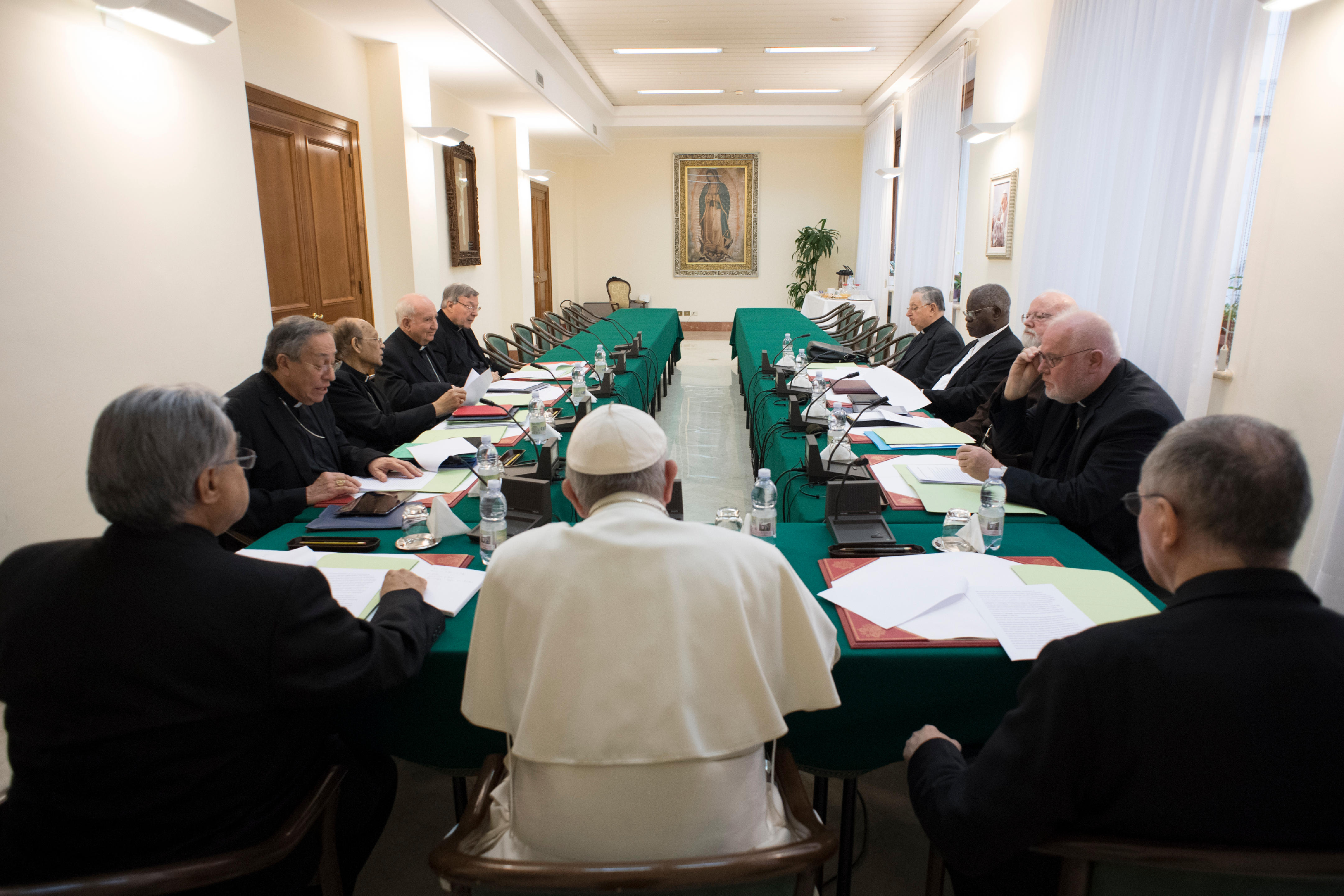
The Council of Cardinals, often referred to as the C9, at a meeting earlier this year
Photo: CNS/L’Osservatore Romano

(2018.9.10 Tablet Christopher Lamb)

 バチカンの前駐米大使が「教皇フランシスコが、司祭や神学生への性的虐待で訴えられている米国のセオドール・マカリック大司教の問題を知っていながら隠ぺいした」とする告発文書を発表してバチカンを揺るがしているが、バチカンはこの問題に対する公式見解を、近く公表することになった。

 9人の枢機卿による教皇顧問会議 (C9)が10日から3日間の日程で開かれているが、10日の声明で、「ここ数週間議論になっている問題について、聖座が『必要な説明』をしようとしていると、顧問会議は認識している」ことを明らかにした。

 顧問会議はまた、この声明で、前駐米大使のカルロ・マリア・ビガーノ大司教が強行に辞任を迫る告発文書を明らかにした後も、教皇と「完全な連帯」を保っている、と言明した。

 前駐米大使は告発文書で、教皇フランシスコは前任のベネディクト16世がマカリックに課した制裁措置を知っていた、と聞いている、と主張している。

 だが、バチカン内部からの教皇に対する予期せぬ攻撃、となったこの文書は、カトリック教会内部の「同性愛者ネットワーク」についての指摘で脚色されており、教皇フランシスコ支持派に対する数多くの言いがかりの一つも含まれている。加えて、マカリックに対する制裁措置は実行されておらず、前駐米大使もこれが公のものでなかったことを認めた。

 先日のアイルランドでの家庭大会出席からの帰りの機上会見で、この問題について意見を切られた教皇は「ひと言」も言わない、と答えらえたが、聖座から制度上の対応の可能性については否定しなかった。

 前駐米大使は告発文書で、バチカンは(教皇フランシスコの就任前の)2000年にマカリックについての訴えを知っていたが、翌年にマカリックをワシントン大司教と枢機卿に任命し、2009年にワシントン大司教を退任するまで、教会内部で影の実力者として力をふるわせた、と批判している。

 なお、10日にC9から出された声明は、また、顧問会議が教皇に対して、顧問会議の「役割、仕組み、構成」について再検討するよう求めたことも明らかにした。これは、顧問会議の9人の枢機卿のうち5人が75歳の”定年”に達し、あるいは超えているためだ。マカリック大司教も枢機卿として、C9のメンバーだったが、今夏に、性的虐待で訴えられたのを受け、枢機卿のタイトルを剥奪され、メンバーから除外されている。

(翻訳・「カトリック・あい」南條俊二)

(Tabletはイギリスのイエズス会が発行する世界的権威のカトリック誌です。「カトリック・あい」は許可を得て翻訳、掲載しています。 “The Tablet: The International Catholic News Weekly. Reproduced with permission of the Publisher”   The Tablet ‘s website address http://www.thetablet.co.uk)

2018年9月12日

・性的虐待対応で前駐米バチカン大使による教皇”告発”の余震続く(CRUX)

(2018.8.30 Crux Editor  John L. Allen Jr.)

 ローマ発―教皇フランシスコがマカリック前枢機卿に関する聖職者性的虐待問題に不適切な対応をした、として辞任を迫る書状を前駐米バチカン大使のビガーノ大司教が公開したことで起きた大嵐を、教皇庁は無視しようとしているが、余波は止まらないようにローマでは感じられる。

 この書状は、マカリック前枢機卿が何世代にもわたって神学生たちを堕落させた、として前任の教皇、ベネディクト16世は公的職務から外すなどの制裁措置をとり、フランシスコ教皇は2013年の教皇就任後にこれを知らされていたにもかかわらず、この措置を最近まで解除していた、とし、性的虐待と隠ぺいの罪を犯した前枢機卿に適切な措置を取らなかった責任をとって、自主的に退任し、他の高位聖職者たちに範を示すべきだ、と求める内容だった。

 この”告発”について、25日のダブリンからローマへの帰国途上の機内会見で「話しません」と言明したことを忠実に守り、29日の水曜恒例の一般謁見でも、言及しなかった。一般謁見で教皇は「罪、スキャンダル、裏切り」への謝罪が基調となった前週末のアイルランド訪問を振り返り、性的虐待を受けた被害者たちとの会見では「深く心を打たれ」たとし、このような現在の状況に対して、「誠実と勇気」をもって臨むように訴えた。

 だが、嵐を乗り切ろうとするあからさまなバチカンの戦略にもかかわらず、26日に発生した地震から少なくとも4つの余震が続いている。

 一つは、イタリアの通信社が教皇の側近がビガーノ事件について教皇は苦々しい思いをしていたと述べたという記事を発信した後、バチカンのスポークスマンたちが、これを否定する声明を出すことを強制されたこと。

 もう一つは、28、29の両日に、米国の2人の大司教が相次いで、ビガーノ大司教の書状に書かれている内容の信憑性が高いことを確認したこと。

 そして、ビガーノ大司教本人が、この書状をスクープした記者たちの1人とインタビューに応じ、負け惜しみで教皇に暴言を吐いたとする見方を否定することも含めて、自身の考えを述べたこと。

 さらに、29日の一般謁見の最後に、会場となったサンピエトロ広場にいた一団が聖歌を歌い、それがその場にいた多くの人には「ビガーノ!」と言っているように聞こえたことだ。広場にいたある司祭は、彼らは巡礼団で、彼らの地元の司教の名を呼んでいたのだ、と語っているが、人々がこの歌声を聴いてすぐに「ビガーノ」を頭に浮かべた、と言う事実は、大司教の名がいかに多くの人の間に広がっているか、と示すものに違いない。

 29日にイタリアの通信社ANSAが、教皇の側近たちがビガーノ事件で教皇を苦々しく思っているとの記事を発信した。同じ日に、イタリア司教協議会の公式紙Avvenireは、「バチカンの権威筋」の発言として、「『教皇が苦々しい思いをした』というのは、ニュースではない。『陰謀』であり、『いやしい言動』だ」と批判した。

 一方、バチカンのスポークスマン、グレッグ・バーク師は、ローマへの帰国途中の機内会見で教皇が見せた高ぶった雰囲気について、記者から聞かれ、教皇は(ダブリンで改めて印象付けられた)聖職者による性的虐待のスキャンダルに取り組もうとする努力で頭がいっぱいだったのだ、と説明し、「25日夜の飛行機の中で、教皇は苦々し思いをしているように見えましたか?」と逆に問いかけた。「お願いです…(「カトリック・あい」注・教皇を苦しめるようなことはしないでほしい)」。

 教皇が苦々しい思いをしているか、いないかはともかく、「ビガーノ書状」が起こした衝撃波、とくに米国でさらに2人の大司教が書状の信頼性を擁護する姿勢に踏み込んだことで増幅された波を受けても、教皇は少しもたじろぐことがなかった、とは想像しがたい。

 米オクラホマ市のポール・コークレイ大司教は28日、教区の司祭、信徒に宛てた声明で、ピガーの書状への内容についての論評を避けながら、「私はビガーノ大司教と彼の高潔さを深く尊敬しています」と述べ、「彼の書状は称賛に値します。彼は書状で、その指摘するところ一つ一つについて、徹底的に調査し、評価することを求めているのです」と支持を表明した。

 翌日には、サンフランシスコのサルバドーレ・コルディレオーネ大司教が声明を出し、ビガーノ大司教は「無私の奉献で自己の使命を果たした人」であり、「彼の書状は重く受け止めねばなりません。軽視することは(「カトリック・あい」注・教皇フランシスコが日ごろから言われている)『否定とごまかしの文化』を放置することになります」と訴えた。

 もっとも、コークレイ、コルディレオーネ両大司教が、ビガーノ文書に対する声明を出した最初の高位聖職者ではない。フィラデルフィアのチャールズ・チャプット大司教は、彼らの前に、広報担当者を通じて、ビガーノ大司教に対する支持を表明していた。

 また29日には、ビガーノ大司教が身を隠し、命の危険を感じている、との情報がツイッターで流れ、本人が所在を隠したうえで、イタリアのジャーナリストに電話でインタビューに応じ、「光はいつも勝ちます。抑えつけることはできません。とくに信仰を持っている人の場合は」と静かに確信を語った。さらに、この書状に対しては様々な反響を受け取っており、その中には、彼が麻薬中毒患者だ、というものもあるが、たくさんの「司祭や信徒たち」からの感謝の言葉も受け取っている、と多くの支持を受けていることを強調。さらに、教皇とのやりとりはその内容の重大性から秘匿するという原則を破ったことを認めたうえで、「私は、カトリック教会の高位の指導者たちのレベルにまで腐敗が達していることから、あえて語ったのです」と説明した。

 このインタビューで大司教はまた、バチカン内部の金融汚職について告発した文書が報道機関に流出した2011,2012年の“Vatileaks” 事件の調査のために前教皇ベネディクト16世が設置した3人の枢機卿による委員会が前教皇の意向通り機能していれば、「バチカン官僚機構の浄化」がされていた、との見方を示した。

 また、大司教は、今回の書状の動機について、一部に言われている「負け惜しみ」-2012年にバチカン市国政府のナンバー・ツーのポストを得そこなったことや、駐米大使を終えてローマに帰国後に枢機卿に選ばれなかったことなどへの不満-があったとする見方を否定、「実際には、私が枢機卿になることを放棄したのです」とし、ベネディクト16世が教皇在任中に、自分が財務事務局長官(通常は枢機卿が就くポスト)になることを望まれたが、待ってくれるように頼んだことを明らかにした。

 インタビューの最後に、彼が病身の兄弟、ロレンゾの介護をせねばならないとして、米国への派遣を止めてくれるようにバチカンの上層部に頼んだ、というのは嘘で、実際は、財産を巡る一族内部の争いがあり、大司教は自分の取り分を失うのを心配していたのが本当の理由だ、とするロレンゾの出した声明を一蹴し、「私は当時、自分の兄弟を介護し、守るという道義的な責任を強く感じていたのです」と弁明した。

 ・・・・・・・・・・・・・・・・

 今ここに至っても、バチカンがこの問題について、さらに踏み込んだ声明を出そうとしているという動きはみられない。

 だが、米国カトリック司教協議会会長のダニエル・ディナルド枢機卿が、マカリック前枢機卿のスキャンダルについて捜査することについて教皇の了承を得るため、同司教協議会の幹部をバチカンに派遣する、と発表した以上、教皇フランシスコと側近たちが、いつまでもぬかるみを歩き続けることはできないだろう。

(翻訳「カトリック・あい」南條俊二)

・・Cruxは、カトリック専門のニュース、分析、評論を網羅する米国のインターネット・メディアです。 2014年9月に米国の主要日刊紙の一つである「ボストン・グローブ」 (欧米を中心にした聖職者による幼児性的虐待事件摘発のきっかけとなった世界的なスクープで有名。映画化され、日本でも昨年、全国上映された)の報道活動の一環として創刊されました。現在は、米国に本拠を置くカトリック団体とパートナーシップを組み、多くのカトリック関係団体、機関、個人の支援を受けて、バチカンを含め,どこからも干渉を受けない、独立系カトリック・メディアとして世界的に高い評価を受けています。「カトリック・あい」は、カトリック専門の非営利メディアとして、Cruxが発信するニュース、分析、評論の日本語への翻訳、転載について了解を得て、掲載します。


・教皇ヨハネ・パウロ1世選出から40年に

(2018.8.28 「カトリック・あい」)

 ベニス大司教だったビーノ・ルチアーニ枢機卿が、教皇に選出され、ヨハネ・パウロ1世が誕生した日から40 年。Vatican Newsがビデオ(英語字幕付き)を放映した。

 前任のパウロ6世の死去を受けて開かれたコンクラーベで、ヨハネ・パウロ1世が教皇に選出されたのは1978年8月26日。いつも笑顔を絶やさないことで「微笑みの教皇」と呼ばれ、「第二バチカン公会議」を始めたヨハネス23世、その成果を継いだパウロ6世の後を受けて、現代世界に生きる教会に向けた改革推進の期待を一身に受け、精力的な取り組みを始められたが、わずか在位33日で突然亡くなられた。

 後を継いだヨハネ・パウロ2世は2003年に、彼を「神のしもべ」と呼び、列福の準備を事実上開始、現在の教皇フランシスコは2017年に、その英雄的な徳を称え、尊者の称号を捧げた。

 亡くなられたのがあまりにも突然であり、原因も不明のままにされたことから、当初、教皇の改革に積極的な姿勢を快く思わない、バチカン内部の保守派勢力の関わりなども一部に取りざたされたが、その後沙汰やみとなった。だが、周囲が彼の健康についてあまり気遣うこともなく、ケアもしていなかったのは、確かなようであり、いろいろな意味で後味の悪さが残った。

 いずれにしても、ヨハネ・パウロ1世が健康で、活動を続けられていれば、没後30年余り後に彼の遺志を事実上継いだ教皇フランシスコが苦闘されている、現在のような、教会改革の遅滞、聖職者による性的虐待と高位聖職者による隠ぺいの世界的拡大などは起こっていなかった可能性がある。

・教皇、帰国途上の機上会見でも”性的虐待”に質問集中

(2018.8.28 「カトリック・あい」)

 教皇フランシスコは26日、2日間のアイルランド訪問を終え、帰国途中の機内で恒例の記者会見をされたが、記者団からの質問の大半は、欧米を中心に未だに終息を見せない聖職者による未成年性的虐待と高位聖職者による隠ぺいスキャンダルで占められた。

 質問では、元駐米教皇大使のカルロ・マリア・ヴィガノ大司教が教皇のアイルランド訪問直前に公開した教皇あての手紙が取り上げられた。手紙は、未成年者の神学生に対する性的虐待で告発され、事実上枢機卿の地位をはく奪された米国の前ワシントン大司教、セオドア・マカリック元枢機卿への対処で、教皇フランシスコの責任を問うもの。前教皇ベネディクト16世が元枢機卿の罪状を知って全ての職務から外す措置をとったにもかかわらず、教皇フランシスコは教皇就任直後に、その制裁措置を解除していた、とし、一連のスキャンダルに関与した高位聖職者への見本を示す意味からも、自主的に退任を求める、という激しい内容だが、バチカン当局は真偽を確認していない。

 この内容の真偽と感想を問われた教皇は「今朝(26日朝)、私はそれを読みました」と述べ、「皆さんがその文章を注意深く読んで、皆さんが判断してください。私はこれについて何も話しません。文書が言っていることです。皆さんのジャーナリストとしての能力をもって、結論を出してください」と、事実上コメントを拒否するにとどまった。

 また、別の記者からは、関係者の間で取りざたされている、虐待で訴えられた司教たちについて審理、判決を下す特別裁判所の設置について見解を聞かれたが、教皇は「すでにこうした問題一つひとつのケースに合わせ、特別な法廷を開いています。この形の方がよく機能すると思います」と答えられた。

 さらに、「聖職者によるこのような邪悪な行為を前に、信者はどうしたらよいのか」という問いには、「何かを知ったら、すぐにそれを裁判官や司教に話すことが大切です。それが神の民ができることです」と答えた。ただし、「時には、家族自身がそれ(子供たちが聖職者から性的虐待を受けたこと)を信じないこともあり、透明性の確保が難しい」とし、「司祭が信者から不当に訴えられ、裁判を経て、無実とされたケースもあり、慎重さが必要とされる面もあります」とも指摘された。

(バチカン公式発表の会見内容やCruxの報道をもとに「カトリック・あい」がまとめました)

 バチカン公式発表の機上会見の全文は以下の通り(「カトリック・あい」)

Press Conference of the Holy Father on the return flight from the Apostolic Journey to Ireland, on the occasion of the IX  World Meeting of Families (25-26 August 2018), 27.08.2018

Yesterday, during the flight from Dublin to Rome, at the end of the Apostolic Voyage to Ireland, on the occasion of the IX World Meeting of Families, the Holy Father Francis met the journalists on board the plane at a press conference, whose transcription we report below:

Greg Burke:
Good evening, Holy Father!

Pope Francis:
Good evening!

Greg Burke:
Thank you for this time dedicating us, after two days so intense. Certainly there have been difficult times in Ireland – there is always the question of abuse – but also very beautiful moments: the family feast, the testimonies of families, the meeting with young couples and also the visit to the Capuchins, who help so much the poor.

We pass the word to journalists, to start with the Irish … But maybe you want to say something earlier …

Pope Francis:
Thank you, because if I got tired, I think of you, that you have work, work, work … I thank you so much for your effort, for your work. Thank you very much.

Greg Burke:
The first question, as usual, comes from a journalist in the country, Tony Connelly, of RTÉ – Irish Radio TV.

Tony Connelly, RTÉ (Radio TV Ireland)
Holiness, Saturday spoke of the meeting he had with the Minister for Children; he said how much he touched what Mrs. Le said on the houses for mothers and children. What exactly did he tell you? And you were so impressed because it was for you the first time you heard about these houses?

Pope francesco:
The Minister first told me something that did not touch so much mothers and children; he told me – but it was a short one – “Holy Father, we have found mass graves of children, buried children. We are investigating. Does the Church have anything to do with all this? “, But she said it with a lot of education, really, and with a lot of respect. I thanked her, touched my heart, to such an extent that I wanted to repeat it in the speech. It was not at the airport – I was wrong – it was in the meeting with the President. At the airport there was another lady – Minister, I think – and I got confused. But she told me: “Then I will send you a memo”. The memo sent me, I could not read it. I saw that he had sent me a memo. It was very balanced in telling me: there is a problem, the survey has not been completed yet, but it also made me feel that the Church had something to do with that thing. In my opinion, this was an example of constructive collaboration, before … I do not want to say the word “protest”, but of complaint, of lamentation for what in the past time the Church had perhaps favored. That Lady was of a dignity that touched my heart. And now I have that memo, which I’ll study when I get home. Thanks to you.

Greg Burke:
Now, another Irishman is Paddy Agnew, of the “Sunday Independent”, who is a resident of Rome but an Irish journalist.

Pope Francis:
He is not the only Irishman in Rome!

Paddy Agnew, “Sunday Independent”:
Holy Father, thank you and good evening. Yesterday, Marie Collins, the Marie Collins victim you know very well, reported that you are not in favor of setting up new Vatican investigation tribunals on the problem of sexual abuse, and in particular of the so-called bishops’ investigative tribunals. taking responsibility on the part of the bishops ( bishop accountability ). Why do you think these are not necessary?

Pope francesco:
No, no, it’s not like that. It is not so. Marie Collins is a bit ‘fixed on the idea … – I esteem Marie Collins, sometimes we call her in the Vatican to give lectures -, she has remained fixed on the idea of ​​that written “Like a loving mother”, in which it was said that to judge the bishops it would be good to make a special tribunal. Then it was seen that this was not practicable and it was not even convenient for the different cultures of the bishops to be judged. One takes the recommendation of “loving Mother” and makes the jury for each bishop, but it is not the same. This bishop is to be judged and the Pope makes a jury that is more capable of taking that case. It’s something that works better, also because, for a group of bishops, leaving the diocese for this is not possible. So the courts, the juries change. And so we did until now. Several bishops were judged: the last is that of Guam, the archbishop of Guam, who appealed and I decided – because it was a very, very complex case – to use a right that I have, to take on I appeal to you and do not send it to the appellate tribunal that does its job with all the priests, but I took it upon myself. I made a committee of canonists to help me and they told me that, in short, a month at most, the “recommendation” will be made for me to make the judgment. It is a complicated case, on the one hand, but not difficult, because the evidence is very clear; on the evidence side, they are clear. But I can not pre-judge. I wait for the report and then I will judge. I say that the evidence is clear because they are the ones that brought the first court to condemnation. This was the last case. Now there’s another one going on, let’s see how it will end. But it is clear, I said to Marie: the spirit and also the recommendation of “Like a loving mother” is implemented: a bishop must be judged by a court, but it is not always the same court, because it is not possible. She [Marie Collins] did not quite understand this, but when I see her – because she comes to the Vatican at times, we call her – I will explain it more clearly. I love her. we call her – I’ll explain it more clearly. I love her. we call her – I’ll explain it more clearly. I love her.

Greg Burke:
Now the Italian group, Holy Father: there is Stefania Falasca, of “Avvenire”.

Stefania Falasca, “Avvenire”:
Good evening, Holy Father. You have said, even today, that it is always a challenge to welcome the migrant and the foreigner. Just yesterday it was a painful affair, that of the ship “Eighteen”. Is there your “hand” behind this solution? Is his involvement, his interest?

Pope Francis:
The paw is of the devil, not mine! [laugh] The hand is of the devil …

Stefania Falasca:
And then, many see a blackmail to Europe on the skin of these people. What do you think?

Pope Francis:
Welcoming migrants is an ancient thing like the Bible. In Deuteronomy, in the commandments God commands this: to welcome the migrant, “the stranger”. It is an ancient thing, which is in the spirit of divine revelation and also in the spirit of Christianity. It is a moral principle. On this I spoke, and then I saw that I had to explain a little more, because it is not about welcoming “alla belle étoile“No, but a reasonable welcome. And this is true in all of Europe. When did I realize how this reasonable attitude should be? When there was the attack on Zaventem [Belgium]: the boys, the guerrillas who made the attack on Zaventem were Belgians, but children of non-integrated, ghettoized immigrants. That is, they had been received by the country but left there, and they have made a ghetto: they have not been integrated. That’s why I stressed this, it’s important. Then, I remembered, when I went to Sweden – and Franca [Giansoldati] in an article made mention of this and how I put this to mind – when I went to Sweden I talked about integration, and I knew it because during the dictatorship, in Argentina, from 1976 to 1983, many, many Argentineans and even Uruguayans fled to Sweden. And there, immediately the government took them, made them study the language and gave them work, integrated them. To the point that – and this is an interesting anecdote – the Minister who came to leave me at Lund’s airport was the daughter of a Swedish woman and an African migrant; but this African migrant has integrated to the point that his daughter has become Minister in the country. Sweden was a model. But, at that moment, Sweden was beginning to have difficulty: not because it did not have good will, but because it did not have the possibility of integration. This was the reason why Sweden stopped a bit, and took this step. Integration. And then, I spoke here, at a press conference among you, about the virtue of prudence that is the virtue of the ruler, and I talked about the prudence of peoples on the number or possibilities: a people that can accept but can not integrate, better not welcome. There is the problem of prudence there. And I think that this is the sore point of dialogue today in the European Union. We must continue to talk: the solutions are found …

What happened with the “Eighteen”? I did not put a hand on it. What did the work with the Minister of the Interior was Father Aldo, the good father Aldo, who is the one following the Don Benzi Opera, which the Italians know very well, who work for the release of prostitutes, those who They are exploited and many things … And the Italian Episcopal Conference, Cardinal Bassetti, who was here, also entered the phone, but all the mediation followed, and one of the two undersecretaries, Mons. Maffeis, negotiated with the Minister. And I think that Albania came … They took a certain number of migrants Albania, Ireland and Montenegro, I think, I’m not sure. The others took charge of the Episcopal Conference, I do not know whether under the “umbrella” of the Vatican or not … I do not know how it was negotiated; but they go to the “Better World” Center, in Rocca di Papa, they will be welcomed there. The number I think is more than a hundred. And there they will begin to learn the language and do the work that has been done with integrated migrants. I have had a very rewarding experience. When I went to the Roma III University there were the students who wanted to ask me questions and I saw a student … “I know her”: she was one who had come with me among the thirteen I had brought from Lesbos. That girl was at the university! Because? Because the Community of Sant’Egidio, from the day after his arrival, took her to school, to study: go, go … And she integrated it at the university level. This is work with migrants. There is the opening of the heart for everyone, to suffer; then, integration as a condition for welcoming; and then the prudence of the rulers to do this. I saw, I have a clandestine movie, what happens to those who are sent back and are taken back by the traffickers: it’s horrible, the things they do to men, women and children …, they sell them, but men do the most sophisticated torture. There was one there that was able, a spy, to make that video, which I sent to my two under-secretaries of migration. For this reason, to send them back we must think well, well, well …

And then, one last thing. There are these migrants who come; but there are others who are deceived, at Fiumicino, are deceived: “No, we give you the job …”. They have their cards, all of them, and they end up on the enslaved sidewalk, under the threat of the traffickers of women … This is it.

Greg Burke:
Thank you, Holy Father. The next question is from the English-speaking group: Anna Matranga, from the American television NBC.

Anna Matranga, NBC:
Good evening, Holy Father! I will return to the topic of “abuse”, of which he has already spoken. This very early morning a document was issued by Archbishop Carlo Maria Viganò, in which he says that in 2013 he had a personal conversation with you at the Vatican and that in this interview he would have talked with you explicitly about the sexual behavior and abuses of ex cardinal McCarrick. I wanted to ask you if this was true. And I also wanted to ask another thing: the archbishop also said that Pope Benedict had sanctioned McCarrick, who had told him that he could not live in the seminary, he could not celebrate Masses in public, he could not travel; it was sanctioned by the Church. Can I ask you if these two things are true?

Pope Francis:
One thing: I would prefer – even if I answer your question – I would prefer that before we talk about the trip and then other topics … but I answer. I read that release this morning. I read it and I sincerely have to tell you this, to you and to all those of you who are interested: read the notice carefully and make your own judgment. I will not say a word about this. I believe the statement speaks for itself, and you have enough journalistic capacity to draw conclusions. It is an act of trust: when some time has passed and you have drawn conclusions, perhaps I will speak. But I would like your professional maturity to do this job: it will do you good, really. That’s okay.

Anna Matranga:
Marie Collins said, after meeting her during the meeting with the victims, who spoke directly with you about former Cardinal McCarrick; he said that you were very harsh in your conviction of McCarrick. I wanted to ask you: when was the first time you heard about the abuses the former cardinal had committed?

Pope francesco:
This is part of the McCarrick release: study and then I’ll say. But since I had not read it yesterday, I allowed myself to speak clearly with Marie Collins and the group [of the victims], in the meeting that lasted an hour and a half, something that made me suffer so much. But I think it was necessary to listen to those eight people; and from this meeting came out the proposal – which I made, and they accepted it and helped me to realize it – to ask for forgiveness today in the Mass, but on concrete things.

For example, the last, which I had never heard: those mothers … – it was called the “washing of women” – when a woman was pregnant without marriage, went to a hospital or do not know what it was called, institute …, but they were the nuns who held it, and then gave the child up for adoption to the people. And there were children, at that time, who tried to find mothers, if they were alive, they did not know … and told them it was a mortal sin to do this; and even to the mothers who were looking for their children, they said it was a mortal sin. This is why I ended up saying today that this is not a mortal sin, but it is the fourth commandment.

And the things I said today, some I did not know, and it was painful for me, but also with the consolation of being able to help clarify these things. And I await your comment on that document, I’d like to! Thank you. I did not know some of them, and it was painful for me, but also with the consolation of being able to help clarify these things. And I await your comment on that document, I’d like to! Thank you. I did not know some of them, and it was painful for me, but also with the consolation of being able to help clarify these things. And I await your comment on that document, I’d like to! Thank you.

Greg Burke:
Thank you, Holy Father. Now Cecile Chambraud of “Le Monde”

Cecile Chambraud, “Le Monde”:
Good evening, Holy Father. I hope you do not mind if I ask my question in Spanish and I beg you to answer in Italian for all the colleagues. In your address to the Irish authorities, you referred to your recent Letter to the People of God. In that letter, you call all Catholics to participate in the fight against abuses in the Church. Can you explain to us what concretely Catholics can do, each in their own position, to fight against abuses?

And in this regard, in France, a priest began a petition calling for the resignation of Cardinal Barbarin, accused by victims. Do you think this initiative is adequate or not?[En su discurso to las Autoridades de Irlanda, usted if I refirió a su reciente Carta al Pueblo de Dios. En aquella Carta, usted llama a todos los católicos a tomar parte en la lucha contra los abusos en la Iglesia. ¿Puede detallarnos lo que concretamente los católicos pueden hacer cada uno en su sitio para lucar contra los abusos? In France, a priest has iniciado a petición llamando a que renuncie el Card. Barbarin, acusado por víctimas ¿The parece adecuada esta iniciativa, or not?]

Pope Francis:
If there are suspicions or proofs or half-proofs, I do not see anything bad about doing an investigation, if one does on the fundamental legal principle: Nemo malus nisi probetur , nobody is bad if you do not try it.

And so often there is the temptation not only to do the investigation, but to publish that the investigation was made and why it is guilty …, and so some media – not yours, I do not know – begin to create an atmosphere of guilt. And I would like to say something that has happened in these times, which will help in this, because for me it is important how we proceed and how the mediathey can help.

In more or less years, the problem of so-called pedophile priests has begun in Granada, a small group of seven or eight or ten priests, who have been accused of child abuse and even of parties, orgies and these things. I received the accusation directly: a letter made by a young twenty-three year old; according to him he had been abused, gave names and everything. A young man who worked in a religious college in Granada, very prestigious; the letter, perfect … And he asked me what to do to report this. I said: “Go to the Archbishop, the Archbishop knows what you must do”.

The Archbishop did everything he had to do, it also came to the civil court. There were two processes. The mediaof the place they started to talk, to talk … Three days later, all written in the parish, “pedophile priests” and things like that, and so the conscience was created that these priests were criminals. Seven were interrogated, and nothing was found; in three the investigation went ahead, they remained in prison for five days, two, and one – Father Roman, who was the parish priest – for seven days.

For almost three more years the hatred suffered, the slaps of all the people: criminalized, they could not go out, and they suffered humiliations made by the jury to prove the boy’s accusations, which I do not dare repeat here. After three years and more, the jury declares the innocent priests innocent, but above all these three: the others were already out of the case, and the complainant guilty. Because they had seen that young man was imaginative, but he was a very intelligent person and he worked also in a Catholic college and had this prestige, which gave the impression of telling the truth. He was condemned to pay the costs and all these things, and they were innocent. These men were condemned by theaverageof the place before justice.

And for this, your work is very delicate: you must accompany, you must say things but always with this legal presumption of innocence, and not the presumption of guilt! And there is a difference between the informant who informs about a case but is not played for a previous conviction, and the investigator, who does the “Sherlock Holmes”, which goes with the presumption of guilt. When we read Hercule Poirot’s technique: for him, everyone was guilty. But this is the job of the investigator. They are two different positions. But those who inform must always start from the presumption of innocence, saying their impressions, doubts …, but without giving condemnations. This case happened in Granada for me is an example that will do good to all of us, in our [respective] profession.

Greg Burke:
In the first part [of the previous question] he asked what God’s people could do in the matter …

Pope francesco:
Ah yes, yes. When you see something, talk right away. I will say something else a little ugly. Sometimes, parents are covering an abuse of a priest. A lot of times. It is seen in the sentences. [They say:] “But, no …”. They do not believe, or they are convinced that it is not true, and the boy or girl remains that way. I have the method of receiving one or two people every week, but it is not mathematical; and I received a person, a lady, who for 40 years suffered this scourge of silence, because the parents had not believed her. She was abused at the age of eight. To speak, this is important. It is true that for a mother, to see this … it would be better if it were not true, and then she thinks that the child may have fantasies …

[But we must] speak. And talk to the right people, talk to those who can begin a trial, at least prior investigation. Talk to the judge or the bishop, or if the parson is good to talk to the parish priest. This is the first thing God’s people can do. These things should not be covered, they should not be covered. A psychiatrist told me some time ago – but I do not want it to be an offense to women – than for the sense of motherhood, women are more inclined to cover the things of the child than men. But I do not know if it’s true or not … But this is: talking. Thank you. speak. Thank you. speak. Thank you.

Greg Burke:
Javier Romero of “Rome Reports TV” belongs to the Spanish group.

Javier Romero:
Holiness, excuse me, I would like to ask you two questions. The first is that the Prime Minister of Ireland, who was very direct in his speech, is proud of a new model of family different from the one that traditionally proposes the Church so far: I speak of homosexual marriage. And this is perhaps one of the models that generates more clashes, especially in the case of a Catholic family, when there is a person in this family who claims to be a homosexual. Your Holiness, the first question I would like to ask you is: what do you think, what would you say to a father, a father, to whom the son says he is a homosexual and wants to go and live with his partner. This is the first question. And the second one, which, in fact, you also spoke about abortion in your speech with the prime minister; we have seen how Ireland has changed so much in recent years and it seemed that the Minister was, indeed, satisfied with these changes: one of these changes was precisely abortion. We have seen that in recent months, the issue of abortion has come out in many countries, among other things in Argentina, your country. How do you feel when you see that, in fact, this is a topic you often talk about and there are so many countries where it is put …

Pope Francis:
All right. I start from the second, but there are two points – thanks for this – because they are related to the issues we are talking about. On abortion, you know how the Church thinks it. The problem of abortion is not a religious problem : we are not against abortion for religion. No. It’s a human problem, and must be studied by anthropology. Studying abortion by starting from the religious fact, is bypassing the thought. The problem of abortion must be studied by anthropology. And there is always the anthropological question on the ethics of taking out a living being to solve a problem. But this is already the discussion. I just want to underline this: I never allow people to start discussing the problem of abortion from the religious fact. No. It’s an anthropological problem, it’s a human problem. This is my thought.

Second. There have always been homosexuals and people with homosexual tendencies. Always. Sociologists say, but I do not know if it’s true, that in times of age changes there are some social and ethical phenomena, and one of these would be this. This is the opinion of some sociologists. Your question is clear: what would I say to a father who sees that his son or daughter has that tendency. I would first tell him to pray: pray. Do not condemn, dialogue, understand, make room for the son or daughter. Make room for it to be expressed. Then, at what age does this restlessness of the child manifest itself? It’s important. One thing is when it manifests itself as a child, when there are so many things that can be done, to see how things are; another thing is when it manifests itself after the age of 20 or something like that. But I will never say that silence is the remedy: ignoring the son or daughter with a homosexual tendency is a lack of fatherhood and motherhood. You are my son, you are my daughter, as you are; I’m your father and your mother, let’s talk. And if you, father and mother, do not get along, ask for help, but always in dialogue, always in dialogue. Because that son and daughter are entitled to a family and this is the family: do not drive him away from the family. This is a serious challenge to fatherhood and motherhood. Thank you for the question, thank you. Because that son and daughter are entitled to a family and this is the family: do not drive him away from the family. This is a serious challenge to fatherhood and motherhood. Thank you for the question, thank you. Because that son and daughter are entitled to a family and this is the family: do not drive him away from the family. This is a serious challenge to fatherhood and motherhood. Thank you for the question, thank you.

Greg Burke:
Thank you, Holy Father.

Pope Francis:
And then, I would like to say something to the Irish who are here: I have found so much faith in Ireland. So much faith. True, the Irish people have suffered so much from the scandals. But there is faith, in Ireland, and strong. And moreover, the Irish people can distinguish, and I quote what I heard today from a prelate: “The Irish people can distinguish well between truths and half-truths: it’s something inside”. It is true that it is in a process of elaboration, of healing from this scandal; it is true that some open themselves to positions that seem to move away from the faith. But the Irish people have a deeply rooted faith. I want to say it because it’s what I saw, I heard and about which I have been informed in these two days.

Thank you for your work, thank you very much! And pray for me, please.

Greg Burke:
Thank you. Good dinner and good rest.

2018年8月28日

・「世界家庭大会」閉会ミサ-教皇、聖職者による性的虐待被害者に赦しを乞う

(2018.8.27 バチカン放送)アイルランド訪問中の教皇フランシスコは26日午後、ダブリンのフェニックス・パークで、カトリック教会の「世界家庭大会」の閉会ミサを行われた。ミサには信徒たち30万人が参加した。

  教皇はミサの中で、アイルランドのカトリック教会の数多くの聖職者や修道者による未成年者への性的虐待について、被害者たちに赦しを乞うとともに、教会が「(被害者たちへの)同情や正義と真理を追求しようとする姿勢を欠いていた」こと、「(被害者たちの)苦痛に満ちた状況を前に沈黙していた」ことを謝罪。回心の祈りで、「このようなことが二度と起きないように、そして正義が行われるように、神がこの恥と悔い改めの心を育ててくださるように」と祈られた。

 ミサの説教では、イエスの言葉を信じず、つまずく弟子たちに、イエスが「あなたがたも離れていきたいか」(ヨハネ福音書6章67節)と問いかけられた場面を観想され、「私たちにとっても、イエスの教えは実行不可能に思われることがあります」としたうえで、「自分を傷つけた人を赦すこと、移民や外国人を受け入れること、失望や拒絶、裏切りに耐えること、まだ生まれる前の命や、高齢者たちを守ることは、何と難しいことでしょうか」と話された。

 「しかし」と教皇は、「こうした状況にある時こそ、私たちは、聖霊の力と私たちの傍にいつもおられるイエスに勇気づけられ、『あなたこそ神の聖者であると、私たちは信じ、また知っています」(ヨハネ福音書6章69節)と信頼を込めて語ったペトロの言葉で、答えなくてはならないのです」と強調された。

 ミサの後、教皇はダブリン市内の修道院で、アイルランドの司教団との出会いを持たれた後、ダブリン空港での送別式を経て、ローマに戻られた。次回の「世界家庭大会」は2021年にローマで開かれる。

・・・・・・・

 8月21日からアイルランドの首都ダブリンで開かれたカトリック教会の「第9回世界家庭大会」に、教皇は25日にダブリンにおいでになっていた。到着後に、大統領はじめアイルランド各界要人との会見で「家庭」の大切さをグローバルな視点で訴えたほか、夫婦たちとの対話、貧しい家族たちとの交流、世界の家族が集った「家庭の祝祭」など、様々な出会いを持たれた。26日午前には、アイルランド西部の聖母巡礼地クノックを訪れ、カトリック教会の聖職者による性的虐待の被害者や、世界中の家族たちを聖母の保護に託して祈られた。

(編集「カトリック・あい」)

2018年8月27日

・教皇、アイルランド訪問で「おぞましい犯罪に、教会は正しく対応できなかった」と率直に反省

(2018.8.25 バチカン放送)

 教皇フランシスコは25日、「世界家庭大会」出席のため、アイルランドを訪問。ダブリン城で、レオ・バラッカー首相をはじめとする政府関係者、および各界の要人、同国駐在の外交団と会見された。

 ダブリン城でバラッカー首相の出迎えを受けた教皇は、城内の「サン・パトリック・ホール」で挨拶された。その中で、教皇は、訪問の目的をダブリンで開催中の「世界家庭大会」への出席、と説明したうえ、教会は「いくつもの家族で構成された一つの家族」であり、そのために、「家族が神から与えられた召命を社会の中で喜びをもって果たしながら、家庭内の教育を通して、健全な社会の発展に寄与できるように、支える必要があります」と話された。

 さらに、「変遷の激しい今日の社会の中で、家族は多くの困難に直面し、結婚や家庭生活の混乱が、様々なレベルで私たちの共同体の未来にも影響を及ぼそうとしている」とし、「社会における家庭の役割を軽視せず、あらゆる手段をもって支え、守らなければならなりません」と語られた。そして「私たちは家庭において、人生の最初の一歩をしるし、調和のうちに生活しつつ、利己主義を抑え、それぞれの違いを和解させ、何よりも人生の真の意味を悟ることを学びました」。「ですから、私たちは全世界という唯一の家族においても、最も弱い立場の人々をはじめ兄弟姉妹たちとの一致や連帯が求められているのです」と強調。

 そして、「人種や民族の違いから起こされる憎悪や紛争・暴力、人間の尊厳や権利の軽視、貧富の差の拡大などを前に、私たちは無力に感じることがあるかもしれません。それでも、民の集まりとしての唯一、真の家族としての『人類』の意味を、政治や社会などあらゆる面において、取り戻さなければなりません」と訴えられた。

 教皇は、北アイルランド和平をめぐり、アイルランド共和国政府と英国政府が1998年結んだベルファスト合意(聖金曜日協定)から、今年で20年を迎えることに言及し、「この歴史的合意によって、多大な苦しみを生んだ紛争に平和の構図が生まれたこと」を神に感謝されるとともに、「平和プロセスを通し、残る障害を乗り越え、調和と和解、相互信頼に満ちた未来を推進する」ことを希望された。

 また「真の平和は神の賜物です」として、「この霊的な基礎を欠くと、国家が集まる地球家族は単なる空の場所となってしまうでしょう」と話され、さらに「今日の経済発展は、正しく平等な社会をもたらしているでしょうか」と問いつつ、物質主義的な「切り捨ての文化」によって、「生まれてくる前の命をはじめ、人類家族の最も弱い立場にある人々が、生きる権利を取り上げられています」と批判。深刻な移民危機の解決のためにも「短期的、政治的な視点を超えた、賢明で人道的な広い視野を持つことが必要です」と述べられた。

 教皇は、アイルランドの教会関係者による性的虐待の問題も取り上げられ、過去に特別困難な状況に苦しんだ女性たちに思いを寄せるとともに、性的虐待の被害者となった未成年者たちを思い起こされた。そして、「子どもたちを守り、教育する役割にある人々が引き起こした、このおぞましい犯罪」に対し、『教会が正しく対応できなかったことが、人々の怒りを生み、カトリック共同体の苦しみと恥の源となった」のは当然のことであり、「私もまったくその通りと思う」と述べた。

 前教皇ベネディクト16世が、当時、教会関係者による人々への信頼の裏切りを厳しく非難し、決然と介入することで、過ちを繰り返さないための、現在の関係者の取り組みがなされるようになった、という経過を語られる一方、「すべての子どもは神の貴重な贈り物」であるにもかかわらず、それを軽んじ、侮辱するような「人々の怠慢と過ちを明るみに出したこのスキャンダルの重大さ」を改めて認識しつつ、「社会全体に、未成年者と無防備な成人の保護へ関心が高まる」ことを強く希望された。

 最後に、アイルランドとカトリック教会について、教皇庁は90年前、アイルランド自由国を最初に認めた国・国際機関の一つとなり、以来、「両国は長きにわたって友好と協力関係を築いてきました」と述べ、「一時的に両国関係に曇りが見られたこともありましたが、最近、再び双方の合意と善意のもとに、友好関係復活の努力が行われるようになったことを喜ばしく思います」とさた。そして、「昔も今も、アイルランド国民は、信仰から生まれた叡智をもって社会生活を豊かにする努力を行い、同国の歴史の最も暗い時も、人々は信仰の中に勇気の源を見出してこられました」とし、「アイルランドが今日の社会・政治的議論の合唱のさなかにある時も、キリスト教のメッセージのメロディーに耳を傾けることができるように」と祈られた。

(「カトリック・あい」が編集)

2018年8月25日

・「素晴らしい言葉、だが今は行動の時」-教皇書簡へ被害者たちの反応(CRUX)

(2018.8.21 Crux Vatican Correspondent Christopher White and Inés San Martín)

 ダブリン発 – 聖職者による性的虐待を原因とする危機に対して教皇フランシスコが20日に出した書簡で、教会が「小さな人々にいたわりを示さず、私たちは放置した」ことを告白したことは、性的虐待の被害者たちに好感をもって受け入れられたものの、関係者の全体としての感想は「それは前にも聞いたことだ」という言葉にまとめられるようだ。

 「バチカンや教皇の声明は、どれほど酷い性的虐待があったか、どうやって説明責任が果たされねばならないか、を語るのを止めるべきです」。性的虐待の被害者でアイルランド人のマリー・コリンズ氏はツイッターに書き込んだ。「そのようなことを語る代わりに、(性的虐待と隠ぺいの)責任をとるために何をしているか、を説明してもらいたい。それが、私たちの聞きたいことです。『今、やっています』と言えるのは、何十年もの対応の”遅れ”について説明することではありません」と強調した。

 教皇が書簡を出した前の日に、コリンズ氏はCruxとのインタビューで、教皇が25日にアイルランドを訪問される際、「お詫びを繰り返す」ことよりも教皇に聞きたいのは、性的虐待を隠ぺいした司教たちに責任をとらせることを保証する具体的な処置についての説明です」と語っていた。(カトリック・あい注・コリンズ氏は、教皇が数年前に設置した弱者保護に関する員会の委員だったが、バチカン官僚などの問題意識の低さ、非協力的な態度に抗議して、他の性的被害者代表と共に委員を辞任している。)

 教皇は書簡で、聖職者による性的虐待の犠牲者たちの「胸を締め付けられるような痛み」に言及し、彼らは「天に向かって叫び」をあげても、「長い間、無視され、黙らされていた」。だが、「彼らの叫びは、それを黙らせようとするすべての手立てを上回る力があり、連鎖に落ち込むことで重大性を増した決断によって、問題を解決しようとさえしました」と述べていた。

 チリの被害者、ホアン・カルロス・クルス氏は、十年以上にわたって、加害者であるフェルナンド・カラディマ神父を糾弾し、同神父の犠牲となった人々を代表してバチカンで教皇と会見していたが、今回の書簡について「バチカンと教皇が、(聖職者による性的虐待について)『犯罪、怠慢、司法当局に委ねる、隠蔽』などの言葉を使っていることを、うれしく思います。書簡はすべて好ましい内容になっている」と評価した。そして、このような用語は、司法当局だけでなく、教会でも通常使われるようになっているが、「いつものことながら、遅れているのは司教たちです」とチリの司教たちの対応の遅さを嘆いた。

 チリの検察当局はこのほど、いくつかの教区とチリ司教協議会本部の資料保管庫を強制捜査し、首都サンチャゴ大司教のリカルド・エザッティ枢機卿を聖職者による性的虐待を隠ぺいした疑いで事情聴取のため召喚。枢機卿は21日に事情聴取を受ける予定だったが、弁護士の求めで、延期されている。

 このようなチリでの動きを見て、クルス氏は「教皇の書簡で、私は大きな希望を持ちました」としつつ、「私たちが受けた(性的虐待の)恐ろしさはあまりにも酷く、心身に受けたダメージは修復しがたい。書簡で安心せず、被害者たちを支援する戦いを続けねばなりません」と言明する一方、チリの司教たちについて「被害者たちを『教会を攻撃しようとする者』と非難することで、今だに自分たちを守ろうと汲々としている者は、教会を去るべきです。時代は変わったのです」と語った。

「言葉を少し抑え、もう少し行動を」

 コリンズ氏と共に教皇の委員会の委員の委嘱を受け、任期前に退任した英国のピーター・サンダース氏は、教皇の書簡についてのCruxの質問状に「Fine words(素晴らしい言葉)。 WORDS??」とだけ、答えた。

 被害者たちだけが書簡に意見を述べている訳ではない。高位聖職者の何人かも、書簡について見解を表明している。自国も性的虐待スキャンダルのただ中にあるオーストラリア司教協議会会長のマーク・コラリッジ大司教は「若い人々、弱者の成人を守ろうとする教皇の決意を、私たちも共有します」としたうえで、「教皇フランシスコから重要な言葉が語られましたが、言葉だけでは不十分です」と被害者たちに同調し、「今は、多くのレベルで行動する時です」と改めて、事態収拾、信頼回復への決意を示した。

 ペンシルバニア州大陪審報告などで、オーストラリアを上回る広域、かつ深刻な事態に追い込まれている米国では、司教協議会会長でガルベストン・ヒューストン大司教のダニエル・ディナルド枢機卿は、司教団を代表して声明を出し、教皇の言葉は「特に司教たちが、行動につなげねばならない」と強調した。

 一般信徒の間でも、同様の受け止め方をする人が多い。米国の人気テレビドラマに出演し、昨年はニューヨーク大司教のティモシー・ドーラン枢機卿が主宰した慈善夕食会で司会を務めた女優のパトリシア・ヒートンさんは、ダウン症の胎児への優性保護的措置に反対するなどカトリックの中絶反対運動のヒーローとして知られるが、ツイッターへの書き込みで、書簡に対して不満を述べた。

 「これは、私の教会についての最後のコメントです(強く抱きしめないで-彼らはひどく怒らせる新しいやり方を見つけているようだ)。私たちはとうとう @Pontifex(注・教皇のツイッター、転じて教皇の意味)からの手紙を手にした、いつもの衣服を切り裂くような苦しみの後で、(行動する)準備をし、実施しようとしている人たちの意に反して、具体的な行動を何も示そうとしない。 ‘Nuf said(注・もう議論はいらないの意味)」と書いている。

 米バージニア大学で National Marriage Projectの事務局長をしているウイリアム・ブラッドフォード・ウィルコックス氏も同じだ。「米国の司教たちの間で指導者の立場で犯した過ちに(更迭などの)実効性のある制裁を行うこと。そうした行動が、言葉に伴わなければ、教皇の書簡の意味はとてもわずかなものでしかない。(性的虐待の隠ぺいなどで退任に追い込まれた枢機卿の)マカリックについて警告されても何もしなかったバチカンの人々のための実効性のある規律を求めたい」と訴えた。

 また、 BishopAccountability.org(司教たちの説明責任を明らかにするブログ)を運営するアン・バレット・ドイル氏は、「そのような具体的な計画を待っていたが、出てこなかった。私は今回の書簡を見て、これまでの書簡を切り抜いて、張り付けたものを読んでいるように感じました。良い考えを繰り返し述べるのが悪い、と言うのではありません。しかし、カトリック信徒たちが現在の事態を終わらせる計画とした強く切望しているものについて、『深刻な読み間違い』があると思うのです」と指摘している。

 彼女は21日、Cruxに「チリの教会の悲惨の状況について申し上げれば、この16年間で初めて、教皇が語り、なさっていることに、とても驚かされました。教会全体の改革が起ころうとしているのかと、思いました」と語った。「初めて、私は信じました…司教たちと高位聖職者たちを罰する新しいメカニズムが出来ようとしている、と考えたのです…でも、この書簡を見ると、教皇ご自身の権力と責任についての認識が欠けているように思われます」と厳しい見方を示した。

「子供たちを第一に置くべきだ」

 聖職者の性的虐待に対応するために教皇が設置した弱者保護の委員会も、教皇の書簡発表の翌日、21日に声明を出し、教皇の言葉と性的虐待の隠蔽に対する説明責任を果たす約束に「勇気づけられた」と述べた。

 同委員会の委員で、教会法の専門家であるミリアム・ウィレン氏は、性的虐待と力による虐待、倫理面での虐待と関連づける教皇の決断を評価しながら、「赦しを願い、修復を望むという対応は、全く不十分です。後ろを見ているだけです。前を向いた対応-子供たちの安全を最優先する文化への大胆な改革を求めること-が必要です」と具体的な対応の必要性を強調した。「教会の評判を守るために、子供たちの安全を第一にすることを明確に規定すべきです。聖職者だけでは、そのような思い切った改革をすることはできないでしょう。書簡で、教皇は(聖職たちに)求めておられます-『謙遜の心をもって、教会共同体全体に助けを求め、助けを受けねばなりません』と。

(翻訳「カトリック・あい」南條俊二)

・・Cruxは、カトリック専門のニュース、分析、評論を網羅する米国のインターネット・メディアです。 2014年9月に米国の主要日刊紙の一つである「ボストン・グローブ」 (欧米を中心にした聖職者による幼児性的虐待事件摘発のきっかけとなった世界的なスクープで有名。映画化され、日本でも昨年、全国上映された)の報道活動の一環として創刊されました。現在は、米国に本拠を置くカトリック団体とパートナーシップを組み、多くのカトリック関係団体、機関、個人の支援を受けて、バチカンを含め,どこからも干渉を受けない、独立系カトリック・メディアとして世界的に高い評価を受けています。「カトリック・あい」は、カトリック専門の非営利メディアとして、Cruxが発信するニュース、分析、評論の日本語への翻訳、転載について了解を得て、掲載します。


2018年8月22日

・「聖職者の性的虐待」深刻化で、教皇が謝罪と全教会に祈りと回心求める

(2018.8.20 バチカン放送)

 カトリック聖職者による未成年者などへの性的虐待と高位聖職者による隠ぺいスキャンダルが米、豪、チリなどで次々と明るみに出、深刻な危機に陥る中で、教皇フランシスコが20日、世界の全教会に回心と祈りを呼びかける書簡「神の民への手紙」を発表された。

 「一つの部分が苦しめば、すべての部分が共に苦しみます」(コリントの信徒への手紙1・12章26節)という、聖パウロの言葉で始まる書簡で、教皇はまず、「聖職者や修道者から性的虐待を受けた未成年者たちの苦しみを思う時、聖パウロのこの言葉が心に響くのを感ぜざるを得ません」と述べた。

 そのうえで、カトリック教会の聖職者や修道者による未成年者への虐待をめぐり、 被害者の消えることのない苦しみを思い、これらの犯罪を前に教会の対応が不十分であったことを恥じ、悔む、としたうえで、書簡を通し、教皇は「被害者の苦しみを自分たちのものとし、この犯罪を前に、自分たちの悔い改めと、勇気をもってこれと戦う決意を表明できるよう、聖霊に回心の恵みと心の内面への塗油を祈っています」と訴えた。

 また、未成年者虐待の犯罪は「被害者は当然のこと、その家族、また社会全体をも深く傷つけることになりました」、「被害者とその家族の苦しみは、私たちの苦しみです」と述べ、「未成年者と無防備な立場にある成人の保護を保証する取り組みが急務」と強調した。

 書簡は、先日、米ペンシルバニア州司法長官が発表した、過去70年間にわたる聖職者による未成年者への性的虐待に関する大陪審調査報告を取り上げ、「この資料において大多数のケースは過去のものですが、被害者たちが負った傷は決して消えることはありません」として、この残忍な犯罪を強く非難し、「この『死の文化』を撲滅するために努力しなくてはなりません」と訴えた。

 同時に、被害者たちの苦しみが長い間、無視され、隠ぺいされてきたこと、また問題を解決すべき関係者たちが、(カトリック・あい注・加害者を保護したり、隠蔽することで)より事態をより悪化させたこと、教会共同体が自分たちの立場を見極めることができず、適切な対応が遅れたことに、恥と悔い改めの念を表明した。そして「教会の中に何という汚れがあることだろうか。それは、まさにキリストに完全に属するべき、司祭たちの間にも!何という傲慢、何という一人よがりの態度だろうか!…弟子たちの裏切り、キリストの御体と御血を受けるにふさわしくないその態度は、贖い主の心を突き刺す、最も大きい苦しみです」という2005年・聖金曜日の「十字架の道行き」のための黙想で、当時のラッツィンガー枢機卿(前教皇ベネディクト16世)が語った言葉を引用して、その念を深くされた。

 教皇は書簡で、「過去の反省を踏まえ、今日、連帯のより一層の重要性を説くと共に、被害者に手を差し伸べ、あらゆる人の心身を危険に陥れかねないすべてのものを訴え出る必要」を説くとともに、「未成年者と無防備な立場にある成人を保護するため、あらゆる対策と処罰を行う」よう関係者に強く求め、全世界の教会に対して、「子どもたちや若者、障害者たちの沈黙の苦しみに耳を傾け、必要なすべての法的手段をとりながら、真実の道を歩んでいけるよう、皆に回心のための断食と祈りをする」よう呼びかけられた。

(編集「カトリック・あい」)

バチカン広報発表の教皇の書簡英語版の全文は以下の通り。

LETTER OF HIS HOLINESS POPE FRANCIS  TO THE PEOPLE OF GOD

 “If one member suffers, all suffer together with it” (1 Cor 12:26). These words of Saint Paul forcefully echo in my heart as I acknowledge once more the suffering endured by many minors due to sexual abuse, the abuse of power and the abuse of conscience perpetrated by a significant number of clerics and consecrated persons. Crimes that inflict deep wounds of pain and powerlessness, primarily among the victims, but also in their family members and in the larger community of believers and nonbelievers alike. Looking back to the past, no effort to beg pardon and to seek to repair the harm done will ever be sufficient. Looking ahead to the future, no effort must be spared to create a culture able to prevent such situations from happening, but also to prevent the possibility of their being covered up and perpetuated. The pain of the victims and their families is also our pain, and so it is urgent that we once more reaffirm our commitment to ensure the protection of minors and of vulnerable adults.

1. If one member suffers…

In recent days, a report was made public which detailed the experiences of at least a thousand survivors, victims of sexual abuse, the abuse of power and of conscience at the hands of priests over a period of approximately seventy years. Even though it can be said that most of these cases belong to the past, nonetheless as time goes on we have come to know the pain of many of the victims. We have realized that these wounds never disappear and that they require us forcefully to condemn these atrocities and join forces in uprooting this culture of death; these wounds never go away. The heart-wrenching pain of these victims, which cries out to heaven, was long ignored, kept quiet or silenced. But their outcry was more powerful than all the measures meant to silence it, or sought even to resolve it by decisions that increased its gravity by falling into complicity. The Lord heard that cry and once again showed us on which side he stands. Mary’s song is not mistaken and continues quietly to echo throughout history. For the Lord remembers the promise he made to our fathers: “he has scattered the proud in their conceit; he has cast down the mighty from their thrones and lifted up the lowly; he has filled the hungry with good things, and the rich he has sent away empty” (Lk 1:51-53). We feel shame when we realize that our style of life has denied, and continues to deny, the words we recite.

With shame and repentance, we acknowledge as an ecclesial community that we were not where we should have been, that we did not act in a timely manner, realizing the magnitude and the gravity of the damage done to so many lives. We showed no care for the little ones; we abandoned them. I make my own the words of the then Cardinal Ratzinger when, during the Way of the Cross composed for Good Friday 2005, he identified with the cry of pain of so many victims and exclaimed: “How much filth there is in the Church, and even among those who, in the priesthood, ought to belong entirely to [Christ]! How much pride, how much self-complacency! Christ’s betrayal by his disciples, their unworthy reception of his body and blood, is certainly the greatest suffering endured by the Redeemer; it pierces his heart. We can only call to him from the depths of our hearts: Kyrie eleison – Lord, save us! (cf. Mt 8:25)” (Ninth Station).

2. … all suffer together with it

The extent and the gravity of all that has happened requires coming to grips with this reality in a comprehensive and communal way. While it is important and necessary on every journey of conversion to acknowledge the truth of what has happened, in itself this is not enough. Today we are challenged as the People of God to take on the pain of our brothers and sisters wounded in their flesh and in their spirit. If, in the past, the response was one of omission, today we want solidarity, in the deepest and most challenging sense, to become our way of forging present and future history. And this in an environment where conflicts, tensions and above all the victims of every type of abuse can encounter an outstretched hand to protect them and rescue them from their pain (cf. Evangelii Gaudium, 228). Such solidarity demands that we in turn condemn whatever endangers the integrity of any person. A solidarity that summons us to fight all forms of corruption, especially spiritual corruption. The latter is “a comfortable and self-satisfied form of blindness. Everything then appears acceptable: deception, slander, egotism and other subtle forms of self-centeredness, for ‘even Satan disguises himself as an angel of light’ (2 Cor 11:14)” (Gaudete et Exsultate, 165). Saint Paul’s exhortation to suffer with those who suffer is the best antidote against all our attempts to repeat the words of Cain: “Am I my brother’s keeper?” (Gen 4:9).

I am conscious of the effort and work being carried out in various parts of the world to come up with the necessary means to ensure the safety and protection of the integrity of children and of vulnerable adults, as well as implementing zero tolerance and ways of making all those who perpetrate or cover up these crimes accountable. We have delayed in applying these actions and sanctions that are so necessary, yet I am confident that they will help to guarantee a greater culture of care in the present and future.

Together with those efforts, every one of the baptized should feel involved in the ecclesial and social change that we so greatly need. This change calls for a personal and communal conversion that makes us see things as the Lord does. For as Saint John Paul II liked to say: “If we have truly started out anew from the contemplation of Christ, we must learn to see him especially in the faces of those with whom he wished to be identified” (Novo Millennio Ineunte, 49). To see things as the Lord does, to be where the Lord wants us to be, to experience a conversion of heart in his presence. To do so, prayer and penance will help. I invite the entire holy faithful People of God to a penitential exercise of prayer and fasting, following the Lord’s command.[1] This can awaken our conscience and arouse our solidarity and commitment to a culture of care that says “never again” to every form of abuse.

It is impossible to think of a conversion of our activity as a Church that does not include the active participation of all the members of God’s People. Indeed, whenever we have tried to replace, or silence, or ignore, or reduce the People of God to small elites, we end up creating communities, projects, theological approaches, spiritualities and structures without roots, without memory, without faces, without bodies and ultimately, without lives.[2] This is clearly seen in a peculiar way of understanding the Church’s authority, one common in many communities where sexual abuse and the abuse of power and conscience have occurred. Such is the case with clericalism, an approach that “not only nullifies the character of Christians, but also tends to diminish and undervalue the baptismal grace that the Holy Spirit has placed in the heart of our people”.[3] Clericalism, whether fostered by priests themselves or by lay persons, leads to an excision in the ecclesial body that supports and helps to perpetuate many of the evils that we are condemning today. To say “no” to abuse is to say an emphatic “no” to all forms of clericalism.

It is always helpful to remember that “in salvation history, the Lord saved one people. We are never completely ourselves unless we belong to a people. That is why no one is saved alone, as an isolated individual. Rather, God draws us to himself, taking into account the complex fabric of interpersonal relationships present in the human community. God wanted to enter into the life and history of a people” (Gaudete et Exsultate, 6). Consequently, the only way that we have to respond to this evil that has darkened so many lives is to experience it as a task regarding all of us as the People of God. This awareness of being part of a people and a shared history will enable us to acknowledge our past sins and mistakes with a penitential openness that can allow us to be renewed from within. Without the active participation of all the Church’s members, everything being done to uproot the culture of abuse in our communities will not be successful in generating the necessary dynamics for sound and realistic change. The penitential dimension of fasting and prayer will help us as God’s People to come before the Lord and our wounded brothers and sisters as sinners imploring forgiveness and the grace of shame and conversion. In this way, we will come up with actions that can generate resources attuned to the Gospel. For “whenever we make the effort to return to the source and to recover the original freshness of the Gospel, new avenues arise, new paths of creativity open up, with different forms of expression, more eloquent signs and words with new meaning for today’s world” (Evangelii Gaudium, 11).

It is essential that we, as a Church, be able to acknowledge and condemn, with sorrow and shame, the atrocities perpetrated by consecrated persons, clerics, and all those entrusted with the mission of watching over and caring for those most vulnerable. Let us beg forgiveness for our own sins and the sins of others. An awareness of sin helps us to acknowledge the errors, the crimes and the wounds caused in the past and allows us, in the present, to be more open and committed along a journey of renewed conversion.

Likewise, penance and prayer will help us to open our eyes and our hearts to other people’s sufferings and to overcome the thirst for power and possessions that are so often the root of those evils. May fasting and prayer open our ears to the hushed pain felt by children, young people and the disabled. A fasting that can make us hunger and thirst for justice and impel us to walk in the truth, supporting all the judicial measures that may be necessary. A fasting that shakes us up and leads us to be committed in truth and charity with all men and women of good will, and with society in general, to combatting all forms of the abuse of power, sexual abuse and the abuse of conscience.

In this way, we can show clearly our calling to be “a sign and instrument of communion with God and of the unity of the entire human race” (Lumen Gentium, 1).

“If one member suffers, all suffer together with it”, said Saint Paul. By an attitude of prayer and penance, we will become attuned as individuals and as a community to this exhortation, so that we may grow in the gift of compassion, in justice, prevention and reparation. Mary chose to stand at the foot of her Son’s cross. She did so unhesitatingly, standing firmly by Jesus’ side. In this way, she reveals the way she lived her entire life. When we experience the desolation caused by these ecclesial wounds, we will do well, with Mary, “to insist more upon prayer”, seeking to grow all the more in love and fidelity to the Church (SAINT IGNATIUS OF LOYOLA, Spiritual Exercises, 319). She, the first of the disciples, teaches all of us as disciples how we are to halt before the sufferings of the innocent, without excuses or cowardice. To look to Mary is to discover the model of a true follower of Christ.

May the Holy Spirit grant us the grace of conversion and the interior anointing needed to express before these crimes of abuse our compunction and our resolve courageously to combat them.

 Vatican City, 20 August 2018 FRANCIS

[1] “But this kind [of demon] does not come out except by prayer and fasting” (Mt 17:21).

[2] Cf. Letter to the Pilgrim People of God in Chile (31 May 2018).

[3] Letter to Cardinal Marc Ouellet, President of the Pontifical Commission for Latin America (19 March 2016).


2018年8月21日

・世界家庭大会で中心的役割の米枢機卿2人が欠席-”性的虐待”の影響(TABLETなど)

( 2018.8.16 |Tablet  Sarah Mac Donald)

 8月21日からアイルランドのダブリンで開かれる世界家庭大会「家庭の福音:世界のための喜び」のキーパーソンの1人、米ボストン大司教のショーン・オマリー枢機卿が欠席することになった。教区内の神学校で性的に”不適切な行為”が行わた疑いが浮上しており、その対応に集中する必要があるためだ。

*また19日付けのCruxによると、同大会で基調報告者に予定されていた米国の首都ワシントンを教区にもつドナルド・ワール枢機卿も18日に出席を取りやめたことが明らかになった。

 (「カトリック・あい」=教皇フランシスコが使徒的勧告「(家庭における)愛の喜び」を実践につなげるための重要な大会とし、教皇自身も参加する今回の大会に、その成否を大きく左右する高位聖職者2人が欠けることは、その成果の行方にも少なからぬ影響を与えると懸念されるとともに、世界的に深刻な事態となっている聖職者による性的虐待スキャンダルが、「家庭」という教皇にとって、世界の教会にとって最重要の課題への対応にも影響を与え始めた、とも言えそうだ。)

 ボストン大司教区事務局が15日、声明を発表し、「ボストン大司教区の聖ヨハネ神学校と養成課程に入る神学生の司牧に関する重要な案件」のために、オマリー枢機卿がアイルランド行きを中止することを決めたことを明らかにした。声明はまた、神学校の問題に関する捜査が枢機卿の「個人的な配慮と参加」を求めている、と説明した。

 オマリー枢機卿はバチカンの児童保護委員会を主宰しており、24日に世界家庭大会のセミナーに性的虐待の被害者やバチカンの弱者保護委員会の前委員、マリー・コリンズ氏とともに出席、座長を務めることになっていた。このセミナーには、他に、やはり弱者保護委員会の前委員のシェイラ・ホリンズ氏、ボストン大司教区の前司牧支援・幼児保護事務局長のバーバラ・ソープ氏、弱者保護委員会の現委員でフィリピン人のガブリエル・ダイ・リアッコ教授も、出席を予定している。

 オマリー枢機卿は先週10日、不適切な行為の訴えを受けて捜査されているの聖ヨハネ神学校の校長について職務停止の措置をとっている。この件では、元神学生2人が、同校に在学中に「道徳的な規準とカトリック司祭に求められている規律に反する行為を、目撃し、経験した」とソーシャル・メディアを使って訴えて、表面化していた。枢機卿はまた、先に枢機卿のタイトルを事実上剥奪されたセオドール・マカリックに関する警告を、ボストン大司教区事務局が無視した、との訴えについても、対応を求められている。マカリックは幼児に対する性的虐待とニュージャージーの神学校での神学生たちとの”不適切な行為”の訴えをもとに捜査を受けている。

 3年に一度開かれている世界家庭大会で、児童保護に関するセミナーが開かれるのは今回が初めて。ペンシルバニア州の大陪審報告書で聖職者の恥ずべき行為が次々と具体的に明らかにされ、セオドール・マカリックの枢機卿タイトルの事実上の剥奪などに続いて、ボストンの神学校での疑惑と、米国のカトリック教会が、聖職者による性的虐待スキャンダルの泥沼にはまる中での、セミナーとなる。

(翻訳・「カトリック・あい」南條俊二)

(Tabletはイギリスのイエズス会が発行する世界的権威のカトリック誌です。「カトリック・あい」は許可を得て翻訳、掲載しています。 “The Tablet: The International Catholic News Weekly. Reproduced with permission of the Publisher”   The Tablet ‘s website address http://www.thetablet.co.uk)


2018年8月19日

・8月21日からダブリンで世界家庭大会「家庭の福音:世界のための喜び」

(2018.8.15 「カトリック・あい」)

 バチカン発表によると、8月21日から26日にかけて、アイルランドの首都ダブリンで、カトリック教会の「世界家庭大会」が開かれる。

 聖ヨハネ・パウロ2世教皇が1994年に始められてから9回目となる今回のテーマは「家庭の福音:世界のための喜び」。教皇フランシスコが家庭をめぐる2つのシノドス(全世界代表司教会議)をもとに発表された使徒的勧告「愛の喜び」への信徒たちの理解を深め、分かち合う機会とすることを目指している。

 教皇フランシスコは25日から2日間、ダブリンを訪問、大会に参加され、大会の頂点となる「家庭の祝祭」(25日)と「閉会ミサ」(26日)を主宰される。

 この一方で、現地からの報道によると、同国から米国、チリ、オーストラリアなどに広がり、次々と新事実が出て泥沼状態の聖職者による児童性的虐待と高位聖職者による隠ぺいのスキャンダルを背景に、アイルランドの新聞、テレビなどのメディアが、前アイルランド大統領のマリー・マカレーズ女史が明らかにしたこのスキャンダルに絡むバチカン高位聖職者による同国政府に対する不当な圧力について大きく報じている。

 スキャンダルの早期終息、徹底した再発防止、そして教会と聖職者の信頼回復に腐心している教皇の、ダブリンでの言動に教会関係者だけでなく国民の多くが注目しているようだ。

2018年8月15日

・あらためて確認する教会の死刑への姿勢・・ただし「教義」ではない(菊地大司教の日記)

 報道されているように、教皇様の裁可を経て、教理省は昨日、カテキズム2267番の記述を変更すると発表し、同時に教理省長官の名で全世界の司教あての文書を公表しました。

 カテキズム2267番は、十戒の第五戒である『殺してはならない』を、具体的にどのように生きるのかの教えの流れの中にあり、国家の刑罰としての死刑を取り扱っています。一般の報道では、「教会が姿勢を転換して死刑廃止に舵を切った」というトーンですが、教会は急に今回舵を切ったわけではありません。

これまでの教会の理解については、わたし自身が以前に書いた『司教の日記』2015年3月6日の記事を参照ください

すべての命には尊厳があり、神の似姿として創造されたとキリスト者は信じているのですから、すべての命はその始まりから終わりまで尊厳ある存在として守られ尊重されなくてはなりません。

しかし現実の世界には様々な事由があり、例えば正当防衛の枠組みで攻撃してくる者の命を奪うことは許されるのか、と言う議論の文脈の中で、教会は国家という共同体を守る手段がほかにない場合、正当防衛として死刑は認められるとしてきました。

これに関してヨハネパウロ2世が回勅「いのちの福音」において命の尊厳を優先的課題としてかたり命の文化を成立させようと呼びかける中で、死刑の問題に触れられました。そこにはこう指摘されています。

「他の方法では社会を守ることができない場合を除いては、犯罪者を死刑に処する極端な手段に訴えるべきではありません」(56)

その後、歴代の教皇は様々な場で死刑の廃止を訴え、教皇庁も国際的な場で、死刑廃止に向けての努力に賛意を表明してきました。

ですから今回のカテキズムの改訂は、そういった流れをさらに明確にしたものですので、教皇フランシスコの個人的おもいではなく、教会の教えの理解の進展と言うことになります。

なお、カテキズムは、教義そのものではありません。しばしば『カテキズムに違反している』などという言説を耳にしますが、カテキズムとはそのような性質の存在ではありません。1992年に現在のカテキズムが発表されたときのヨハネパウロ2世の使徒憲章や、97年にラテン語版ができたときの使徒的書簡にも、「カトリック教理の概説書」とか「教会の信仰とカトリック教理の解説」と記されているように、カテケージス(教会の教えを伝えること)を行うための参考書です。

従ってヨハネパウロ2世が記されたように、カテキズムは「一方では伝統的で、・・・同時に、内容は、現代の疑問に答えるため、しばしば『新しい』形で説明されています」。それは「新しい状況や、過去にはまだ提起されていなかった諸問題を、信仰の光に照らして解明する助け」だからです。

すなわち、教会の教義が変更されたわけではなく、21世紀の今を生きる信仰の光に照らして、教会の教えを理解する手引きが明確に示されたと言うことであります。

 (2018.8.4記)

(菊地功=きくち・いさお=東京大司教 )(「司教の日記」より転載)

2018年8月11日

・チリ司教協議会が性的虐待問題に具体策―教皇、早期実施指示

(2018.8.8 「カトリック・あい」)7日付けのVaticanNewsなどが伝えたところによると、聖職者による児童性的虐待とその組織的ともいえる隠ぺい問題で大揺れのチリで、司教協議会が3日まで特別総会を開き、具体的な対応策を決議。教皇フランシスコは5付けで同協議会あてに短い書簡を送り、特別総会の決議に従って具体的な対応を急ぐよう、強く促された。

 チリ司教協議会は、特別総会閉会後に決議について声明を発表し、「司牧者としての自分たちの義務をおろそかにし、司祭や修道者によって犯された重大な罪と不正の犠牲者に、耳を傾け、彼らを信じ、寄り添い、ケアをすることができなかった」こと、また「性的搾取や権力の乱用の犠牲者の苦しみを前に、迅速に対応できないことがしばしばあった」ことを謙虚に反省し、「何よりもまず犠牲者らに赦しを乞う」と謝罪を表明。

 さらに「自分たちの過ちと怠慢が人々の苦しみと疑念を生み、教会の交わりを損ね、回心と希望を妨げたこと」を反省し、「真理と、正義、犠牲者への償いのために努力する」とともに、罪を犯した者が処罰から逃れることができないように①法的な時効の研究②未成年虐待問題との闘いのためのガイドライン策定③警察当局との完全な協力④未成年虐待を犯した聖職者の名を刑法・教会法における判決結果と合わせて公表⑤虐待の犠牲者たちへの直接的ケアと再発防止策の強化-などを約束している。

 チリ司教協議会の発表によると、教皇は書簡で、決議の内容を注意深く読み、その考察と識別の作業と、未成年虐待問題に取り組むための決断に心を打たれた、としたうえで、「このような現実的かつ具体的な対策は、問題に対処する動きを全面的に助けるでしょう」と婉曲的な表現で、具体的かつ厳正な対応を急ぐように求めた。

 チリのカトリック教会は、聖職者による児童の性的虐待を長期間にわたって事実上見過ごし、隠ぺいした問題で、教会内外から厳しく責任を追及されている。司教団は、ようやく4月に会議を開いて具体的な検討を始め、5月中旬には教皇からバチカンに召喚されて、具体的報告を求められるとともに、司教全員が辞表を教皇に提出。教皇は、これまでにこの問題の中心となって来た司教二名の辞表を受理し、事実上更迭処分にしている。


2018年8月8日

・「死刑は許容しがたい」-教皇フランシスコが「教会のカテキズム」を改定(CRUX)

(2018.8.2 Crux Rome Bureau Chief  Inés San Martín)
ローマ発―「カトリック教会のカテキズム」では、死刑は今後、いかなる状況においても承認することが出来ない、との判断になる―教皇庁が2日、発表したところによると、教皇フランシスコは、ヨハネ・パウロ2世教皇の下で1992年12月に公布された現在の「カトリック教会のカテキズム」の概論を次のように変更することを承認した。

 「カトリック教会のカテキズム」では今後、死刑に関する表現を「死刑は許容しがたい。なぜなら、それが人の inviolability (不可侵性)と dignity (尊厳)を攻撃するものだからです」とし、さらに教会は「世界的な死刑廃止のために決意をもって取り組みます」とする。

  ヨハネ・パウロ2世が公布した現在のカテキズムでは、死刑に関して「教会の伝統的な教えによれば、違反者の身元や責任が完全に確認された場合、それが不当な侵犯者から効果的に人命を守ることが可能な唯一の道であるならば、死刑を科すことも排除されていません」(2267項)とする一方、襲撃者から人を守るのに、犯罪者を死に至らしめないような手段が十分に確保されている場合、当局はその手段に限定すべきことも規定され、「その様な手段は、共通善の具体的な状況に一層よく合致するからであり、人間の尊厳に一層かなうからです」と極力、抑制すべきこと強調している。

 カテキズムの個別箇所追加・変更は、これまでにもヨハネ・パウロ2世が1995年に出した回勅「Evangelium vitaeいのちの福音」をもとに1997年に行われた例があり、現在のカテキズムには当初の表現にさらに、「死刑執行が絶対に必要とされる事例は、『皆無ではないにしても、非常にまれなことになりました』」という表現が追加されている。

 2日のバチカン広報発表のラダリア教理省長官の声明では「教皇フランシスコはカテキズム2267項の変更を承認した」としている。

 声明によれば、変更後の、2267項では「公正な裁判にもとずいて、司法当局が死刑を採用することは、これまで長い間、しかるべき犯罪の重大さに鑑みて適切であり、受け入れられるもの、共通善を守る最終的な手段と考えられてきました」が、今日では「極めて重大な犯罪がなされた後でも、人の尊厳が失われていない、という認識が高まっています。加えて、国家による刑事制裁の重要性についての新たな理解が生まれています」。そして「市民の保護を確実なものとし、犯罪を救済する可能性を決定的に奪わないような、犯罪者を拘禁する効果的な体制が近年、開発されています」との認識を示している。

 このような理由から、「福音の光の中で」、教会はこれまでの慣行は許容しがたい、と教えている。

 カテキズム2267項の変更と合わせて、世界の司教たちに宛てたラダリア長官の書簡が明らかにされたが、長官はその中で、カテキズムの発表から25周年を迎えたこの機会に、死刑に関する教えを「この点に関する教理の進展をよりよく反映するように改める」のが教皇フランシスコの意向である、と説明している。

 今回の変更に先立って、教皇は死刑について「人の尊厳をひどく傷つける」ものであり、「非人間的なやり方」と述べ、「福音に反するものです。なぜなら、それは、創造者の目には常に聖なるものである人間の命を抹殺する自発的な決定であり、究極において、神のみが真の審判者であり、保証人であるからです」としていた。

 ラダリア長官によれば、カテキズムのこの改定は「教導権による従来の教えと相反しない教理の進展」を示すもの、であり、従来の死刑に関するカテキズムの表現は、刑事制裁に異なる理解があった社会的な状況の中で理解できるものであり、それは「犯罪者が再犯を侵さないことを保証することが従来よりも難しくなっていた状況の下で作られた」とした。

 そうした状況からのこれまでの進展について、長官は、現教皇の先立つ二人の教皇について言及し、ヨハネ・パウロ2世の回勅「Evangelium vitaeいのちの福音」が教理の進展に重要な役割を果たした、として、その回勅の中でヨハネ・パウロ2世は「死刑が社会において『正当な防衛』とみなされている時でさえも、反対の声の高まりがあった」ことを含め、命の新たな文化への希望のしるしを挙げていたことを指摘。回勅は死刑の問題についての考え方の変化の口火を切った、死刑が正当化されるケースは、現実には「実際的なものとして存在しない」としていた、と長官は語った。

 長官は、ヨハネ・パウロ2世のこのような死刑廃止に関する認識は、「死刑を制限するあらゆる努力の必要性に、社会の指導者たちが注意を向けるように」と呼びかけたベネディクト16世に引き継がれた」とし、声明の最後を、新しい規定によって、「一人ひとりの命の尊厳を認識し、政府当局との敬意を持った対話の中で、死刑がまだ適用されている地域で死刑を制限する条件の策定を進める」努力が強まることを期待する、と締めくくっている。

(2018.8.3 バチカン放送=日本語=)

 教皇フランシスコは、『カトリック教会のカテキズム』中の、死刑について言及する部分、n.2267の変更を承認。これにより、同箇所は、「教会は福音の光に照らし、『人間の不可侵性と尊厳を侵害することから、死刑は許容しがたいもの』と教えている」と書き換えられた。

 教皇庁教理省長官、ルイス・ラダリア枢機卿は、8月1日付で文書を発表し、教皇フランシスコが2018年5月11日、同枢機卿への接見の席で、『カトリック教会のカテキズム』のn.2267の新たな内容を認可すると共に、それを各言語に訳し、同カテキズムのすべての版において、挿入するよう命じた野を受けて、教理省は8月1日付で「死刑をめぐる、『カトリック教会のカテキズム』n.2267の新しい内容に関しての司教への書簡」を公布。同項の変更の経緯と、前任の教皇たちの死刑をめぐる教え、そして、教皇フランシスコによるその継続性に触れている。

*教皇、『カテキズム』中の死刑に関する項目改訂を承認(2018.8.3付け カトリック中央協議会)

 バチカン公式サイトの8月2日の発表によりますと、教皇フランシスコは、『カトリック教会のカテキズム』中の、死刑に関する2267項の変更を承認しました。改訂された同項は、「国家が科す刑罰の意義に関して、新たな理解が現れてきて」おり、「死刑は認められません」と述べています。

 またこれに関し教皇庁教理省長官のルイス・フランシスコ・ラダリア・フェレール枢機卿から全世界の司教たちに宛てた書簡も発表されています。この中で同枢機卿は、「この教えは実際、懲罰への理解が変化してきた社会背景の中で、行政当局が共通善を保護するという一義的な責任の光に照らし、説明しうるもの」と述べています。

2267項の改訂版の暫定訳は、以下の通りです(正式な訳文は、後日発表されます)。2267 合法的な行政機関が、公正な裁判に従い死刑を用いることは長年、特定の重大犯罪に対する適切な対応であり、たとえ極端ではあっても、共通善を守るための手段として受け入れられると考えられてきました。しかしながら、今日、たとえ非常に重大な罪を犯したあとであっても人間の尊厳は失われないという意識がますます高まっています。加えて、国家が科す刑罰の意義に関して、新たな理解が現れてきています。最後に、より効果的な拘留システムが発展してきており、それによって市民の安全を適正に確保することができますが、同時に、犯罪者から罪を償う可能性を決定的に奪うことはありません。
これらの結果として教会は福音の光に照らして次のように教えます。「死刑は認められません。それは人間の不可侵性と尊厳への攻撃だからです」【1】。さらに教会は全世界での死刑廃止のために決然と働きます。

注1.教皇フランシスコ、「教皇庁新福音化推進評議会の会議参加者へのあいさつ、2017年10月11日」(オッセルバトーレ・ロマーノ2017年10月13日号)

また、同項目のこれまでの文章は以下の通りです。

2267 教会の伝統的な教えによれば、違反者の身元や責任が完全に確認された場合、それが不当な侵犯者から効果的に人命を守ることが可能な唯一の道であるならば、死刑を科すことも排除されていません。
攻撃する者に対して血を流さずにすむ手段で人命を十分に守ることができ、また公共の秩序と人々の安全を守ることができるのであれば、公権の発動はそのような手段に制限されるべきです。そのような手段は、公共善の具体的な状況にいっそうよく合致するからであり、人間の尊厳にいっそうかなうからです。
実際、今日では、国家が犯罪を効果的に防ぎ、償いの機会を罪びとから決定的に取り上げることなしに罪びとにそれ以上罪を犯させないようにすることが可能になってきたので、死刑執行が絶対に必要とされる事例は「皆無ではないにしても、非常にまれなことになりました」。

⇒「カトリック・あい」評論=(2018.8.10改定)

 「死刑廃止」を教会の教えとして明確にすることは評価できる。だが、それと同時に、死刑に代わる、多発する残虐な犯罪を抑止する手立てについても、可能な限り言及する必要があるのではないだろうか。

 実際に、世界中で、テロ、内戦はもとより、一般人の間でも、殺人を含む残虐な犯罪が後を絶たず、むしろ増加する傾向にある。だが、今回の改定前のカテキズムにも「今日では、国家が犯罪を効果的に防ぎ、償いの機会を罪びとから決定的に取り上げることなしに、罪びとにそれ以上、罪を犯させないようにすることが可能になって来た」と書かれており、今回の改定でも、同じ表現が盛り込まれ、「死刑廃止」推進の根拠とされている。だが、本当にこのような認識を、確信をもって世界の皆が受け入れるだろうか。とくに、現実の社会の中で、犯罪の凶悪化に恐れを感じ、苦しみ、被害に遭った人々にとって、「国家が犯罪を効果的に防ぎ・・罪びとにそれ以上、罪を犯させないようにすることが可能になって来た」というような認識をもつことが出来るとは、とても思われない。

 実際、米国では銃の乱射による大量殺人が繰り返し起きているし、アジア、アフリカの国々でも、テロの犠牲になる人々が後を絶たない。日本でも、保険金狙いなどの計画殺人、高速道路や駅などでの衝動的な殺人、あるいは自分の子供など弱者をやすやすと手にかける残虐な犯罪が、むしろ増えているようだ。その一方で、カトリック国のフィリピンのように、2006年にアロヨ大統領の下で死刑を廃止したものの、ドゥテルテ現大統領が国内に氾濫する麻薬の撲滅作戦の一環として、裁判抜きの麻薬犯罪者処刑を続け、それに対して教会は何ら効果的な手が打てないでいる、という「死刑廃止」はるか以前の状態の国もある。

 こうした現状を見る時、死刑廃止のみを叫ぶのは、このような傾向を加速しかねず、きれいごととしか見られない恐れもあるのではないか。実際に、日本では20歳の成人に達していない者の殺人など残虐な犯罪にもほとんどが少年法に保護されて厳罰に処されず、成人の場合も殺人が一人の場合は死刑を宣告されることはまずない。しかも、日本には、他国のような終身刑や累積刑がなく、死刑でない場合の最高刑は「無期懲役」であり、10年かそこいらで刑を終えて出所してしまうケースが多い。現に、そうしたことを事前に知っていて「どうせ殺しても、まだ『少年』だから厳しく罰せられることはない」などと、たかをくくって犯行に及ぶ例も少なくないと聞く。

 このような現状を放置したままで、ただ「死刑廃止」を叫ぶなら、それはすでに多くの人々から批判のある「加害者の人権を優先し、被害者・親族の人権が事実上なおざりにされる状況」を加速し、残虐な犯罪を加速する環境を作ってしまうことを懸念せざるを得ない。

 日本の教会も、単にきれいごとの「死刑廃止」を叫ぶのでなく、具体的に、現在の犯罪の残虐化、非人間化を防ぐ、死刑に代わる手立て-例えば、終身刑、累積刑など罪を一生かかって刑務所内で償わせることや抜本的な更生プログラムの開発など―もあわせて提起し、その方向で刑法、刑事訴訟法を改正するような運動を考えるべきではないか。

*バチカン広報が2日に発表した「カトリック教会のカテキズム」2267項の改定内容の英語公式訳の全文は以下の通り。

[New revision of number 2267 of the Catechism of the Catholic Church on the death penalty – Rescriptum “ex Audentia SS.mi”, 02.08.2018]

  The Supreme Pontiff Francis, in the audience granted on 11 May 2018 to the undersigned Prefect of the Congregation for the Doctrine of the Faith, has approved the following new draft of no. 2267 of the Catechism of the Catholic Church, arranging for it to be translated into various languages and inserted in all the editions of the aforementioned Catechism.

The death penalty

2267.  Recourse to the death penalty on the part of legitimate authority, following a fair trial, was long considered an appropriate response to the gravity of certain crimes and an acceptable, albeit extreme, means of safeguarding the common good.Today, however, there is an increasing awareness that the dignity of the person is not lost even after the commission of very serious crimes. In addition, a new understanding has emerged of the significance of penal sanctions imposed by the state. Lastly, more effective systems of detention have been developed, which ensure the due protection of citizens but, at the same time, do not definitively deprive the guilty of the possibility of redemption.Consequently, the Church teaches, in the light of the Gospel, that “the death penalty is inadmissible because it is an attack on the inviolability and dignity of the person”,[1] and she works with determination for its abolition worldwide.

*上記の改定について、教理省から全世界の司教あての書簡の英語訳全文は以下の通り。

[Letter to the Bishops regarding the new revision of number 2267 of the Catechism of the Catholic Church on the death penalty]

1. The Holy Father Pope Francis, in his Discourse on the occasion of the twenty-fifth anniversary of the publication of the Apostolic Constitution Fidei depositum, by which John Paul II promulgated the Catechism of the Catholic Church, asked that the teaching on the death penalty be reformulated so as to better reflect the development of the doctrine on this point that has taken place in recent times.[1] This development centers principally on the clearer awareness of the Church for the respect due to every human life. Along this line, John Paul II affirmed: “Not even a murderer loses his personal dignity, and God himself pledges to guarantee this.”[2]

2. It is in the same light that one should understand the attitude towards the death penalty that is expressed ever more widely in the teaching of pastors and in the sensibility of the people of God. If, in fact, the political and social situation of the past made the death penalty an acceptable means for the protection of the common good, today the increasing understanding that the dignity of a person is not lost even after committing the most serious crimes, the deepened understanding of the significance of penal sanctions applied by the State, and the development of more efficacious detention systems that guarantee the due protection of citizens have given rise to a new awareness that recognizes the inadmissibility of the death penalty and, therefore, calling for its abolition.

3. In this development, the teaching of the Encyclical Letter Evangelium vitæ of John Paul II is of great importance. The Holy Father enumerated among the signs of hope for a new culture of life “a growing public opposition to the death penalty, even when such a penalty is seen as a kind of ‘legitimate defense’ on the part of society. Modern society in fact has the means of effectively suppressing crime by rendering criminals harmless without definitively denying them the chance to reform.”[3] The teaching of Evangelium vitæ was then included in the editio typica of the Catechism of the Catholic Church. In it, the death penalty is not presented as a proportionate penalty for the gravity of the crime, but it can be justified if it is “the only practicable way to defend the lives of human beings effectively against the aggressor,” even if in reality “cases of absolute necessity for suppression of the offender today are very rare, if not practically non-existent” (n. 2267).

4. John Paul II also intervened on other occasions against the death penalty, appealing both to respect for the dignity of the person as well as to the means that today’s society possesses to defend itself from criminals. Thus, in the Christmas Message of 1998, he wished “the world the consensus concerning the need for urgent and adequate measures … to end the death penalty.”[4] The following month in the United States, he repeated, “A sign of hope is the increasing recognition that the dignity of human life must never be taken away, even in the case of someone who has done great evil. Modern society has the means of protecting itself, without definitively denying criminals the chance to reform. I renew the appeal I made most recently at Christmas for a consensus to end the death penalty, which is both cruel and unnecessary.”[5]

5. The motivation to be committed to the abolition of the death penalty was continued with the subsequent Pontiffs. Benedict XVI recalled “the attention of society’s leaders to the need to make every effort to eliminate the death penalty.”[6] He later wished a group of the faithful that “your deliberations will encourage the political and legislative initiatives being promoted in a growing number of countries to eliminate the death penalty and to continue the substantive progress made in conforming penal law both to the human dignity of prisoners and the effective maintenance of public order.”[7]

6. In this same prospective, Pope Francis has reaffirmed that “today capital punishment is unacceptable, however serious the condemned’s crime may have been.”[8] The death penalty, regardless of the means of execution, “entails cruel, inhumane, and degrading treatment.”[9] Furthermore, it is to be rejected “due to the defective selectivity of the criminal justice system and in the face of the possibility of judicial error.”[10] It is in this light that Pope Francis has asked for a revision of the formulation of the Catechism of the Catholic Church on the death penalty in a manner that affirms that “no matter how serious the crime that has been committed, the death penalty is inadmissible because it is an attack on the inviolability and the dignity of the person.”[11]

7. The new revision of number 2267 of the Catechism of the Catholic Church, approved by Pope Francis, situates itself in continuity with the preceding Magisterium while bringing forth a coherent development of Catholic doctrine.[12] The new text, following the footsteps of the teaching of John Paul II in Evangelium vitæ, affirms that ending the life of a criminal as punishment for a crime is inadmissible because it attacks the dignity of the person, a dignity that is not lost even after having committed the most serious crimes. This conclusion is reached taking into account the new understanding of penal sanctions applied by the modern State, which should be oriented above all to the rehabilitation and social reintegration of the criminal. Finally, given that modern society possesses more efficient detention systems, the death penalty becomes unnecessary as protection for the life of innocent people. Certainly, it remains the duty of public authorities to defend the life of citizens, as has always been taught by the Magisterium and is confirmed by the Catechism of the Catholic Church in numbers 2265 and 2266.

8. All of this shows that the new formulation of number 2267 of the Catechism expresses an authentic development of doctrine that is not in contradiction with the prior teachings of the Magisterium. These teachings, in fact, can be explained in the light of the primary responsibility of the public authority to protect the common good in a social context in which the penal sanctions were understood differently, and had developed in an environment in which it was more difficult to guarantee that the criminal could not repeat his crime.

9. The new revision affirms that the understanding of the inadmissibility of the death penalty grew “in the light of the Gospel.”[13] The Gospel, in fact, helps to understand better the order of creation that the Son of God assumed, purified, and brought to fulfillment. It also invites us to the mercy and patience of the Lord that gives to each person the time to convert oneself.

10. The new formulation of number 2267 of the Catechism of the Catholic Church desires to give energy to a movement towards a decisive commitment to favor a mentality that recognizes the dignity of every human life and, in respectful dialogue with civil authorities, to encourage the creation of conditions that allow for the elimination of the death penalty where it is still in effect.

The Sovereign Pontiff Francis, in the Audience granted to the undersigned Secretary of the Congregation for the Doctrine of the Faith on 28 June 2018, has approved the present Letter, adopted in the Ordinary Session of this Congregation on 13 June 2018, and ordered its publication.

Rome, from the Office of the Congregation for the Doctrine of the Faith, 1 August 2018, Memorial of Saint Alphonsus Liguori.

Luis F. Card. Ladaria, S.I.  Prefect     X Giacomo Morandi Titular Archbishop of Cerveteri Secretary

2018年8月3日

・欧米の侍者の若者たち約7万人が、ローマへ巡礼

ローマに巡礼した侍者の少年少女たち、2018年7月30日、ローマのサンタ・マリア・イン・アラチェリ教会前で

  (2018.7.31 バチカン放送)7月30日から8月3日まで、国際侍者協会(Coetus Internationalis Ministrantium,  CIM)主催のローマ巡礼が行われ、ミサで侍者として奉仕するヨーロッパの少年少女たち、およそ7万人が、巡礼のためローマを訪れている。

 侍者は、ミサの際、祭壇での儀式に参列し、司祭と助祭の傍らで、祭儀の進行に常に注意を払いながら、各要所で必要とされる助けを行う役割を持ち、祭壇奉仕者ともいわれる。

 今年、第12回を迎えたCIMのローマ巡礼は、「平和を尋ね求め、追い求めよ」(詩編35,15b)をテーマに、ドイツ司教協議会・青少年司牧委員会に率いられた約5万人をはじめ、東西のヨーロッパ諸国および米国など、19か国から、合わせておよそ7万人の侍者の少年少女らが参加して行われた。

 巡礼期間中、参加者らは、司教らと共に、ローマのおよそ300ヵ所で、ミサや赦しの秘跡に与り、祈りの集いや信仰の分かち合い、見学や遠足など、多くのプログラムを体験。行事の頂点として、7月31日夕方から、バチカンの聖ペトロ広場で、教皇フランシスコとの集いが開催される。

 ドイツ司教協議会・青少年司牧委員会議長のステファン・オスター司教は、この巡礼が、若者たちが信仰のアイデンティティーを深め、互いの一致を強めると共に、世界の若者との出会いを通して、侍者の任務の普遍性に気付く機会になることを期待した。

 今回のCIMの巡礼のために「Go Rome」というアプリケーションソフトが作られた。これによって、参加者らは巡礼中の日程を同時進行で追い、意見や感想を交換したり、今年10月に行われる若者をテーマにしたシノドスに向け、教皇に質問を送ることもできるという。

2018年8月1日