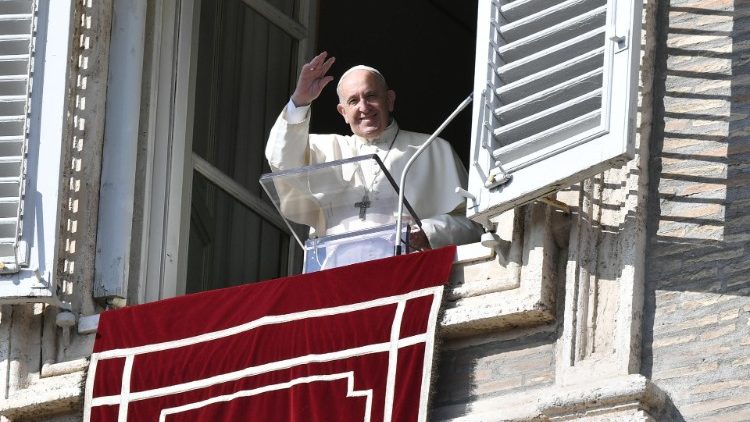
教皇はスペイン語で語られたメッセージで、ロマンス諸語(ラテン語の口語である俗ラテン語に起源をもつ諸言語)で見られる用語の類似性(el final: the [temporal] end vs. el fin: the aim or end goal)を取り上げ、「『最終目標』は、物語を書いたり絵を描いたりすることを可能にするもの… それぞれの言葉の終わりや沈黙の終わりのように『日常生活の小さな目標』に注意を払うように…『この瞬間は終わる(注:永遠ではない)』ということを意識している人生だけが、それを永遠なものにするのです」と説かれた。
A Vatican Radio English-language translation is below:
Dear young people of Scholas Occurrentes gathered from so many nations of the world, I celebrate with you the end of this meeting. I want to stop there. I wish to dwell on this: the end.
What would become of this encounter if it did not have an end? Perhaps it wouldn’t even be an encounter. And what would become of this life if it did not also have its end?
I know some will say: “Father, don’t put on a funeral face.” But let us think this through. I know from a good source that you kept the question of death burning throughout this entire experience. You played, thought, and created out of your differences.
Good! I celebrate and thank you for this. Because, you know what? The question of death is really a question about life. And keeping the question of death open, perhaps, is the greatest human responsibility towards the question of life.
Just as words are born out of silence and return to it, allowing us to hear their meanings, so it is with life. This may sound somewhat paradoxical, but… It is death that allows life to remain alive!
It is the end goal that allows a story to be written, a painting to be painted, two bodies to embraced. But watch out, the end goal is not found only at the end. Perhaps we should pay attention to each small purpose of everyday life. Not only at the end of the story – we never know when it ends – but at the end of each word, at the end of each silence, of each page that is being written. Only a life that is conscious of the fact that this exact instant will end works to make it eternal.
On the other hand, death reminds us that it is impossible to be, understand, and encompass everything. It comes as a slap in the face to our illusion of omnipotence. It teaches us throughout life to engage ourselves with mystery. This gives us confidence to jump into the void and to realize that we will not fall, that we will not sink, and that there is always Someone there to catch us. Both before and after the end.
The “not knowing” part of this question results in fragility that opens us to listening to and meeting other people. It is that rising above the commotion that calls us to create something, and urges us to come together to celebrate it.
Lastly, the question of death has driven different communities, peoples, and cultures to be formed throughout the ages and throughout all lands. These are stories that have fought in so many places to stay alive, while others were never born. That is why today, perhaps as never before, we should touch on this question.
The world is already formed, and everything is already explained. There is no room for open questions. Is that true? It is true, but it is also not true. That is our world. It is already fully-formed, and there is no place for unanswered questions. In a world that worships autonomy, self-sufficiency, and self-realization, there seems to be no place for the other. Our world of plans and infinite acceleration – always speeding up – does not allow for interruptions. So the worldly culture that enslaves also tries to put us to sleep so we forget what it means to stop at last.
But the very oblivion of death is also its beginning. And a culture that forgets death begins to die within. He who forgets death has already begun to die.
That is why I thank you so much! Because you have had the courage to confront this question and to pass – with your own bodies – through the three deaths that, by emptying us, fill us with life! The ‘death’ of every instant. The death of the ego. The death of one world gives way to a new one.
Remember, if death is not to have the last word, it is because in life we learned to die for one another.
Finally, I would like to thank especially World ORT and each one of the people and institutions that made possible this activity in which the culture of encounter has become tangible.
I ask each of you please, each in his own way, each according to his own convictions: don’t forget to pray for me. Thank you.
Pope Francis during his weekly General Audience says the Holy Spirit is the protagonist of the Church’s mission.
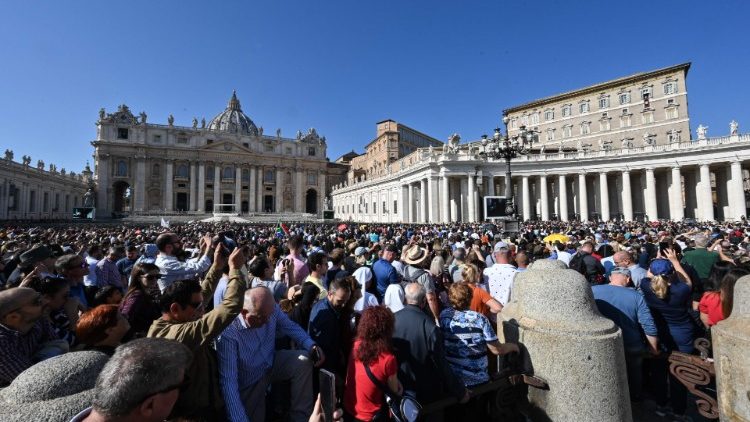
Despite pilgrims and tourists having their umbrellas to the ready for Wednesday’s General Audience, the brief drizzle that descended on St Peter’s Square then turned into a clear sky as Pope Francis reflected on his continuing catechesis on the Acts of the Apostles.
He told those gathered that in this book, one can see how “the Holy Spirit is the protagonist of the Church’s mission: it is He who guides the journey of the evangelizers showing them the path to follow.”
St Paul’s missionary journey
The Pope noted that this can be clearly seen when the Apostle Paul, having come to Troad, receives a vision begging him to come to Macedonia and help the people there.
The Apostle, said Pope Francis has no hesitation; he leaves for Macedonia, sure that it is God Himself who sends him, and arrives in Philippi.
The conversion of Lydia
The Pontiff explained to those present that the power of the Gospel is directed above all to the women of Philippi, in particular to Lydia, a merchant dealing in purple dye, and a believer in God to whom the Lord opens her heart “to adhere to the words of Paul”.
Lydia, continued Pope Francis in fact, “welcomes Christ by receiving Baptism together with her family and welcomes those who belong to Christ, hosting Paul and Silas in her house.” “Here we have the witness of the arrival of Christianity in Europe: the beginning of a process of inculturation that still lasts today”, he said.
The Pope went on to describe how, after having received hospitality at Lydia’s house, Paul and Silas then find themselves having to deal with the harshness of prison. He remarked that they go from the consolation of this conversion of Lydia and her family, to the desolation of prison where the key is thrown away for having healed a slave girl in the name of Jesus.
Speaking off the cuff, the Pope said that this slave’s masters made much money out of getting her tell people’s fortunes.
Even today, Pope Francis commented, “there are people who pay for this” recalling in his former diocese, in a very large park, there were more than 60 tables where fortune tellers read palms and people believed and paid.
Prison and a jailer’s baptism
By praying fervently to the Lord, said the Pope, “Paul and Silas are freed of their chains by a sudden earthquake. This prompts their jailer to ask how he too can be saved, and after hearing the word of the Lord, he receives baptism together with his family.”
Concluding his catechesis, the Pope underlined how “in these events we see the working of the Holy Spirit and the unchained power of the Gospel.